Showing posts with label featured poet. Show all posts

Tuesday, 20 August 2024

Sarah Holland-Batt, "The Jaguar: Selected Poems"


Sarah Holland-Batt is an award-winning Australian poet, editor and critic. Born in Southport, Queensland in 1982, she grew up in Australia and the United States, and has also lived in Italy and Japan. She holds a first-class Honours degree in Literature, an MPhil and a PhD from the University of Queensland, and an MFA in Poetry from New York University, where she was the W. G. Walker Memorial Fulbright Scholar for 2010-2011. She has received fellowships from Yaddo and MacDowell, an Asialink Literature Residency, a Château de Lavigny Fellowship, a Hawthornden Fellowship, a Sidney Myer Creative Fellowship, and the Australia Council Literature Residency at the B. R. Whiting Studio in Rome, among other honours. She is Professor of Creative Writing and Literary Studies at Queensland University of Technology in Brisbane.

Her first book, Aria, was the recipient of several literary prizes, including the Anne Elder Award, the Arts ACT Judith Wright Prize and the Thomas Shapcott Prize, was shortlisted in both the New South Wales and Queensland Premiers' Literary Awards, and was commended for The Age's Poetry Book of the Year. Her second book, The Hazards, won the 2016 Prime Minister's Literary Award for Poetry, and was shortlisted for the New South Wales Premier's Kenneth Slessor Prize, the Western Australian Premier's Book Awards, the Queensland Literary Awards Judith Wright Calanthe Prize, and the John Bray Memorial Poetry Award. Her third book, The Jaguar, won the 2023 Stella Prize, the Queensland Premier’s Award for State Significance, and the Margaret and Colin Roderick Literary Award, and was named The Australian newspaper’s 2022 Book of the Year. The Jaguar was also longlisted for the Griffin Poetry Prize and the ALS Gold Medal, and shortlisted for the Prime Minister’s Literary Award and the Kenneth Slessor Prize.


About The Jaguar: Selected Poems
With its rich selection from each of Sarah Holland-Batt’s books of poetry up to her stellar prize-winning collection The Jaguar (2022), this volume will introduce one of Australia’s best-known and widely read poets to many readers for the first time.

Marked by her distinctive lyric intensity, metaphorical dexterity and linguistic mastery, Holland-Batt’s cosmopolitan poems engage with questions of loss and extinction, violence and erasure. From haunted post-colonial landscapes in Australia to brutal animal hierarchies in the cloud forests of Nicaragua to the devastations and transfigurations of her father’s long illness, Holland-Batt fearlessly probes the body’s animal endurance, appetites and metamorphoses, and our human place within the natural order of things. Her portrayal of a much-loved father trying to cope with Parkinson’s Disease touched the hearts of many in Australia who would never usually read a book of poetry.

Her poetry is charged with a fierce intelligence, and an insistence on seeing the world with exacting clarity—as well as a startling capacity to transform our understandings of the familiar through the imaginative act. The poet’s piercing gaze is also frequently turned inward, offering a dissection of the self that is by turns playful and sharply ironic.

The Jaguar: Selected Poems brings together the finest work from her debut volume Aria (2008), with its minimalistic interrogations of the tyrannies of memory; the searching external and internal landscapes of The Hazards (2015); and the fierce, unflinching elegies of The Jaguar (2022), which challenge us to view ruthless witness as a form of love. 

You can read more about The Jaguar: Selected Poems on the publisher's website here. Below, you can read two sample poems from the collection. 


From The Jaguar: Selected Poems, by Sarah Holland-Batt

Empires of Mind

Beside the fountain’s troupe of sun-bleached rubber ducks,
in the gardens, under a shade sail, 
my father is crying about Winston Churchill.
Midway through a lunch of cremated schnitzel
spoon-fed by the carer with the port-wine stain
my father is crying about Winston Churchill.

In the night he cries out for Winston Churchill.
During his morning bath he cries for Winston Churchill.
When the nurse does up his buttons he will not stop his weeping. 
When the therapist wheels him to Tuesday piano
my father ignores the Mozart and cries for Winston Churchill.

He cries not like a child seeking absolution, 
not like the mourner or the mourned, but free and unconstrained
as one who has spent a long time denying an urge
and is suddenly giddy and incontinent in his liberation.

The cleaners are unmoved. The woman 
who brings his hourly cup of pills is bright as a firework 
and goes about her round with the hardness 
of one who has heard all the crying in the world 
and finds in that reservoir nothing more disturbing
than a tap’s dripping drumbeat in a sink. 

But the night supervisor is frightened 
in the early hours when the halls ping 
with the sharp beep of motion sensors and my father’s crying. 
His longing for silence is fierce and keen
as a pregnant woman’s craving for salt and fried chicken, 
as my father’s crying for Winston Churchill. 

And the women in their beds call for it to stop like a Greek chorus
croaking like bullfrogs each to each in the dark—
unsettled, loud, insatiable—the unutterable fear 
rippling through them like a herd of horses 
apprehending the tremor of thunder
on a horizon they cannot see but feel. 


The Gift

In the garden, my father sits in his wheelchair
garlanded by summer hibiscus
like a saint in a seventeenth-century cartouche.
A flowering wreath buzzes around his head—
passionate red. He holds the gift of death
in his lap: small, oblong, wrapped in black.
He has been waiting seventeen years to open it
and is impatient. When I ask how he is
my father cries. His crying comes as a visitation,
the body squeezing tears from his ducts tenderly
as a nurse measuring drops of calamine
from an amber bottle, as a teen at the car wash
wringing a chamois of suds. It is a kind of miracle
to see my father weeping this freely, weeping
for what is owed him. How are you? I ask again
because his answer depends on an instant’s microclimate,
his moods bloom and retreat like an anemone
as the cold currents whirl around him—
crying one minute, sedate the next.
But today my father is disconsolate.
I’m having a bad day, he says, and tries again.
I’m having a bad year. I’m having a bad decade.
I hate myself for noticing his poetry—the triplet
that should not be beautiful to my ear
but is. Day, year, decade—scale of awful economy.
I want to give him his present but it is not mine
to give. We sit as if mother and son on Christmas Eve
waiting for midnight to tick over, anticipating
the moment we can open his present together—
first my father holding it up to his ear and shaking it,
then me helping him peel back the paper,
the weight of his death knocking,
and once the box is unwrapped it will be mine,
I will carry the gift of his death endlessly,
every day I will know it opening in me.

Monday, 7 March 2022

Judi Sutherland, "Following Teisa"


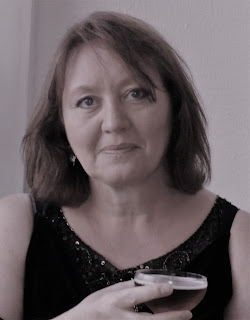
Judi Sutherland was born in Stoke-on-Trent to Geordie parents, spent some time as a child in Northern Ireland, and since then has lived all over England from Sussex to Durham, as paid employment has dictated. She trained in Microbiology and Biochemistry at the Universities of Leeds and Nottingham respectively then pursued a career in the pharmaceutical and biotechnology industries, developing new medicines. 

Judi obtained her MA in Creative Writing in 2012 at Royal Holloway, University of London, where she was awarded the Margaret Hewson Prize. Her poetry is mainly concerned with place, identity and belonging, and she has an interest in landscape and history. Following Teisa was written between 2014 and 2020, when she was living in Barnard Castle, County Durham. Her poems are widely published in magazines such as Oxford Poetry, Prole, The North, New Statesman, and online. She blogs at judisutherland.com. Her first pamphlet The Ship Owner’s House was published by Vane Women Press in 2018. 

She is currently living in Malahide, North County Dublin, Ireland, with her husband and two rescue cats, where she is writing poems about her new surroundings – Fingal – the Land of the Fair Strangers.


About Following Teisa

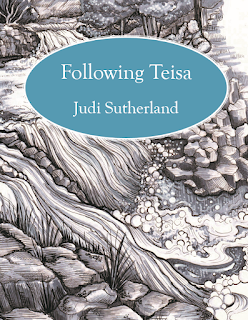
Nobody seems to know much about Anne Wilson, who, in 1778, self-published a 1600-line poem tracing the Tees from source to mouth (see here). The title, Teisa, is allegedly the Celtic name for the River Tees, or of its genius loci, a water goddess. The poem was written, unsurprisingly for its time, in heroic couplets, with many classical allusions, appeals to the muses, and a long, rambling Arthurian story that intrudes at Rokeby Park.

Judi moved to Teesdale in 2014 and felt dreadfully homesick for her previous village near the Thames. She started walking by the Tees as a way of getting to know and love her new environment and decided to repeat Anne Wilson’s poetic journey for a different generation. 

Her strategy for this work was to walk most of the Teesdale Way from the Pennines to the North Sea, as well as to research as much as she could about the towns and villages on both banks of the river. She remains convinced that the contrast between the upper and lower reaches of the Tees is much greater than anything a southern river can offer. 

Following Teisa is published by The Book Mill, Penrith, Cumbria. You can read a review of Following Teisa on Everybody's Reviewing here. Below, you can read a sample from the book. 


From Following Teisa, by Judi Sutherland

Middleton in Teesdale to Kirkcarrion

Middleton, a place, Anne Wilson tells,
of people neither splendid, rich nor poor
where Hudeshope Beck pours from the fell
to meet the river here, beside the livestock mart
where Swaledale ewes and gimmer lambs,
mules and rams are penned for sale; thick-coated,
curly horned, speckle-legged and bold. 

Under the arch on Masterman Place
is a Newtown of neat and convenient cottages -
the chaste and appropriate design of Mr. Bonomi;
a village heavy with lead and temperance
for the most deserving workmen
of the London Lead Company,
whose Quaker sensibilities
abhorred the scourge of alcohol. Instead
let the miners take their toxic chances
hewing blue-grey bouse from the adit
with pick and hammer, plug and feather
crowbar and candle. 

Above the town, a stand of pines on a barrow,
Bronze Age elders whose watchful eyes
follow. Turn around, you’ll swear they’ve shifted
in their rootball, their wooden footfall
silent on the hill. In comes the Lune
from its lonely dale, escaping the broad dams
of Selset and Grassholme. 

Thursday, 3 March 2022

Sue Hubbard, "Swimming to Albania"


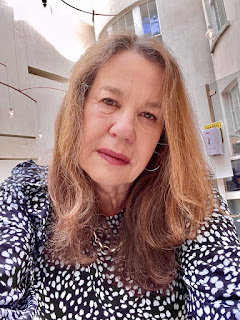
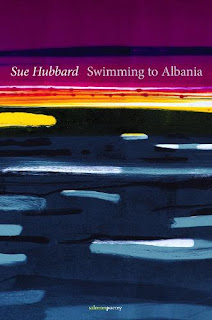
Sue Hubbard is an award-winning poet, novelist, broadcaster and art critic. She has won numerous prizes and, as The Poetry Society’s only Public Art Poet, created London’s largest public art poem, Eurydice, at Waterloo station. Her poems have appeared in The Irish Times, The Observer, The London Magazine and many leading poetry magazines and anthologies, been read on Radio 3,  Radio 4 and RTE, and recorded for The Poetry Sound Archive.  Twice a Hawthornden Fellow, she has an MA in Creative Writing from the University of East Anglia and in 1999 was awarded a major Arts Council Award. She has published three previous collections of poetry, a collection of short stories and three novels. As an art critic she has been a regular contributor to The Independent, Time Out, The New Statesman, The London Magazine, and published a book of essays on art, Adventures in Art (Other Criteria). Her latest poetry collection is Swimming to Albania (Salmon Press). Her website is here


About Swimming to Albania, by Sue Hubbard

Swimming to Albania is my fourth collection. It deals with memory, loss, desire and the process of ageing. Divided into three parts, there are elegies to both my parents and tactile, Proustian remembrances of childhood and the everyday. The poems wander between the west coast of Ireland, Lisbon, Siena and Greece in an attempt to find reconciliation, forgiveness and meaning, to come to terms with different forms of grief.  As I say in the final section, 'we travel to discover who we are.' Threaded through the collection is the sense of an Odyssean journey, a longing for an idealised home, which is captured in the title poem: 'Swimming to Albania.' 


From Swimming to Albania

Lost in Space

There are galaxies inside me,
interstellar stars and dust. 
I am full of dark matter,
quarks and spirals
of deep love that cannot
be seen with the naked eye,
lives that might have been
different under other alignments.
Somewhere amid the black holes
and absorption of light,
beyond the mass of the Milky Way,
there’s a distant room:
the walls covered with faded flowers,
a meadow of flecked sunlight, 
where a child lies beneath 
a bleached quilt in a narrow bed 
dreaming of a boat 
with a single blue sail,
a boat that will take her home.

And soon …

                          soon, it will be over,
the voyage’s end coming into sight
like a bright spit of unmapped land,

as the old yawl turns slowly back into harbour
with its arbour of rusty fish sheds
shrouded in late evening fog.

The saffron light of portholes already dimmed,
the tattered sails lowered,
halyard and spinnakers stilled and trimmed,

furled jibs lashed against the mast.
A sea away I wait on this Atlantic headland
where icy galaxies keep me company in the dark

and a dog-fox barks in a high wet field.
While in those far off Surrey hills
you falter and wane, so I wish my childhood songs

had not been mined in dust and pain,
those black diamonds of hurt and absence.
And now, when all that’s unspoken

is cinders on my tongue, I want to call out:
daddy, oh my daddy, I’ve been here all along,
waiting, waiting across this cold violet sea.

Thursday, 3 February 2022

Sarah Barnsley, "The Thoughts"


Sarah Barnsley grew up in the Midlands where her dad was a firefighter. A winner in the Poetry Society Members’ Poems Competition (2021, 2018), her work has appeared widely in magazines including Poetry Wales, The Rialto and The White Review. Other publications include a pamphlet, The Fire Station (Telltale Press, 2015), co-editorship of Truths: A Telltale Press Anthology (2018), and literary criticism. Sarah is Senior Lecturer in English and American Literature at Goldsmiths, University of London, Contributing Editor to The Understory Conversation and lives in Hove. Her website is here


About The Thoughts 

An assured and inventive debut, The Thoughts explores different manifestations of intrusive thoughts as part of obsessive-compulsive disorder (OCD) before navigating through the twists and turns of recovery and love. These poems inhabit therapists’ treatment rooms, waiting rooms, and everyday documents, appearing in such varied forms as emails, research proposals and kids’ puzzles. Compassionate and at times painfully humorous, The Thoughts is an act of advocacy, giving voice to critically underrepresented experiences of illness through poems that are as peculiar and creative as they are arresting.

You can read more about The Thoughts on the publisher's website here. You can read a review of The Thoughts on Everybody's Reviewing here. Below, you can read a sample poem from the collection. 


From The Thoughts, by Sarah Barnsley

This horse

There’s this horse
that can’t eat apples.
It’s not that the horse
doesn’t like apples
or that its castle of teeth
can’t crush them
or that its leather-satchel tongue
can’t collect the bits
or that its upturned welly of a throat
can’t tramp down the chunks – 

it’s that one day,
as it drew up an apple
of no distinction,
the horse had a thought:
What if I choke on this?
And the more the horse tried
to swat the thought away,
the more the apple grew,
and the more the thought grew

until the horse felt it had Jupiter
and all its moons in its mouth
and it couldn’t breathe
and it was gagging
and its owner tried to reason with it,
but the horse wouldn’t be told
and over the course of a year
the horse visited the vet
every Wednesday at 12

and the vet advised the horse
to try an exercise where the horse
had to choose a small globe 
from a bagged assortment
and hold each one in its mouth
in a series of graded steps:
a robin’s egg for one minute, 
a beetroot for two, 
a cannonball for three;

and the horse had to 
commit to the process
and tolerate the discomfort
and by all means note down 
its thoughts and feelings
but not respond to them
and none of this worked
and the only thing for the horse
to do was to eat oats and practise 
radical acceptance
of apples as something eaten
by other horses 
in another place and time
as if all the apples in the world
were locked behind
glass cabinets
in a museum
with all the other things 
the horse’s thoughts had
forced it to give up: 
cool pools, 
hugs of mud, 
low-hedged fields.


Thursday, 9 December 2021

Angela France, "Terminarchy"


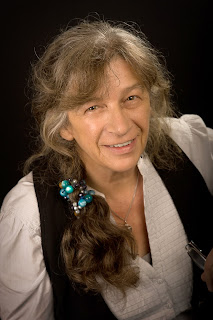
Angela France, photograph by Derek Adams


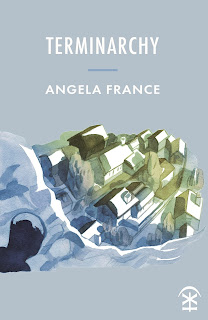
Angela France has had poems published in many leading journals and has been anthologised a number of times. Her publications include Occupation (Ragged Raven Press, 2009), Lessons in Mallemaroking (Nine Arches Press, 2011), Hide (Nine Arches Press 2013) and The Hill (Nine Arches Press 2017). The Hill was developed into a live multi-media poetry show which Angela toured, funded by Arts Council England. Her latest collection, Terminarchy, was published by Nine Arches Press in July 2021 and launched at Ledbury Poetry Festival. She has an M.A. in Creative and Critical Writing and a PhD from the University of Gloucestershire. Angela teaches Creative Writing at the University of Gloucestershire and in various community settings.


Cover by Fumio Obata


About Terminarchy, by Angela France

Angela France’s distinctive new collection of poems, Terminarchy, eloquently considers the troubling terms of existence in an age of climate catastrophe and technological change. How do we negotiate a world where capitalism and greed threaten a fragile earth, where technology seems to promise us connection but might also fuel isolation? Where even finding solace in nature reminds us that the seasons can no longer be trusted? How is human urge and want hastening us towards our own ‘endling’ – and what might it mean to be the ‘last’? 

In reframing ecopoetics in her own instinctive, radical, lyrical form, France juxtaposes the accelerated, all-consuming speed of contemporary and future times with the ‘longtime’ and ancient, and considers whether, rather than collison-course, there might be a better way to coexist. Where extinction threatens, these wry, alert poems and their eloquent, earthy voices try to find a way through and look for hope.

You can read more about Terminarchy on the publisher's website here. Below, you can read three poems from the collection. 


From Terminarchy

Endlings

             drift over the earth, gather
in loose clusters, their calls echo
        then cease.
Predators don’t notice prey, run together,
scan and scent the ground on hill and heath
in widening circles until they tire and lie down
alone.
      The Thylacine doesn’t try; he’s released
the need and drive, has given up and found
a place to lie still as he blurs and fades
to become just a shadow 
                                         on the ground.

On a branch above, 
             the passenger pigeon waits;
her claws no longer able to uncurl,
tree-bark patterning feathers as if braided
in mist. Moths and butterflies whirl
between leaves; don’t settle or rest,
ignored by the birds. The Laughing Owl,
the Forest Thrush, circle the sky
                                                possessed
by an undeniable need and scarred
by hope, until exhaustion brings peace
  in death.

A Barbary Lion calls in the hills unmarked
and Sparrow weeps for the want of an ark.

Small Gods

Our gods are poor things, these days,
insubstantial, weak in sinew and bone,
worshipped through clicks and clichés
and starved though we try to atone
through getting and losing, the sacrifice
of things we don’t need. We’ve grown
past thunder and threat, gods in disguise
to walk among us as man or bull; strength
only known or used as a way to victimise
different thoughts or ways to enhance
helpless lives. We’ve lost Thor’s hammer
Apollo’s bow and Odin’s mead, take offence
at any prick to our comfort while we clamour
on keyboards for anything to fill the holes
they’ve left.  We may edit a page’s banner
to signal who we are but try to control
anything real, of blood and flesh,
by pinning to screens where we can scroll
past whatever disturbs.  Copy, paste, refresh,
we are a worn people whose shrivelled gods
are enshrined in phone lenses as we try to possess
any thing to salve a communal sense of loss.


Down Piggy Lane

The path skulks round the back end of a housing estate,
hidden by overgrown shrubs and tattered trees
either side of the sullen brook. Scraps and patches  
of land line the trail, one-proud fences sagging between.
Pig arks are empty, fading grass straggling 
up the sides. Competing cockerels shout
from pens, hidden by a clutter of buckets,
upturned feed tubs and a green-scummed bath. 

Every patch has a shed or shelter, all alike
in their difference. Walls patched 
with multi-coloured iron, rust collecting
in the corrugations. Here an old front door 
with a fanlight and ghost of a number,
there the lichened side of a caravan.

My foot catches in the muddy ruts and humps
of the path and I stumble into a memory
of dreaming through afternoon school,
waiting for when nine-year-old legs could pump 
the bike pedals, carrying a Tupperware beaker 
of milk for feral kittens and windfall apples
stuffed under my jumper for a shaggy piebald pony. 

How have I forgotten all I wanted then?
To own one of those fields, to live 
in a ramshackle shed with the kittens 
and the pony’s head looking through 
feed-sack curtains, a few large dogs,
a nest of slow worms under the floor
and any other creature who found me.
How once such things were enough.   

Monday, 6 December 2021

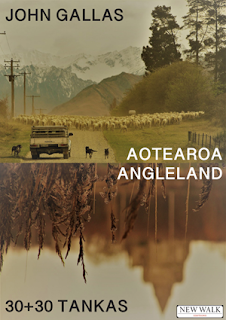
John Gallas, "Aotearoa/Angleland: 30+30 Tankas"


John Gallas was born in New Zealand in 1950.  He came to England in the 1970s to study Old Icelandic at Oxford and has since lived and worked in York, Liverpool, Upholland, Little Ness, Rothwell, Bursa, Leicester, Diyarbakir, Coalville and Markfield, as a bottlewasher, archaeologist and teacher. He is the editor of two books of translations – 52 Euros and The Song Atlas – and eleven collections of his own poetry, all published by Carcanet.  He is a Fellow of the English Association and was 2016 Orkney St Magnus Festival poet.


About Aotearoa/Angleland: 30+30 Tankas, by John Gallas

A life, a heart, a soul – and a book – divided.  Happily divided.  In this pamphlet, John Gallas wanders the corners of his two homelands: Aotearoa (the Maori name for New Zealand) and England. The heart doesn’t bleed, the soul doesn’t yearn to be one, and Life can always get on a plane. As Misuzu Bonchō wrote, when she moved to Dodge City:

          A thing with two roots
          Will grow to embrace the earth
          With both arms.  Read on …


From Aotearoa/Angleland: 30+30 Tankas

Hillgate

From here the hedgerows
roll down to Bree across the
careful corduroy
of two farms. In each a tree,
enisled, tears its windy hair.


Date lines

Everything comes first
to the good folk of Tonga,
from where it proceeds
west in a Mexican Wave
to the world’s less happy lands.


Invitation to Public Reading and Q&A at the University of Leicester

John Gallas will read from and answer questions about his new pamphlet at 4pm on Thursday 9 December 2021 in Belvoir City Lounge, 2nd floor, Charles Wilson Building, University of Leicester. THE EVENT IS FREE AND ALL ARE WELCOME!

Wednesday, 17 November 2021

Carol Leeming, "Song for Guests"


Carol Leeming, photo by Hana Kovacs

Carol Leeming MBE FRSA is Leicester born, of Windrush parents from Jamaica and Antigua, and grew up partly in Jamaica. She received her Queen’s honour as a playwright and poet, and for her contribution to Leicester arts and culture. Carol is a Fellow of the Royal Society for the Arts, a Cultural Olympian of 2012, and is featured on the University Grassroutes Writers' Gallery microsite here. Carol’s choreopoetry is highlighted by Corinne Fowler in the Cambridge Companion to Black & Asian Writing 1945-2010, ed. Deidre Osborne. In 2018, Carol’s poem ‘Molly’ was displayed across a Leicester University Campus building, as part of a centenary celebration week for the British Suffragettes Movement. 

Other notable work includes Carol’s debut chapbook The Declamations of Cool Eye published by Dare Diva. A film poem, entitled Enchanter, featured the poem 'Drawing' from the chapbook. You can see it here. Some other plays produced include Storm, & The Twisted Plait at Haymarket Theatre, The Loneliness of the Long Distance Diva, and Love the life you live … Live the life you love at Curve Theatre, also published in the book Hidden Stories Anthology, published by Leicester University/Phoenix. 

Carol’s poetry features in a number of anthologies. These include 'Valley Dreamers' in  Out of Bounds, ed. Jackie Kay (Bloodaxe), 'Some Things that Never Failed Me' in Covid 19 & Poetry Anthology, ed. Anthony Caleshu and Rory Waterman (Shearsman Press), ‘Song for Guests’ (translated into ten languages) in Welcome to Leicester, ed. Emma Lee (Dahlia Books), Overland, Oversea, ed, Kathleen Bell, Emma Lee & Siobhan Logan (Five Leaves). A recurring feature of her work is to give voice to the voiceless, untold diverse stories, or magic realism in narratives, compelling diverse characters, with distinctive voices. 

Carol recently debuted at A Time to Breathe Festival curated by Greta Mendez MBE, London 2021, in a performance of her new choreopoem play, entitled The Dreadful Dance of Ms. Iniquity. Carol also has a major collection of writing, poetry and choreopoetry entitled The Eclipse of Dread, in preparation for book publication, along with writing the final part of her choreopoem trilogy, ‘Go Where the Songs Are.’ 

Carol works freelance, in literature performing arts and digital media. She is a multi-award award-winning author, published poet, director, playwright, dramaturge, performer and tutor. She was dramaturge and director for Harley, Scholar & Stateman by Pamela Roberts. She previously worked full-time as Resident Assistant Director at Curve Theatre Leicester, on theatre productions My Beautiful Laundrette by Hanif Kureishi, and West Side Story by Laurents/Sondheim/Bernstein.

Carol currently is part-time lecturer at De Montfort University, BA Performing Arts, Guest Visiting Lecturer on the MA Creative Writing at Nottingham University, and Guest Visiting Lecturer Writing for Performance at Derby University, in addition to mentoring prisoners, to create poetry for the NO BARS II Project Anthology launched in 2021. Carol is also Patron of East Midlands Women Awards. 

See more about Carol's work here and hereBelow, you can read a poem by Carol. 


Song for Guests

           'The new arrival of a guest is reason for a feast' - A North African Bedouin Custom

Fear
and hate 
Is flung
it weights down 
a tar-paulin night as
folk crowd fire warmth 
dreaming of dark tunnel  
escape with luminous
hands of friendship 
held aloft ready to catch…?

Welcome us 

We welcome you all
Come … to us 


Sleepless knots of men
crouch into bush hides  
waiting for smoky vehicles
stowaway with stony 
grey lips of newsprint words 
pointed to goad or reject? 

Welcome us 

We welcome you all
Come … to us


Skeins of women children 
hold emotions like nets with
wounded screams as
running tears hearts salt
human streams across earth 
its seas would it wash away
foul slimes cruel indifference
a dirty din from a baited polis 
Is that blood on their hands?

Welcome us

We welcome you all
Come … be with us
Our table is full 
Yet empty missing you


Tuesday, 16 November 2021

James Nash, "Heart Stones"


James Nash is a writer and poet. A long-term resident of Leeds, his third collection of poems, Coma Songs, was published in 2003 and reprinted in 2006. He has two poems in Branch-Lines (Enitharmon Press, 2007), among fifty contemporary poets, including Seamus Heaney and U. A. Fanthorpe. 

Since 2012, his poetry has been published by Valley Press, beginning with selected poems, A Bit of An Ice Breaker, and his first collection of sonnets, Some Things Matter.

Cinema Stories, celebrating the history of cinema in Leeds and written with fellow poet Matthew Hedley Stoppard, came out in 2015..  

A Bench for Billie Holiday was published in 2018, followed by his latest collection of sonnets, Heart Stones, in November 2021.

James's website is here.


About Heart Stones, by James Nash

In his third volume of sonnets, James Nash examines urban and seaside environments in a Yorkshire he has known through fifty years of living in the North. His sonnets soar over the land - from Leeds, a predominantly Victorian city, to the Wolds in the East Riding of Yorkshire, walking and cycling into the natural world with a pen and paper never far from his hand. 

James openly shows his debts to the great poets and writers of previous generations, from Winifred Holtby to Philip Larkin, from Matthew Arnold to Dylan Thomas. To borrow some of his won words, James's gifrt sit to be a "clear microscope" for our times, finding hope in the many "miralces of detail" that pass through his unwavering gaze.

Below, you can read two poems from Heart Stones. You can see further details about the collection on the publisher's website here


From Heart Stones


Yorkshire skies for Patricia

We shared these Yorkshire skies at different times,
A West Riding jumble of spire and mill
And, much later, the eastern coastal dreams 
Which began for me at Garrowby Hill.
I’d no idea fifty years ago
That each daily walk would now be full of you,
The cliffs and beaches, where white pebbles glow,
Each prospect of the Wolds, each distant view.
And yesterday I saw across the bay
As dusk deepened with the slow dropping sun,
You signalling in the last dregs of day;
You are the lighthouse flash, not yet quite done.
I would give you a heart-stone from the beach
But you are fading light, too faint to reach. 

 
Heart stones 


The incoming tide has covered them, fanned
Over, drowned the heart-shaped pattern of stones
Made from beach pebbles and secured in sand.
Large, white punctuation marks; the bleached bones
Of a dinosaur’s toes, gathered, arranged 
By a young artist on a bike with time
He did not have, until all slowed and changed,
To leave temporary signs in chalky rhyme.
From our cliff top eyrie we see it all,
Huge heart under water unmoved by tide.
Can love survive whatever might befall,
Perhaps live on when other things have died?
Just this; in slow erosion, it is worn
Down, dissolving more each day, stone by stone.

Thursday, 4 November 2021

Lisabelle Tay, "Pilgrim"


Lisabelle Tay writes poetry and fiction, often with a speculative bent. After completing her studies in English Literature at King’s College London, she returned to Singapore, where she now lives with her husband and son. Her story 'Surat Dari Hantu' recently placed first in the 2020 Dream Foundry short story contest. Pilgrim is her debut poetry pamphlet, and is published by The Emma Press.


About Pilgrim, by Lisabelle Tay

In her debut pamphlet, Lisabelle Tay leads the reader down through the underworlds of illness, motherhood and family histories. Lighting the way with her luminescent poems, the poet draws on Celtic, Classical and Chinese mythologies, appealing to the selkie, Eurydice, and Chang’e in turn as she seeks a path through the darkness – and back to the light.

Pilgrim depicts a journey and a return, moving from the expansive and mythological to the inward and personal. The pilgrim who left is not the pilgrim who returns …

The pamphlet is illustrated by Reena Makwana and printed in monocolour risograph at The Holodeck.

You can see more details about Pilgrim on the publisher's website here. Below, you can read two poems from the collection. 


From Pilgrim

Pilgrim

Last night I dreamed of a garden on the moon
a stone rolled away, an empty tomb
a wall of violets dripping milk
a harvest of joy
Today I will pack my bags and start walking
pregnant Lazarus freshly woken
collecting dew in living gourds
bread falling from the sky
I will kiss my husband before I go
dust sleep from his clean-shaven face
then leave, slippery as an egg  


List of Things Beyond My Bedroom Curtains

A warrior cleaning her sword
beside a running river

Water off the tip of a wing

A cave full of immortals

Boats burning on the water

In the beginning God spoke summoning
to-the-light and to-the-darkness

A half-cracked shell

Morning and evening

White dew on the underside of a leaf

A gasp of air, something forgotten
now remembered

A bare kernel of deathlessness
sown silently at dusk


Friday, 29 October 2021

Julia Bird, "is, thinks Pearl"


Julia Bird grew up in Gloucestershire and now lives in London, where she works for the Poetry Society and as an independent literature producer and promoter at Jaybird Live Literature. She has two poetry collections with Salt – Hannah and the Monk (2008) and Twenty-four Seven Blossom (2013) – and Now You Can Look, an illustrated poetry pamphlet, was published by The Emma Press in 2017. 

You can read a review of Now You Can Look on Everybody's Reviewing here. Julia's website is here.


About is, thinks Pearl, by Julia Bird

Step into Pearl’s world and take a tour around her faded seaside town, past the graffiti walls, bus stops and the old mattress factory. Except – with Pearl as our guide – the colours suddenly pop and every tiny detail becomes rich with interest. From the lido to the hair salon, to the Christmas shop in June, the ordinary becomes magical and every bit of wildness, weirdness and tattiness is whisked into the foreground.

“Pearl” is an alter ego of the poet: she’s a character who observes the minutiae around her and whose thoughts are a pleasure to follow. This pamphlet follows Pearl as she rollicks around, making her way through a townscape similar but not identical to the too-small-to-be-cities of poet Julia Bird’s 70s & 80s childhood.


From is, thinks Pearl

Helium Pearl

The man who stands all day in the high street
selling helium balloons is, thinks Pearl,
weighed down by the cumulus of gas and foil
capping low above his head. The drag on him
of a hundred fat cartoons tugging their leads
like young dogs: what if he doesn’t sell out,
what if his mate doesn’t show when he said
he would - how could he herd this tangling
and bumbling stock to a sandwich or a coffee shop?
Pearl knows that even one small silver pup,
its two dimensions startled into three, will not
sit still in the changing room, sit still on the bus:
it only wants to drop and dive back to the sun.
Pearl thinks that, when the time comes, this
is what it might be like to mourn, to tie each
elevating death with a ribbon to your wrist
and feel its unexpected weight every time a door
revolves, or you’re at the cinema in a front seat,
or you’re putting on or you’re taking off your coat.

Tuesday, 26 October 2021

Myra Schneider, "Siege and Symphony"


Myra Schneider has had ten full collections of poetry published. The most recent one is Siege and Symphony, in Autumn 2021. Other publications include pamphlets of poetry, books about personal writing, notably Writing My Way through Cancer (Jessica Kingsley, 2003) and Writing Your Self with John Killick (Continuum, 2008). She has also had three novels for young people from Heinemann. Her work has been broadcast on BBC Radio 4 and Radio 3. In 2007 she was shortlisted for a Forward prize. She is consultant to the Second Light Network for women poets, has co-edited anthologies of women’s poetry and she has been a poetry tutor since the late 1990s, mainly for The Poetry School. Her website is here.


About Siege and Symphony, by Myra Schneider

The main theme of Siege and Symphony is celebration and endurance. This is reflected in the long title poem, which draws on original sources to write about the hardship people suffered in the siege of Leningrad in the Second World War and Shostakovich writing his 7th Leningrad symphony. The poem concludes with a section about the symphony being performed in the city by a depleted orchestra in the middle of the siege. The main theme is further explored in the first part of the book in poems about the state of the planet, and also later in the book in personal poems, poems about other contemporary issues such as homelessness, and poems about women. 


From Siege and Symphony

Let Us

throw open splattered windows 
and allow light to stream into rooms, 
not shine dimmed to a sullen grey
by a skyful of cloud, not the mean rays
of reason which enumerate facts and faults,
kill compassion and make us hide fears 
in cupboard dark, not bright beams
chilled by hatred with more bite
than the east wind – 
                                 none of these. Let us
open ourselves to today’s unstinting light.
It’s bringing the warmth of ripe apricot skins, 
the happy go lucky orange of marigolds,  
the clarity of extra virgin olive oil,
the glory of sun alighting on the waters
of Chania.
                Look, it’s kindled the kitchen walls 
and awakened cushions in the living room
so let us breathe – let us breathe it in 
as it glides up the stairs, smiles 
on worn carpets, calms worried beds.
Listen, it sounds like bees murmuring 
to the rampant brambles out in the garden.


Becoming Plastic

The morning starts with a tiresome battle to slit 
and peel skin that fits smoothly as a seal’s.
It’s encasing two tubs of vitamin capsules 

but my fingers can’t find leverage and anger 
blazes as the sleek containers continue to cling
in their see-through wrapping like inseparable lovers.

Nowadays, everything arrives cosied in plastic: 
sultanas, tissues, pears, jumpers, knickers, 
the mattress that was tricky to manoeuvre upstairs,

those newly-erected six-storey flats I scanned
yesterday as I walked over Regent’s Canal, each
swaddled in the stuff as if it couldn’t cope with rain.

In the night I dreamt I struggled through a wild sea 
to an island of unrotted rubbish and weakling palms.
A sound of laboured breathing rose from the debris

and I knew plant roots underneath were striving 
to survive. A dead grouper stared from a pram
which had lost all its wheels, someone screamed.

I turned, was just in time to see a woman 
on a bed with legs parted and a midwife plucking
from her womb a baby sheathed in plastic sheeting.

Thursday, 21 October 2021

Pete Green, "Hemisphere"


Pete Green is a poet and musician who writes about place and identity, finitude, coastlines, cities and landscape change, trains, birds, and sleeping on someone's floor after playing a gig in another city. Their new short book Hemisphere and pamphlet Sheffield Almanac are published by Longbarrow Press, and their poetry has also appeared (or is scheduled to) in Under the Radar, the Fenland Poetry Journal, Stand, Anthropocene and elsewhere. Pete was longlisted in the 2020 National Poetry Competition and shortlisted for the 2019 Brotherton Poetry Prize. They live in Sheffield on the side of a very steep hill. Visit Pete's website at petegreensolo.com and follow @petenothing on social.


About Hemisphere, by Pete Green

Hemisphere is a long poem in a short book, telling the story of a circular voyage which proceeds from the Hebrides around the north Atlantic, Alaska and Siberia, then finally back to Europe. Along the way the protagonist visits a doomsday seed vault, a giant qwerty keyboard, a boundary between Tuesday and Wednesday, the world's largest island on a lake on an island on a lake on an island, two pubs and an Arctic coffee bar. 

These are all real locations on an impossible journey. Ultimately Hemisphere is a sort of meta-travel narrative which poses questions about who has permission to practise place writing, and explores the power of imagination to push back against our ongoing personal lockdowns. 

You can read more about Hemisphere on the publisher's website here. You can watch a short trailer for the book here:


Below, you can read an excerpt from the book.


From Hemisphere

Vladivostok
43°06’43”N 131°52’55”E

Was it a crash or a signal failure? Was it
the whim of some fastidious ambassador
that bore you here? Was it that metallic
clang, unexplained, that rang out between
the islands at the Bering Strait’s midpoint
like the song of a valley floor steelworks?
A deleted vault at the radar’s perimeter
fence? Whatever. Your hand is returning
to your jacket’s inside pocket, where your
ticket radiates assurance. Steel blue-clad
officials have already trooped the length
of your carriage several times; their gaze
interrogates the space you occupy, as if
you are not there. Across the aisle, though,
a woman’s complexion is fresh snowfall;
her eyes are feline, opalescent, much like
Kate’s, and they watch you checking out
the space. Your seeming aplomb prevails.
Your research’s thoroughness outweighs
all the Transsiberian-based thrillers where
naïve westerners are doomed to succumb
to menace or the mere threat of menace,
but you were caught out by the railways’
adherence nationwide to Moscow time
which, at this longitude, gave seven hours
to contemplate the famous hipped roof
of the station, the massive red characters
of its Владивосток sign, their unwieldy
ornateness, the earthenware flagstones
brought from Japan, painstaking mosaics
of berries, fruit and horsemen – all of it
biography of Russia, layered narratives of
regimes, of reinventions and revisionisms,
the wool that’s tugged down over eyes,
the emollient layers of pearl that cancel
disagreeable grains. You know the power
of opalescent eyes, of vodka, of people’s
own readiness to swallow what is served.
For you the cracks appeared back when
the bankers tanked the whole shebang
and chancellors and governors discreetly
summoned bailout billions from the ether
with mouse clicks and commands while
the clinic closed its doors on you during
that fragile first trimester. The ticket man
comes through from the first-class coach;
with him the notion of an upgrade, using
a little quantitative easing of your own.
You imagine requesting the kitten-eyed
woman to join you, knowing full well
that for better or for worse you will do
no such thing – and that’s one more life
thrown under one more cancelled train
of thought. So was it a crash or a failed
signal? Was it one more hardware glitch?
Your vigilance will bear you on through
Khabarovsk, Irkutsk, the room’s perishing
cold account for Omsk, Novosibirsk, and
the frustrated force of all your bloody-
mindedness can see you through the rest.

Wednesday, 20 October 2021

Kim Moore, "All the Men I Never Married"


Kim Moore’s pamphlet If We Could Speak Like Wolves was a winner in the 2011 Poetry Business Pamphlet Competition. Her first collection The Art of Falling (Seren 2015) won the Geoffrey Faber Memorial Prize. Her second collection All The Men I Never Married was published by Seren in 2021. Her first non-fiction book What The Trumpet Taught Me will be published by Smith/Doorstop in March 2022. Kim is originally from Leicester. Her website is here


About All the Men I Never Married

This eagerly awaited second collection of poems from Kim Moore is pointedly feminist, challenging and keenly aware of the contradictions and complexities of desire. The 48 numbered poems take us through a gallery of exes and significant others where we encounter rage, pain, guilt, and love.


From All the Men I Never Married, by Kim Moore


No. 32.

You lived there for a week, in a country
you will not give a name to, not because 
of what happened there, but because
you do not want this story to be changed
into a story of a country, you want it to be
the story of a man, or one-night-of-a-man, 
a story of a hotel, or maybe the story of a lift,
the faded carpet, mirrors on every wall, 
and his insistence, standing too close 
and smiling, both of you pretending 
you’re good friends, maybe this is the story 
of the corridor, how he asked you 
where your room was, and you, stupid,
stupid, said down there and even pointed
and maybe this translated to follow me
to the room with birds fluttering behind 
the walls, the room with birds living 
between the walls, the room of curtains, 
heavy, floor-length, blocking all the light, 
the corners where nobody cleaned, 
dust and the dead battery of a wasp, 
you said my room is down there and then
kept walking, put your key in the lock 
and he was right behind you, you felt
his breath on your neck so you turned
and put your hand on his chest
which may have looked like an invitation
except you were pushing, pushing him back,
who knows if you said no or if you said
I want to go to sleep or if you said both
but when you backed through the door
and slammed it closed, you remember it felt rude 
to shut a door like that, so close to his face,
your heart beating in your chest
as if you’d been running very fast,
you remember thinking you were lucky,
luck got you out of it again, you sank
to your knees in the room of the birds,
you told yourself it was nothing 
though it felt like something very bad
had almost happened, you swore
this would never happen to you 
in silence and stillness again.