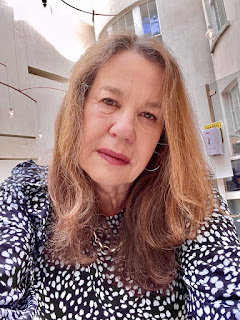
Sue Hubbard is an award-winning poet, novelist, broadcaster and art critic. She has won numerous prizes and, as The Poetry Society’s only Public Art Poet, created London’s largest public art poem, Eurydice, at Waterloo station, which has now been carved in Portland stone and permanently placed in the crypt of St. John’s, Waterloo.
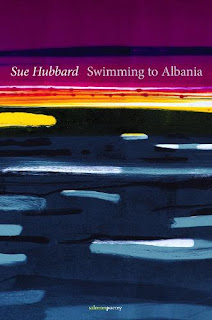
Her poems have appeared in The Irish Times, The Observer, The London Magazine and many leading poetry magazines and anthologies. They have been read on Radio 3, Radio 4 and RTE, and recorded for The Poetry Sound Archive. Twice a Hawthornden Fellow and twice awarded bursaries to Yaddo, US, she has an MA in Creative Writing from the University of East Anglia and in 1999 was awarded a major Arts Council Award. She has published four previous collections of poetry, Everything Begins with the Skin (Enitharmon), Ghost Station and The Forgetting and Remembering of Air (Salt), Swimming to Albania (Salmon Poetry). God’s Little Artist, on the life of Gwen John, is due later in 2023 from Seren.
She has also published a collection of short stories, Rothko’s Red (Salt) and three novels, Depth of Field (Dewi Lewis), Girl in White (Pushkin Press), Rainsongs (Duckworth, Overlook Press, US, Mercure de France and Yilin Press, China). Her fourth novel, Flatlands, is due from Pushkin Press UK and US, and Mercure de France in late spring 2023.
As an art critic she has been a regular contributor to The Independent, Time Out, The New Statesman, The London Magazine, and published a book of essays on art, Adventures in Art (Other Criteria). Her website is here.

About Radium Dreams, by Sue Hubbard
For Radium Dreams I invited the artist Eileen Cooper RA to team up with me to pay homage to one of the world’s greatest female scientists, Marie Curie. Our poems, drawings and collages form an exhibition at the Women’s Art Collection, Murray Edwards College, Cambridge, along with an accompanying book, that follow her through her Polish childhood, her studies and research in Paris, her marriage and very public affair, giving texture and depth to her extraordinary life. It is more than eighty years since her death, but her story remains as compelling as ever.
My poems, accompanied by Eileen Cooper’s drawings and collages, conjure Curie’s life through closely observed moments of struggle, tenderness and joy. Both exhibition and book explore the theme of creative support: between Marie Curie and her sister, and between the scientist and her husband, Pierre Curie. This is reflected in the collaboration between a female poet and artist and resonates with The Women’s Art Collection at Murray Edwards, which was created by women as a college dedicated to educating academically outstanding young women.
Marie Curie’s own feminism was always demonstrated by her actions rather than by theories or words. She believed that progress in science would benefit the world and broke down barriers to pursue new ideas and theories, never allowing herself to be defined by the standards of beauty of her day or the behaviour conventionally expected from a woman. When she got married, she chose to do so in a plain dark gown that she could later use in the lab. Would she have described herself as a feminist? Whilst she was concerned with the education of young women, her abiding interest was always science and the truths it revealed. Stubborn and determined, she believed that knowledge equalled freedom. The men in her life, her husband Pierre, and her lover Paul Langevin, were colleagues with whom she shared her intellectual passions, giving weight to the words of the American writer, Charlotte Perkins Gilman, that “There is no female mind. The brain is not an organ of sex. Might as well speak of a female liver.” Marie Curie was a woman of conviction and courage. Radium Dreams presents her not only as brilliant, intense and uncompromising but also as passionate, flawed and compellingly human.
You can see more information about the exhibition and the collection on the Women's Art Collection website here. Below, you can read two sample poems from Radium Dreams.
From Radium Dreams
She sets up the kitchen chair,
her petroleum lamp,
a porcelain washbasin
printed with a rose
in the attic room of Rue Flatters.
Lives a monastic existence
patching and mending
her shiny, old-fashioned dress.
Doesn’t even know
how to make soup,
survives on buttered bread and tea,
faints in the tiny boxroom.
The laboratory is home,
its brass instruments, bell jars,
and test tubes with their brew of elements.
If only she can move them
close enough, she knows
that hydrogen atoms will fuse.
Standing in her linen smock
among the men, she rehearses
who she’s about to become,
steps forwards,
burette and Bunsen burner in hand.
She’ll not be found wanting.
Uranic Rays
Once they’d have called her
an alchemist for her pains.
Now, moving through the laboratory
among glass wash bottles,
Bunsen burners, the brass microscope,
quiet as an inhale of breath,
a wooden chemistry bench to her left,
the ionization chamber and electrometer
on her right,
she follows Becquerel’s experiments
to expose uranium salts to sunlight,
to see if radiation -
discovered one cloudy day by chance -
can be spontaneously emanated,
pass through metal foil to print,
ghost-like, on a photographic plate,
She wants to discover the cause
of this force, which seems
to violate Carnot’s law
that energy can be transformed,
(though like Time or God
never be created or destroyed).
Now, lying beside her sleeping Pierre,
she dreams of particle waves,
an invisible necklace of opaline ash,
illuminating her bleached skin.