Showing posts with label New Walk Editions. Show all posts

Monday, 23 June 2025

D. A. Prince, "Continuous Present"


Since 2008, D. A. Prince has published three collections with HappenStance Press. The second, Common Ground, won the East Midlands Book Award in 2015. The third, The Bigger Picture (2022), includes ‘The Window,’ Highly Commended in the Forward Prizes anthology for 2020. Her poems have also made less conventional appearances: as bookmarks, on posters on the Longbenton Metro station in Newcastle, and even handwritten, on biscuit wrappers as part of the Wrapper Rhymes installation at StAnza in 2020. Prince reviews contemporary poetry for London Grip, The Friday Poem and Orbis among other literary magazines. 

Prince's new pamphlet, Continuous Present, is published by New Walk Editions, which is co-edited by Nick Everett, Associate Professor of American Literature and Creative Writing at the University of Leicester. 


About Continuous Present, by D. A. Prince
Is there such a thing as an ‘average moment’? If so, what might it contain? The varied immediacy of the natural world, perhaps, richly green; a conversation on a suburban bus or at the hairdresser; or the monotony of the M1 in heavy traffic, where the relentless pressure from heavy lorries and their mission statements – Driven by Perfection, Optimal Solutions, Your Tomorrow Delivered Today – tower over you and your small car. While the continuity of time brings the past close to the present, just out of sight there are other worlds: the what-ifs, parallel lives and choices you might have made. These poems explore the textures of routine experience but also glimpse alternative dimensions within and beyond our daily lives.

You can read more about Continuous Present on the publisher's website here. Below, you can read two sample poems from the collection.


From Continuous Present

I’d Got My Notebook Out

but the man by the window untangling his hearing aids
explains how the batteries stick — no, not rechargeable
and, when the bus bounces, that the drain covers
need resetting, how it’s easier with tarmac
unlike the Chinese granite — this City Council,
that Mayor they’ve got — and he and his brother
(both into archaeology) complained —
but do they listen? Then he’s back to the cellar,
his aunt’s house, demolished now —
but you know that bar, that Belgian one
and when the gas was put in
they found a hole, could see three arches
with those Roman bricks, and a wall,
but were the Council interested? And now
it’s all gone, but what’s beneath, buried:
who knows? Gets off at the museum
(two developers gone bust, the deadlined posters
eaten by the rain) and pavement, asphalt, tarmac
aren’t the solid footings they were yesterday.


Cézanne at Tate Modern

Too many apples says my friend, dismissing
Cézanne and his stubborn brush working
the canvas over and over, trying
to uncover truth or whatever
lies under the skin. His apple-flesh grows solid
but never solid enough for him:
he’s weighing their presence, finding that they lack
what his brush won’t give. Perhaps it’s the light
falling too thin on them, too forgiving
of failure. Perhaps he can’t forgive himself,
his hand closing too tight. Perhaps
one more time will get it right, then one more time.
He can’t have too many apples. None
is perfect but it’s no longer apples that matter,
only how in the alchemy of oil and canvas
and his brush they become apples.
Obstinate, indestructible, wrote Rilke
after Cézanne’s death. Now they hang here
framed and untouchable, still challenging
the ticketed crowd nodding past,
familiar with the surface blur of apples
Too many apples — red, green, why so many?
not seeing each apple testing itself
against the previously unpaintable air,
the brush coming to terms with the press of paint
against weave and hand and eye.
We can’t have too many apples.

Friday, 8 November 2024

Polly Walshe, "Silver Fold"


Polly Walshe is a poet and painter. In recent years her poems have appeared in Acumen, Pennine Platform, PN Review, The London Magazine, 14 Magazine, Shearsman, The High Window and The Spectator. She was longlisted three times in the National Poetry Competition, in 2019, 2020 and 2022. In 2019, a selection of her poetry featured alongside Melissa Ruben’s paintings in the exhibition Night Vision(s) at the Atlantic Gallery in New York City, and in the same year she won the Frogmore Prize. Her novel The Latecomer was published by Random House in 1997 and won a Betty Trask Award. Silver Fold is her first pamphlet of poems.

The pamphlet is published along with Graeme Richardson’s Last of the Coalmine Choirboys by New Walk Editions, which is co-edited by University of Leicester Associate Professor of American Literature and Creative Writing, Nick Everett. Register here for the free online launch reading by Polly Walshe and Graeme Richardson at 7pm on Wednesday 27 November.


About Silver Fold, by Polly Walshe
We are always starting out – from ourselves and our pasts, from our own words and ideas. The poems in Silver Fold are preoccupied with how far from ourselves we can ever get, and with our struggle to make words say the fresh things we constantly need them to say.

You can read more about Silver Fold on the publisher's website here. Below, you can read two sample poems from the collection. 


From Silver Fold

Bridge Building

The day they came to take the phones away
Was a revealing one. Some threw devices

Into hoppers happily, lobbing them high,
Watching them fall with a whoop. Others tried

To bury, cancel, download, go AWOL. All
Pointless. The signals were dying

And the servers had combusted. Myself?
Loved it, hoped all the long-ago winters might

Return to us, the looking-at-faces, the nothing-
To-do, the night in our horses’ manes,

The bright law of the morning. We’d be
Building a bridge into space as we were meant to,

We’d laugh as we laughed once, like a river
Rising for no reason, scarcely contained –

For a few seconds fearsome, then drawing back,
Earth different, small stones rearranged.


Moving to the Coast

Don’t think of moving to the coast
Since everything you need is here.

Cars rushing by make an evening tide
And there’s something of the wharf

About these traffic lights. Gulls swarm
Behind our bin lorries on collection day

Then politely disperse.
Gulls by the sea are known to be worse.

However far you go you’ll never feel,
Sufficiently, there. Why trouble yourself?

Rumours of a better place won’t stop
But every halt has empty shops

And dummkopf men in secret clubs
And the lonely women they fear.

The painful laughter of those women
Clatters forever everywhere. They yearn –

The women and the men – for gestures
From an unconventional god

Yet find it hard to think
That Being’s bird might sing

Along this landlocked street
In preference to Scarborough or Deal

Or any flaking crust shored up
Against the indecision of the sea.

Coast is the ravelled edge of time.
It’s where you are.

Monday, 10 June 2024

Penny Boxall, "The Curiosities"


Penny Boxall is a poet and children’s writer who has worked in various museums. She won the 2016 Edwin Morgan Poetry Award with her debut collection, Ship of the Line. She is writer in residence at Wytham Woods, University of Oxford, and was visiting Research Fellow in the Creative Arts at Merton College in 2019. She has held Royal Literary Fund Fellowships at the Universities of York and Cambridge, and is an RLF Bridge Fellow. She created new works for Tartu and Bodo Capitals of Culture 2024. Her debut novel for children is forthcoming in 2025. Her website is here.  

Penny's new poetry pamphlet, The Curiosities, is published by New Walk Editions, which is co-edited by Nick Everett, Associate Professor of American Literature and Creative Writing at the University of Leicester. 


About The Curiosities, by Penny Boxall
How do we remember and memorialise when we’re not at all sure what we have just experienced? How do we know our own minds when we find ourselves by turns reflected and obscured? The poems in this pamphlet are like artefacts in a half-forgotten museum: records of how life once was, or might have been.

You can read more about The Curiosities on the publisher's website here. Below, you can read two sample poems from the collection. 


From The Curiosities

Equity

I see her, evenings, in the new retirement flats
near my mother’s house. The curtains
are always open, or there are no curtains,
and so no mystery. She’s young for there.
 
She sits on the neat sofa, ankles crossed,
or writes neat letters at the bureau.
Sometimes there is a glass of champagne,
a single orchid. There are never visitors
 
I have suspicions. The space is as anonymous
as a brochure: not a particle on the carpet;
cards wishing her a happy something
lined up faultless on the mantelpiece.
 
Easier to think she’s on the payroll, Equity Card
tucked inside her model’s-own purse.
Easier that than to accept she really lives
like this: all lights up, nothing to hide.


Conservation Status

Least concern                            More than you can shake a stick at
Near threatened                         Enough for you to shake a stick at
Vulnerable                                  I wish you would put that stick down
Endangered                               Can’t see the wood for the trees
Critically endangered                 What is the sound of a tree falling
Extinct in the wild                       What is the sound of no trees falling
Extinct                                        What is a tree


Thursday, 1 February 2024

Blake Morrison, "Never the Right Time"


Blake Morrison was born in Yorkshire and was formerly literary editor of the Observer and the Independent on Sunday. His publications include two bestselling memoirs, And When Did You Last See Your Father? and Things My Mother Never Told Me; the poetry collections Dark Glasses, The Ballad of the Yorkshire Ripper and Shingle Street; and four novels, including The Last Weekend and The Executor. He has won various awards, including the Eric Gregory, EM Forster and JR Ackerley prizes. His latest memoir, Two Sisters, came out last year along with the poetry pamphlets Skin & Blister and Never the Right Time. He was Professor of Creative and Life Writing at Goldsmiths University from 2003-2023. 


About Never the Right Time
In earlier poetry collections, Blake Morrison has broached some difficult and occasionally violent subject matter: the serial killer Peter Sutcliffe, the Pendle witch trials, Cold War espionage, the loss of his younger sister. In this pamphlet the mood is gentler. There's a sense of passing time or 'timefulness' - of fading memories, missed chances and the coming of age (and beyond it the only end of age). But the tone isn't mournful - humour and irony are never far away.

Never the Right Time is published by New Walk Editions, which is co-edited by University of Leicester Associate Professor of American Literature and Creative Writing, Nick Everett


From Never the Right Time, by Blake Morrison

Never the Right Time

Remember the flat you sold
after the market crashed. 

Or the job you took, on a whim, 
giving up one you enjoyed. 

Or your "I love you,"
too slow a follow-up to theirs. 

Or the pregnancy
neither of you planned. 

Or the painting you liked,
red-stickered when you went back. 

Death will be the same, 
early, late, never the right time. 


Timeful

The waves bloom white against the rockface
or swamp the beach in bridal lace. 
It's the timelessness you come for,
afraid your own is running out. 

Timeful: there's a word you never hear.
It helps to be oblivious to oblivion
but you face it every night that you can't sleep.

Then it's dawn and the forgetting resumes.
Here you are, on the balcony,
the sea surrounding you,
the sun with its armful of light. 
  

Tuesday, 5 December 2023

Derron Sandy, "The Chaos"


Derron Sandy is a Trinbagonian performance poet. In 2021 he won the National Poetry Slam title in Trinidad and Tobago and was long-listed for Bocas Lit Fest’s Johnson and Amoy Achong Caribbean Writers Prize. His book for children, A Story of Hope (2020), was published by the Pan American Development Foundation as part of a project building greater understanding between host and migrant communities in the Caribbean. Sandy is Artistic Director of youth spoken word and theatre organisations The 2 Cents Movement and The Quays Foundation, an actor – and an avid basketball fan. The Chaos is his first pamphlet of poems. 

The pamphlet is published by New Walk Editions, which is co-edited by University of Leicester Associate Professor of American Literature and Creative Writing, Nick Everett


About The Chaos
The subjects of this pamphlet are the individuals and communities who suffer most from injustice, poverty and violence in contemporary Trinidad. Using a variety of forms and approaches, the poems describe scene after painful scene – from the murder of an abusive boss and a killing at a gang member’s wake to a child’s suicide and the finding of a missing person’s body in a barrel – evoking the ‘chaos’ in each case with eloquence, clarity and compassion. Sandy offers no easy solutions to the social problems behind these incidents, but his poems are nevertheless imbued with a profound faith, hope and sense of redemption.

You can read more about The Chaos on the publisher's website here. Below, you can read two poems from the collection. 


From The Chaos, by Derron Sandy

A Dead Child

Bareback pampers dead.
Face down on concrete dead.
Four months old dead.
 
There is a woman
bawling for the dead
in a Trinidadian accent.

A grandmother at wits’ end
dropped her grandbaby
over a ledge and the dead

child is a viral video
and a story missed
by mainstream news.
 
Chaos at its best.
What poem gives solace?
Not this dead one. 


A Cashier Will Kill an Employer for this Reason

The day comes when you start creating somethings out of nothings and that in itself is an intense madness. People will respond by saying “is just so it happen” and “outta the blue” and “the mad woman trip off” and other things that will ferry their ways into the inaudible realms.

In the night he used to turn a beast and she was a cave for him to rest in and one day the cave caved in and the knife that run a jagged trail from cheek to collarbone is how she excavated his demons from resting inside her. Is never just so or outta the blue or trip off. Is calculated.

Is the ability to see yourself dead from the next side of the chaos and claw your way back to life. Is stiff resistance against being twice owned (as woman and employee). Is retribution, Lucifer, for every man you hypnotise by waving his own prick in front him. Is justice. 


Monday, 17 April 2023

Alan Jenkins, "The Ghost Net"

New Walk Editions, which is co-edited by Nick Everett in the Centre for New Writing at the University of Leicester, is publishing its first full-length poetry collection, The Ghost Net, by Alan Jenkins. 


Alan Jenkins was born in 1955, and has lived in London for most of his life. He has worked as an editor, reviewer and teacher in England, Europe and the United States, and published several volumes of poetry, among them the Forward Prize-winning Harm (1994), A Shorter Life (2005), Revenants (2013) and Marine (a collaboration with John Kinsella, 2015). New Walk Editions published his chapbook Tidemarks in 2018.


About The Ghost Net

A ghost net is a fishing net, or part of one, that remains in the sea after it has been discarded or lost. Alan Jenkins’s eighth full collection of original poems (and his first for a decade) has netted a haul of painful or poignant moments and memories: places and people recalled vividly, sometimes obsessively, in sorrow and in anger. Central to these are an unnamed woman – or women – and the journalist Marie Colvin, who was killed in Syria in 2012. But the paths and ‘sea-roads’ here beckon us insistently back into a past that is not merely personal: The Ghost Net is haunted by a sense of loss in which, as a reviewer of Jenkins’s New Walk chapbook Tidemarks pointed out, a nation and the way it sees itself are implicated. And the elegiac music so distinctive to this poet is accompanied by the wit, telling detail and powerful directness that make reading him a rare pleasure.

You can see more details about The Ghost Net on the publisher's website here. Below, you can read two sample poems from the collection. 


From The Ghost Net, by Alan Jenkins

A Song of Maine

It seemed absurd,
To be flying up to Maine,
An ‘honoured guest’, the week I’d heard
That my life would never be the same again,
That the time had come to pay for every word
I’d let go in unkindness, or in haste,
Every chance I’d let go to waste,
Each drag, each drunken fuck,
Each drop of booze,
Each bit of undeserved good luck
I’d somehow refused to use;
 
That I who’d been
The doctor, was now the disease ...
Could I have known, could I have seen
How I’d mislay that knack I had, to please
By a sort of laying on of hands?
Or, now that I had lost my touch
So that a single touch of mine appalled,
And everything came down to cells and glands,
How much, how much
I’d need you, or that when you called
To say I wasn’t real, what that would mean?

I sat and stared
At the grey Atlantic, at
The grey mist that rolled unimpaired
Over pines and firs, grey rock and where I sat –
A granite perch on Schooner Head, a deck I shared
With foxes, squirrels and a grey raccoon
– Its mask of sadness; at the moon,
Most nights, as it sailed through
A storm-rinsed sky
To mock me and my need for you,
Absurd as that seemed, to its eye.

 
Player’s Navy


I work to make my flat proof against the winters,
My flat roof, my skylights and window-frames,
Unhelped by him, who gave our claims the slip ...
When I kneel to strip the rough planks of my flooring,
Sanding when the soiled, soaked rag snags on splinters,
My head swims with the shining decks of twelve, thirteen;
With white spirit and the whiff of coiled rope. I see him
Straighten up to light another Player’s Navy Cut,
Snap the lighter shut and smooth his moustache-ends
With the back of his hand. I tell myself we were friends
As I reel home after drinking all night in The Ship,
Make my window-latches fast, batten down the hatches
Of my skylights then keel over in the wrack
Of oily rags, the reek of the years that I want back
And listen to the room creak and strain at its mooring.
 

Monday, 6 December 2021

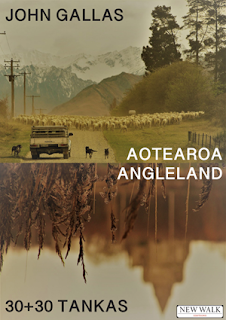
John Gallas, "Aotearoa/Angleland: 30+30 Tankas"


John Gallas was born in New Zealand in 1950.  He came to England in the 1970s to study Old Icelandic at Oxford and has since lived and worked in York, Liverpool, Upholland, Little Ness, Rothwell, Bursa, Leicester, Diyarbakir, Coalville and Markfield, as a bottlewasher, archaeologist and teacher. He is the editor of two books of translations – 52 Euros and The Song Atlas – and eleven collections of his own poetry, all published by Carcanet.  He is a Fellow of the English Association and was 2016 Orkney St Magnus Festival poet.


About Aotearoa/Angleland: 30+30 Tankas, by John Gallas

A life, a heart, a soul – and a book – divided.  Happily divided.  In this pamphlet, John Gallas wanders the corners of his two homelands: Aotearoa (the Maori name for New Zealand) and England. The heart doesn’t bleed, the soul doesn’t yearn to be one, and Life can always get on a plane. As Misuzu Bonchō wrote, when she moved to Dodge City:

          A thing with two roots
          Will grow to embrace the earth
          With both arms.  Read on …


From Aotearoa/Angleland: 30+30 Tankas

Hillgate

From here the hedgerows
roll down to Bree across the
careful corduroy
of two farms. In each a tree,
enisled, tears its windy hair.


Date lines

Everything comes first
to the good folk of Tonga,
from where it proceeds
west in a Mexican Wave
to the world’s less happy lands.


Invitation to Public Reading and Q&A at the University of Leicester

John Gallas will read from and answer questions about his new pamphlet at 4pm on Thursday 9 December 2021 in Belvoir City Lounge, 2nd floor, Charles Wilson Building, University of Leicester. THE EVENT IS FREE AND ALL ARE WELCOME!

Sunday, 19 April 2020

Rory Waterman, "Sweet Nothings"


Rory Waterman was born in Belfast in 1981, grew up in rural Lincolnshire, and lives in Nottingham, where he is Senior Lecturer in English at Nottingham Trent University. He has a BA and a PhD from the Department of English at the University of Leicester. His first collection of poetry, Tonight the Summer's Over, was a Poetry Book Society Recommendation and was shortlisted for the Seamus Heaney Prize. His second, Sarajevo Roses, was shortlisted for the Ledbury Forte Prize for second collections. The poems featured below are taken from his third book, Sweet Nothings, published by Carcanet this month. He is also the author  of several books on modern poetry, and co-edits New Walk Editions. You can find out more about Rory and his work at www.rorywaterman.com.


Sweet Nothings, his new collection, is about absences, how they tempt us, and sometimes what they make us do. An absence is a conjuration, not palpably present in longing, imagination or dream. We are lured on by absences, and how they call to us, in Thomas Hardy's memorable phrase. The poems sometimes come in sequences; always they are in dialogue with one another, responding, echoing - within and between the book's two sections. At times, the leitmotifs are apparently personal, exploring divisions and painful losses. But we also encounter the largely invented academic Dr Bob Pintle, promoted at work since his cameo in Waterman's previous book, an anti-hero of the modern university system. In this book we also find the zero football score, the zero scores in life's more significant conflicts, and an obverse: the desire to settle at nothing, or for nothing less than what life might offer. Sweet Nothings is in fact a book of hopes and passions - quiet and lyrical at times, but also fiercely witty and bold.

Until 28 May, you can get 25% off the cover price of the book at www.carcanet.co.uk, if you enter the code WATERMAN25 at checkout.

Here are some poems from the collection:


Reaping

          ‘We need to test harder whether we can take a young 18- or 19-year-old out of their 
          PlayStation bedroom, and put them into a Reaper cabin and say: “Right, you have 
          never flown an aircraft before. That does not matter, you can operate this.”’
- Air Marshal Greg Bagwell

18 or 19 – what was I doing then? 
Well, one day, I biked here 
to RAF Waddington’s ‘viewing point’, 

from where I saw no action –
called by the urgent Tornados
which had skimmed our village 

shocking pliant heads
at intervals of my childhood,
and must have come from somewhere.

Runway approach lights have switched on
and point skywards at nothing 
coming in. A pigeon. A slip of moon.

A screech owl would be too apposite. 
But I saw one once a mile from here,
on Bloxholm Lane. It stalled a moment, 

then beat on past the hedges
tall as houses, living its purpose
suddenly beyond range.

And who knows what they do 
in a concreted cube two hundred yards
behind wires and warning signs,

or who does it – or why
an inch from where it would have died
a sandfly fills its nest?

Grasses by the road 
dip like a million rods 
to a million tiny catches. A saloon

half a mile off indicates 
only to the clouding dusk,
slows to corner the perimeter

on a red route B road to home. 
Nothing to do but follow
at a generous distance.


First published in PN Review


Where to Build

I never thought I’d have a home
but then I’d built one up from the bay,
a shrub-scrubbed cleft half-hiding it,
a plunging stream behind the grate

and locals pointed up, or down,
to where I lived beside myself
for years, with all I’d wanted most,
building a greenhouse, annexe, shelves, 

and made it all I knew to want
and drowned the voice that said I don’t
with all I’d always done for this
and grew tomatoes, seed to light

and ate them, happily, every night,
and fixed the leak that drew the rain
and fixed it when it sprung again.
Well, I knew of rock across the bay – 

a skerry? – green-topped, curving round
to out of sight behind near rock.
But rain set in, the endless rain,
and through the sheet of endless cloud

a jet of sudden light cracked down
across that further hunk of land,
which glimmered ginger. And it stayed
for seconds, minutes, hours, days,

the whole life of my house away.


First published in the Times Literary Supplement


Re: Application

FAO Dr Bob Pintle
Senior Lecturer in Professional Creativity, Peterborough University

Dear Robert,
                    The Board regrets to inform
several colleagues, including you,
that your recent sabbatical applications
will not go forward, after review.

The panel felt that ‘Write some poems
I haven’t yet written, so it’s absurd
to say much else’ lacked requisite rigour.
We do ask for ‘No more than 2000 words’

but suitable answers require something close.
We advise you attend our ‘Winning Support for
Sabbaticals Workshop’, when places are open.
There are none at present. We’ll advertise more

when we secure funding. To raise an objection,
write to your Sub-Dean of Sub-Research. State
your grounds for appeal, in accordance with Guideline
11 6 2 (Staff Handbook, page 8).

Ensure your 4* REF Output Agreement
and book contract are both attached to the email,
with endorsements from two Student Reps and your Mentor,
and a piece of your heart. Should your first appeal fail,

we invite fresh applications each year,
though from March 2020, all will be screened
for written support from Lead Industry Partners
linked to our Strategy Goals. We are keen

to support your research. We value team players
and wish you every success going forward.
Lastly, I’m pleased, on a personal note,
to congratulate you on your Teaching Award

(Bronze.) Our Faculty Press Team will write
a blog post next week, and request you take part
in our new poster ad, so congratulations!
Yours,
Dr Jim Jones
Dean, School of Arts


First published in Wild Court


Re: Re: Application

FAO Dr Jim Jones
Dean of Arts, Peterborough University

Hi Jim, Bob pecks, then deletes. Dear Jim, Oh YES!
I’ll write with that! Those sabbaticals: who got them?
And have those colleagues had thirteen precious years
on what you term ‘the front line’? Anyway, Cheers!
When I find time, I’ll thank you in a poem,
and place it in the fucking TLS.

I see you proclaim in your email signature line
you’re ‘often abroad and send out-of-hours emails,
but rarely expect instant replies to them.’ 
Well, Jim, tonight I marked till 10pm:
Rhetoric essays. I’d give your email a Fail,
you shite-backfilled and heaving cliché-mine.

On a personal note, how are the kids, you knob?
See much of them? Does Nanny wipe their arses?
And what are the call girls like out in Guangdong?
He sighs. Holds backspace till all his work is gone.
The cursor blinks along with his catharsis,
and he stabs Dear Jim, That’s excellent! Thanks. Bob.


First published in Wild Court


You can also watch Rory perform one of his poems here.

Monday, 25 November 2019

Invitation to New Walk Editions Launch


Free and All Welcome!

Please join us 6.00-7.30pm on Friday 29 November in the Courtyard Room of the Leicester Creative Business Depot, 31 Rutland St, Leicester LE1 1RE, for the launch of two provocative new collections of poetry from New Walk Editions

Steve Ely will be reading from I Beheld Satan as Lightning Fall from Heaven, a sequence about love and betrayal; and John Greening from Europa’s Flight, a crown of sonnets about Cretan myth, borders, the refugee crisis and yes, Brexit …

And congratulations are due to New Walk Editions, which has recently been shortlisted for the Michael Marks Publisher's Award 2019. One of the pamphlets published by New Walk Editions, Declan Ryan's Fighters, Losers, has also been shortlisted for an award. You can see further details here

Hope to see you at the launch event. Admission is free, and there is street food and a bar!