Showing posts with label poem. Show all posts

Thursday, 12 June 2025

Lewis Buxton, "Mate Arias"


Lewis Buxton, photo by Rosie A Mills-Smith


Lewis Buxton won the Winchester Poetry Prize in 2020 and has a full-length collection out with Nine Arches Press. He regularly visits schools, delivering workshops and performances to young people, and his theatre shows tour extensively in the UK. He lives in Norfolk.


About Mate Arias, by Lewis Buxton
Mate Arias is Lewis Buxton’s love song to his friends, a soaring voice attempting to communicate in a masculine world often punctuated by silence or violence. Muscles are torn, crossword clues are pondered, and pints are lifted as the poet attempts to make sense of his friends and himself, and their often clumsy, physical dances around each other.

Under the glares of floodlights and movie screens, with a backdrop of superheroes and zombies, Buxton creates the settings for new versions of male friendships. A poignant and funny exploration of making and maintaining relationships as lives begin to move in different directions, Mate Arias is a unique celebration of the tenderness and love that can be communicated by men.

You can read more about Mate Arias on the publisher's website here. Below, you can read a sample poem from the collection. 


Working Out 

We lift until our arms are dead rabbits: 
he would prefer we were sat in awkward 
positions, dumbbells slung across our hips 
thrusting upwards, rather than find a word 

for what we are to each other: Mate? Friend? 
Buddy? Pal? Brother? I don’t even know. 
Now we are fit shadows trying to bend 
our bodies into shape. I wouldn’t go 

if you didn’t come with me, Alex says 
as we knacker ourselves on the treadmills, 
horses eating air, speaking through spittle. 
I often turn up alone but most days 

that feels thick and forlorn. It’s nice you’re here 
mate, friend, buddy, pal, brother, whatever.

Tuesday, 20 May 2025

Rhian Elizabeth, "maybe i'll call gillian anderson"


Rhian Elizabeth is a trainee counsellor and a writer. Her debut novel, Six Pounds Eight Ounces, was published in 2014 by Seren Books and is currently being adapted for TV, and there are the poetry collections the last polar bear on earth, published in 2018 by Parthian Books, and girls etc, by Broken Sleep Books, which has been shortlisted for Wales Book of the Year 2025. Her prose and poetry have been listed in various competitions and prizes and appeared in many magazines and anthologies worldwide, recently being longlisted for the Plaza Poetry Prize and winning Verve Press’ poetry competition, as well as being featured on BBC Radio 4’s PM programme. She was named by the Welsh Agenda as one of Wales’ Rising Stars - one of 30 people working to make Wales better over the next 30 years. She is a Hay Festival Writer at Work and was previously Writer in Residence at the Coracle International Literary Festival in Tranås, Sweden. maybe i’ll call gillian anderson is her latest collection of poetry, published by Broken Sleep Books.


About maybe i'll call gillian anderson, by Rhian Elizabeth
Rhian Elizabeth's maybe i'll call gillian anderson is a raw, darkly funny, and deeply affecting collection that navigates the liminal spaces of love, loss, and reinvention. With a voice that is both unguarded and sharply observant, Elizabeth crafts poems that move through heartbreak, motherhood, memory, and self-destruction with biting wit and aching tenderness. Whether tracing the ghosts of past selves, confronting absence, or yearning for connection, these poems refuse sentimentality, instead offering something braver-an intimacy that is as unsparing as it is humane.

You can read more about maybe i'll call gillian anderson on the publisher's website here. Below, you can read a sample poem from the collection. 


From maybe i'll call gillian anderson

the winter the murders stopped 

i went to the christmas party dressed as a reindeer, 
           top floor apartment by the river, 
spilled my manhattan over her and her couch, cold collarbones, 
           cold leather, walked home 
through the glacial streets drenched in stars, coat slick 
           with sleet and regret, 

           i feel like a photograph yellowing.

           i miss hearing the creak of my daughter’s bedframe
in the middle of the night, miss being summoned 
           for glasses of water she could easily 
get herself, and now my house is filled 
           with spiders, since there is
no one here afraid of them,
           asking me to kill for them, anymore.

Friday, 15 March 2024

Richard Byrt, "The Trouble with Carruthers"


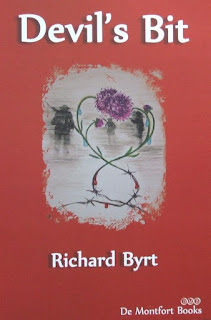
Richard Byrt has tried to improve and develop his poems since completing an MA in Creative Writing at De Montfort University, following his retirement from his day job in 2011. He has published poems in his collection, Devil's Bit (2015), in several co-authored collections and in Glitterwolf LGBTQ+ magazine. Richard facilitates Creative Writing at SoundCafe Leicester, a charity for people with many talents and abilities, who have experienced homelessness or insecure housing. He is actively involved in Pinggg...K!, a monthly poetry event in Leicester, and occasionally reads / performs his work. 

You can read a review on Everybody's Reviewing of Devil's Bit here. Below, you can read one of Richard's more recent poems, "The Trouble with Carruthers."


About the Poem "The Trouble with Carruthers," by Richard Byrt 
This was the fourth poem I drafted on a long railway journey on 24 November, 2023 - immediately after working on some rather depressing poems on artificial intelligence, war and terrorism. I often write funny poems after drafting more serious stuff. I think I wrote "The Trouble with Carruthers" as a bit of light relief, and as a contrast to the previous three poems.  I did some revisions after the first draft, but not a great deal. The poem is probably influenced by my reading of the P. G. Wodehouse stories about Jeeves and Wooster and the Blotto and Twinks comic detective stories by Simon Brett, set in the 1920s. Part of me wonders whether I should just write comic poetry, but I also enjoy including grim humour in some of my more "serious" poems.   


The Trouble with Carruthers

The trouble with Carruthers was that none of the chaps 
Knew who he was, or where he was from.
Some of the chaps rumoured that his people 
Were – well – not quite from the top drawer.
It was said, though no one could remember by whom,
That Carruthers had an uncle who owned a manufactory, and that his pater 
Had even – horror of horrors – attended a polytechnic.
It was noted by some of the chaps that Carruthers
Vulgarly chewed gum and failed to hold his fork properly when dining
In the way chaps should.  Naturally, none of the chaps could speak to him.
But what a relief when the chaps discovered that the rumours about Carruthers
Were about a different Carruthers, and that the Carruthers this poem is about  
Was the eldest son of the Duke of Malmesbury.
And so, the chaps concluded, it could not be vulgar for Carruthers
To chew gum and hold his fork differently.
After all, as the chaps remarked, he was an aristocrat, so what he did must be tickety-boo.
And very soon, after the chaps discovered who Carruthers was,
They all started chewing gum and holding their forks
Just like he did.

Saturday, 2 March 2024

Z. R. Ghani, "In the Name of Red"


Z. R. Ghani is from London. She graduated with a B.A. in Creative Writing from Bath Spa University in 2012. Her poems, which explore themes of identity, femininity, religion, and nature, have been published in literary journals such as Magma, Black Bough Poetry and The Adriatic. In 2021 her first collection of poems was shortlisted in the Poetry Wales Pamphlet Competition.


About In the Name of Red
From lips and warmed cheeks to silk and falling leaves, the subjects of Z.R. Ghani's poems radiate with redness. Sometimes a cloak, often a shining symbol, Ghani's reds are sacred and dazzling: pomegranates ripening to jewels and perfectly-placed bindis shining like suns.

But something darker lurks beneath the ruby depths. A city is held hostage by a heatwave, a flame is lit in a dark room, a ballerina twists inside a jewellery box.

As though developing photographs, Ghani shines a deep light over her poems as a tool to slowly make the unseen visible, the unsaid audible. This is a debut book rich with desire, shame, grief, faith, love, and at the forefront of it all: the colour red.

You can read more about In the Name of Red on the publisher's website here. Below, you can read a sample poem from the collection. 


From In the Name of Red, by Z. R. Ghani

Mother

There are reasons to grieve today.
Mother runs a cold tap
over slabs of laundry,
cursing the day she was born.
That unwashed stench of hospital—
flesh, sweat, placenta
lolls over me like a suicide.
Her fourth daughter is a week old;
I’m not the youngest anymore.
I can’t help but steal glances,
though I’ll soon hear haunting  
thuds as she beats herself, 
or threatens to drink bleach.


Thursday, 9 November 2023

Matthew Stewart, "Whatever You Do, Just Don't"


Matthew Stewart works in the Spanish wine trade and lives between Extremadura and West Sussex. His new second full collection is Whatever You Do, Just Don’t (HappenStance Press, 2023). You can read about his first full-length collection, The Knives of Villalejo, on Creative Writing at Leicester here


About Whatever You Do, Just Don’t

These poems refuse to be pigeon-holed. Whatever they focus on—matters of the heart, football, the post-Brexit marketplace—their method is concise and yet searching, serious but playful. Their language is (mainly) English, their standpoint European.

By day, Matthew Stewart is involved in the Spanish wine trade. But his commitment to poetry is just as intense. Line by line, he weighs the risks, invests meticulous skill, and finally invites the trust on which everything else depends. He promises much—and he delivers.

You can read more about Whatever You Do, Just Don't on the publisher's website here. Below, you can read a sample poem from the collection. 


From Whatever You Do, Just Don't, by Matthew Stewart

The Banana

Come to think of it, she didn’t tell us
who’d got hold of the banana, or how,
and we forgot to ask, stunned by the news
that at ten years old she’d never seen one.

She was still proud her class had raffled it
for the war effort, still slightly mournful
at it turning black on her teacher’s desk
long before they drew the winning ticket.

She wouldn’t talk about gas masks, the Blitz,
the doodlebugs (how they changed to V2s) —
but she always recalled her fury
at the waste of bloody good food.


(First published in One Hand Clapping).


Saturday, 15 April 2023

Rishi Dastidar, "Neptune's Projects"


Rishi Dastidar is a fellow of The Complete Works, and a consulting editor at The Rialto magazine. A poem from his debut Ticker-tape was included in The Forward Book of Poetry 2018. A second book, Saffron Jack, was published in 2020, and he is editor of The Craft: A Guide to Making Poetry Happen in the 21st Century. He is also co-editor of Too Young, Too Loud, Too Different: Poems from Malika’s Poetry Kitchen (Corsair). His third collection, Neptune’s Projects, is published by Nine Arches Press.


About Neptune's Projects, by Rishi Dastidar

In the blurb for Neptune’s Projects, I’ve said that the poems are a ‘post-apocalyptic jig and reel.’ The apocalypse bit is important, in that I’m thinking of the book as ‘apocalyptic poetics’ rather than eco poetics. Mainly because I’m not sure ‘ecopoetics’ as a phrase quite gets the alarm we should be feeling – it feels passive to me. I concede that ‘apocalyptic poetics’ is not particularly active either, and absolutely is an overclaim and hyperbole – right now – but in that gap, I thought there was some interesting space to explore; how do you raise concerns about the environment in a new way? Can finding a tone that isn’t bystanding and handwringing per se achieve more, anything? Is there space for, dare one say it, jokes? Hence why Neptune, my main protagonist / avatar this time round, is world weary, sarcastic, and very aware of its limitations – a register I’ve found great for accessing bleak, black humour.

You can read more about Neptune's Projects on the publisher's website here. Below, you can read a sample poem from the collection. 


From Neptune's Projects

Dhow

Are you bored yet, bored of your desk,
your window, the same vista, not even 
a breeze to make the starling fly faster? 

I am bored of performing when I should
be meeting; I don’t know where my eyes 
even go anymore. Only boring people are 

ever bored, a boring person once said, 
and sure my imagination isn’t locked down, 
but then all I could think about was being 

on a dhow right now, a kamal for a heart, 
a lateen the only future, the infinite same 
different from this. I can’t even swim.


Thursday, 8 September 2022

Jo Bratten, "Climacteric"


Jo Bratten is a poet and teacher living in London. Her poetry has been widely published in journals such as Ambit, The Butcher’s Dog, Finished Creatures, The North, Poetry Birmingham, The Rialto and Under the Radar, amongst others. Her debut pamphlet Climacteric (2022) is published by Fly on the Wall Press. Her website is here


About Climacteric

‘Climacteric’ – a noun, meaning ‘a critical period or moment in history,’ or ‘the period of life when fertility is in decline’; or an adjective, meaning ‘critical, decisive, epochal.’ This pamphlet interrogates how we can love ourselves at the climacteric of our lives and of the planet.

Climacteric bubbles with anger and guilt at the failures of both spirit and body and expresses a coming to terms with loss: for the natural passing of loved ones to the unnatural passing of our planet’s ecosystems. These poems also offer solace, for we are not alone – ‘in the fractured dark we’re all doomscrolling / before dawn, lit up like Caravaggios.’ They find joy in the simplest forms of love.

You can find more information about Climacteric on the publisher's website here. Below, you can read two poems from the collection. 


From Climacteric, by Jo Bratten

New Year’s Day

Morning of the new year and I’m scrubbing 
the bath, tugging snakes of hair 
from the stinking drain, wondering 
how so much of me got down here. 

In the cold estuary I’m circling 
black terns under a groggy sky, 
tangling with pintails, shored on a tide 
of mud with the plover and the lapwing, 
stuck in the gullet of the godwit 
and the rare avocet. 
                                I’m far out at sea, 
brining with molluscs, latching on to 
resolute cephalopods like flame, 
waking somewhere in the belly of a whale, 
retched up on your shore, a warning.


Because we have forgotten how to sleep


we are whispering our reasons to strangers; 
we are googling our exes and our symptoms: 
there is a pain in a place, our legs all 

electrical filaments, twanging; our hair 
is coming out in clumps; we are sweeping 
it from corners, from beneath the bed, 

gathering it into our sleepless nest, 
tumours hatching on our ribs like eggs;
our mouths are bubbling with hope 

and peril; we are thinking up good titles 
for poems; in the between spaces we are
having vivid dreams; mine are subaquatic:

I am dreaming of Sponge Bob in a porno 
with an octopus; they are touching 
each other like rain; her tentacles slip-

pering through the yellow spaces of his flesh, 
she is shimmering like caviar, all lips: 
you are thinking there is a tenderness 

in how her suckers clasp his little shorts; 
you know it is not real but after all 
these curdled nights you think it looks like love.


Saturday, 3 September 2022

Jaimie Gusman, "Anyjar"


Jaimie Gusman is a writer and ceramic artist living in Ka‘a‘awa on the island of Oahu. Jaimie earned her MFA in Poetry at the University of Washington and her PhD in Creative Writing at the University of Hawai‘i Mānoa. She is the founder of Mixing Innovative Arts, a reading series that ran from 2010-2019 in Honolulu. Her first book Anyjar was published in September 2017 by Black Radish Books. Jaimie is a recipient of the Rita Dove Poetry Award (2015) and the Ian MacMillan Prize (2012). She also has published three chapbooks: Gertrude's Attic (Vagabond Press, 2012), The Anyjar (Highway 101 Press, 2011), and One Petal Row (Tinfish Press, 2011). In 2020, Jaimie became the editor of Tinfish Press, an experimental poetry press dedicated to publishing work from the Pacific region. Her most recent writing can be found in The Feminist Wire, Black Warrior Review, and DIAGRAM.


About Anyjar

Marthe Reed writes: "Jaimie Gusman’s Anyjar navigates the proliferating forms of body, memory, and self, as the shores of the Anyjar approach and recede without warning. Who, where am I, the Anyjar asks, refusing a single perspective or form. A conch shell, the missing part, one’s heart, womb or nest, a child, death and loss, an incursion, a lament, an invisible sea—the complex matrix of making, artist-writer-animal-person. The instability of the Anyjar, its profligate forms, mirrors the dilemma of the poems’ speaker, who 'a two sea' is herself doubled. The reader finds herself loosed and multiplied, also, in the pages of this collection, the Anyjar as profligate as language itself. 'Memory is not practical but memory is practice.' All that body holds spills out, memory writing us into being, like the knit-work of DNA: Anyjar is a conch shell held to our ears speaking the fabric of (our) making." 

You can read more about Anyjar here. Below, you can read a poem from the collection. 


From Anyjar, by Jaimie Gusman

And like MAGIC Anyjar is Gone

Forgive me, he says, I took the Anyjar and buried it in snow until part of the glass froze and then I tried to break the Anyjar apart with an ax that was underneath the kitchen sink, which I discovered when rain caught the slate-stick and with one, two, twenty smashes the Anyjar wouldn’t budge, which meant that an ax wouldn’t do so I went to the bedroom where I found a chain-saw, revved the engine like a quake of earth and sawed the hell out of the Anyjar, but what happened next was disappointing because nothing shattered except my right knuckles and all bloody and in a bad mood I called a friend to help and the friend said I’ll do anything I can do anything to help a friend so the friend came over with very new rubber gloves and twisted the Anyjar until the friend’s hands looked like new hands but of course we thought if new hands wouldn’t do, any other hands would surely fail to open the Anyjar, so then I thought extremely hard about everything and we began to make a catapult from space and flung the Anyjar into the air but it boomeranged right back only to hit the friend in the anything-but-good eye so I ran to get some frozen peas and a patch, and then I got tired so I suggested that maybe the best thing to do was to go get a blanket (take the one the dog sleeps on) and drape it over the Anyjar and just like that I sighed and the Anyjar disappeared—so forgive me he says sorry again, it could be anywhere.


Thursday, 25 August 2022

Peter Raynard, "Manland"


Peter Raynard is a disabled, working-class poet and editor. His previous two books of poetry are Precarious (Smokestack Books), and The Combination: A Poetic Coupling of the Communist Manifesto (Culture Matters), both in 2018. He edited Proletarian Poetry: Poems of Working Class Lives, for five years, featuring over 150 contemporary poets. His second collection Manland was published by Nine Arches Press in 2022.


About Manland
Peter Raynard is a skilled observer, and these razor-sharp poems document parenthood through the lens of a stay-at-home dad, attempt to tell the truth about men and depression, study our cultural, social and medical relationships with drugs and drug-taking, and lay bare the realities of life at the sharpest edges of society. By turns frank, painful and bleakly funny, this humane and brilliant book encompasses pride and prejudices, the bonds between lads and dads, the toxic pressures of masculinity and the way illness and poverty irrevocably shape lives.

You can see more information about Manland on the publisher's website here. Below, you can read a poem from the collection.


From Manland, by Peter Raynard

You Talking to Me?

'The whole problem with the world is that fools and fanatics are always so certain of themselves, and wiser people so full of doubts' - Bertrand Russell.

Discussion unfolds like a front page scoop
that knits the purl of a bloody dispute.

In the fruit bowl of cups of tea couple of pints
breaking bread sat at a table on your knees

nose-to-nose problems arise when unused
to another’s game play. Such noise also flows

under arrogant bridges spanning two richly
educated rivers where the ‘they’ in ‘they said

is oracle, bulleted with ‘nothing of the kind’ 
& ‘puh-leeze’ - privileged weapons against empathy

until you’re told to wipe that political position
off your working class rowing boat. Full stops

include: ‘it’s always been a one-way street as far
as I’m concerned.’ or ‘I don’t care what you say

about smoking, my nan lived till she was ninety.
If all else fails to persuade, there’s always the ‘but still

the fine detail trump-of-all-cards not to be played
too early for fear of an undisputed spat that lets

the lions loose in your own den of antiquity. But still
if none of such floats your throat there’s always

the dulcet twist to be found in the space between
what you believe, what you say, and what the fuck

you are going to do about it. Now who wants a fight?


Wednesday, 15 June 2022

Mina Gorji, "Scale"


Mina Gorji was born in Iran and lives in Cambridge, where she is Associate Professor at the Faculty of English, University of Cambridge and a fellow of Pembroke college. Her debut, Art of Escape (Carcanet, 2020) was a Telegraph 'Book of the Month.' She has published poems in Poetry Review, Magma, London Magazine, bath magg, bad lilies and the Forward Book of Poetry amongst others. She has also written a study of John Clare's poetry, and essays on weeds, rudeness, little things and listening; a lyric-critical essay, 'Listening for Stars,' was published in Poetry Review (2021). Her new book is Scale (Carcanet, 2022). 


About Scale, by Mina Gorji 

At the volcano's edge, in exilic space, at the bottom of the Arctic Sea, or in the acid clouds of Venus, Mina Gorji's Scale traces life at its limits. The poems range across scales of distance, temperature and time, from vast to minute, glacial to volcanic, Pleistocene to present day, constellation to millipede. Adapting to the cold of a new continent opens a chromatic investigation of feeling. Shifting between scales, from insect to ancient star, Scale explores the forms, conditions and frequencies of survival.

Gorji's poems feed into current ecological concerns, but in no conventional or clichéd way. Marina Warner described her poems as 'building a place of safety—for herself, her family, her readers, and all those who are wandering and uprooted; her poetic methods take their cue from the many marvellous creatures she evokes and the multiple protective measures they adopt—nests, camouflage, mimicry, display. Above all, language can help create shelter.'

You can read more about Scale on the publisher's website here. Below, you can read two poems from the collection. 


From Scale

The world is growing smaller
 
One of the tadpoles has died.
It is lying very still,
comma turned full stop.
Nobody cries.
We feel the shadow –
even as we shrink
from its touch
behind closed doors.
It is spring.
Up in the attic
I am imagining
outside:
deadnettle leaf
through a beetle’s eyes.


Pluto 

I dream of distance –
cold, untroubled distance,
the quiet further reaches of our sun,
far out from Saturn’s icy rings,
cold, remote, so beautiful.
Planet of the underworld,
guarded by Charon, Kerberos,
Styx, Nix, and Hydra.
We see your features,
almost familiar –
canyons, ice plains,
mountains topped
with mercury snow.

Thursday, 12 May 2022

Nina Walker, "Blooming"


Nina Walker is a third-year student and Leicester University. She enjoys writing, rug making and Ray Bradbury’s short stories. She’s been writing poetry since she was sixteen when the only person reading it was her mum. The dream is to be published eventually. 

Nina performed the following poem at the Creative Writing Student Showcase at Literary Leicester in March, 2022. 


About the poem 'Blooming,' by Nina Walker

The following poem was inspired in part by my paternal grandmother Wendy Walker, who worked in the hosier industry that was huge in the Midlands, as well as an article I read about the disgustingly long waiting list for people in this country needing cancer treatment. Since my grandma died of cancer during 2020 the two seemed thematically close. I wanted to try and get across the sense of loss I feel when I think about my grandma and the industry she used to work in. 'Blooming' is part of a larger collection I hope to publish about England’s past and how it affects our understanding of the present, as well as how we can come to love such a deeply troubled country.


Blooming

The alley behind Debenhams sells discount granny bras 
And I want to cut off my hair
Watch the threads slip down the drain
One by one

I keep reading about our collapse
Makes me sick, stomach full of all this bile
So I eat cleaner
Greener

But I still feel rotten, soft like a pear gone brown in the middle
Soft like the skin round a lump
Growing plump
In the glands in my chest
An anxious spasm

The city is not our friend
Doesn’t recall our names like a bad teacher
Fumbles with our futures like a bleeding pen
Blubbering like the lady behind Debenhams 
Or on the market 
With her cheap elastic bloomers 
When I’ve lost my job and my hair
I hope she’s the only millionaire 

Something about these people with their day jobs and money makes me feel faker than tan.
I can’t carve away at the pain we’re all stuck to like plump blue bottles
Can’t make work mean more than pennies counted
Can’t remove the tumours

We work till our fingers can’t pick out the stitching anymore 

Till they’ve worn us out like Primark trainers 

My grandma worked with her hands 
Just like the woman did
But a tumour took my nan and a tumour is taking the woman too
But it's not in her body
So I can’t cut it out

The tumour is barren 
Stripped us of our tools 
Left us arthritic 
So we send our projects abroad to children with quick fingers 
Blank eyes

Your nan will live
Or not
They don’t really care if she makes a living 

Never mind the back alleys and soft flesh, it’s our conscience we should be searching.
If this country was a dog I’d shoot it out of mercy.

Friday, 6 May 2022

Ian Pople, "Spillway: New and Selected Poems"


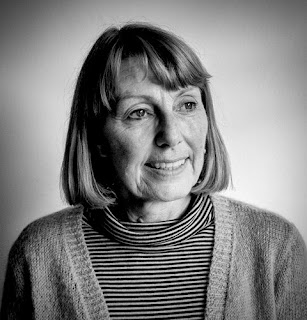
Ian Pople, photograph by Mark Epstein


Ian Pople was born in Ipswich and educated at the British Council, Athens, and the universities of Aston, Manchester and Nottingham. He has taught English in secondary and higher education in UK, Sudan, Greece and Saudi Arabia. He taught at the University of Manchester for over twenty years. 


About Spillway: New and Selected Poems, by Ian Pople

Ian Pople is a man of the world. He has travelled and taught in the UK, Greece, Sudan and Saudi Arabia. His poems explore England, the larger world, and how changing perspectives readjust the sense of England and home. They deal with borders, crossings, closing boundaries. They are about transitions in space and time, the ways life and relationships change and adapt to illness, love, estrangement and loss.

The traveller changes identities as he moves, responding to different surroundings, and the early poems collected here provide a varied retrospect, moving through Africa, Europe and Asia – so that we read the more recent work from a different perspective. The travel poems explore the range of reactions, appropriations and misappropriations as physical and psychological boundaries are crossed. More recent writing responds to music and the visual arts, using assemblages or bricolage to convey the painfully familiar experience of displacement, dislocation. There are poems that answer back to figures from jazz history, Roland Kirk, Dupree Bolton and Pat Metheny among them. It is wonderful to encounter such an accomplished and varied a body of work which shares with us its vivid spaces and tones. Pople, one of the most lucid critics of modern and contemporary—especially American—poetry, is an original artist in his own right.

You can read more about Spillway on the publisher's website here. Below, you can read a sample poem from the collection. 


From Spillway: New and Selected Poems, by Ian Pople

The Aerodrome

This is rain in the Home Counties.
It falls on station platforms, on bicycle

helmets, on magpies that strut
on the grass, among the crows that spool

from the tops of trees, and winter
wheat as it appears in the field,

the field corner with its weed and rubbish.
It is raining from the corner all the way

to the horizon, to where the ‘no’
is divided from the ‘yes’; and beyond

to that transfiguration, and to you,
old aerodrome among fields, runways

among grass, broken frames, Nissen huts
that rust among the silver birches.

Wednesday, 2 February 2022

Valerie Bence, "Overlap"


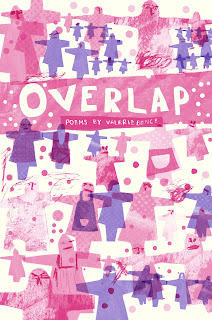
Valerie Bence finished her doctorate in her mid-fifties and completed a Poetry MA at MMU in 2017. She was shortlisted for the Poetry School/Nine Arches Press Primers 4 in 2018, the Fish Poetry prize in 2019, and longlisted for the Ginkgo Prize in 2019. Her first collection, Falling in Love with a Dead Man, was published by Cinnamon Press in 2019. She is a mum and nonna and lives and works in Buckinghamshire.


About Overlap

Valerie Bence’s debut poetry pamphlet is a testament to ordinary lives, and a meditation on grandmothers. Part memoir, part family history, Overlap is a series of vivid vignettes from the poet’s childhood, courtship, motherhood and grandmotherhood, spanning the 20th and 21st centuries.

Bence’s grandmothers Winifred and Harriet are at the heart of this book. She reflects on their hardy, steadfast lives as she too becomes a grandmother, in very different times. Stranded from her family in the Covid-19 pandemic, the poet conjures up their ghosts, walks in their footsteps and – sometimes – feels herself become them.

You can read more about Overlap on the publisher's website here. Below, you can read a sample poem from the collection. 


From Overlap, by Valerie Bence

Collusion
 
From my vantage point under the kitchen table
I watch her knees as she walks by – dimpled,
thick stocking’d in summer and winter,
slippers with holes at the toes,
crossover pinny pockets full of scraps
and peelings for chickens. Grandma Harriet.
 
We mash tealeaves and bran for the rabbit,
the sweet aroma fogging her glasses, and every day
she scrubs bloody butcher’s aprons
for five shillings a week.
We take the clean ones back on the bus,
until the day she faints outside Boots in the rain,
sliding down the wall like in a cartoon,
her wartime hat slipping over her eyes.
 
Thinking she is dead I run into the chemist’s;
a man brings her a glass of water.
Sipping it she squeezes my arm –
Don’t tell him she says, pulling me close.
 
This will not be difficult, as in all my seven years
he has never spoken to me.

Friday, 17 December 2021

Anne Bailey, "What the House Taught Us"


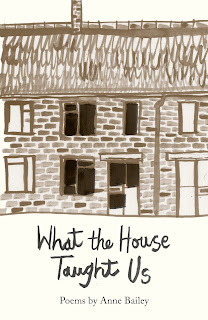
Anne Bailey was born in West Yorkshire, very close to the Pennine moors. She has worked as a teacher, a mother and a couples counsellor in London, and now lives in North Norfolk. She is a committee member for Café Writers. Her poem ‘What the River did Next’ was commended in the 2021 Ambit Poetry Competition. Her new pamphlet of poems is What the House Taught Us, published by The Emma Press. You can find her on Twitter: @Anneebai


About What the House Taught Us, by Anne Bailey

You never know how things really are in other people’s families, in other people’s homes. There’s the public face and the private truths – the personal griefs and tragedies, whether festering or resting in peace. In her wry, engagingly strange poems, Anne Bailey takes the door off the latch and lets us inside. 

She shows us loss and disappointment, as well as hardness and resilience, particularly through the eyes of a daughter, wife and mother. We see the domestic sphere in such close-up detail that it becomes bizarre, an uncanny dimension that nonetheless rings horribly, weirdly true. 

You can see more details from What the House Taught Us on the publisher's website here. Below, you can read a sample poem from the pamphlet. 


Domestic

So you’ve put a picture on the lovely blank wall
that used to go pink in the sun
and feel like an ice cream.
A wall on which I used to rest my eyes
in pleasant contemplation.
A wall which represented air
that could be breathed.
A wall through which it was possible to see
how much space is in the universe.
The distance between one star and another.


Wednesday, 17 November 2021

Carol Leeming, "Song for Guests"


Carol Leeming, photo by Hana Kovacs

Carol Leeming MBE FRSA is Leicester born, of Windrush parents from Jamaica and Antigua, and grew up partly in Jamaica. She received her Queen’s honour as a playwright and poet, and for her contribution to Leicester arts and culture. Carol is a Fellow of the Royal Society for the Arts, a Cultural Olympian of 2012, and is featured on the University Grassroutes Writers' Gallery microsite here. Carol’s choreopoetry is highlighted by Corinne Fowler in the Cambridge Companion to Black & Asian Writing 1945-2010, ed. Deidre Osborne. In 2018, Carol’s poem ‘Molly’ was displayed across a Leicester University Campus building, as part of a centenary celebration week for the British Suffragettes Movement. 

Other notable work includes Carol’s debut chapbook The Declamations of Cool Eye published by Dare Diva. A film poem, entitled Enchanter, featured the poem 'Drawing' from the chapbook. You can see it here. Some other plays produced include Storm, & The Twisted Plait at Haymarket Theatre, The Loneliness of the Long Distance Diva, and Love the life you live … Live the life you love at Curve Theatre, also published in the book Hidden Stories Anthology, published by Leicester University/Phoenix. 

Carol’s poetry features in a number of anthologies. These include 'Valley Dreamers' in  Out of Bounds, ed. Jackie Kay (Bloodaxe), 'Some Things that Never Failed Me' in Covid 19 & Poetry Anthology, ed. Anthony Caleshu and Rory Waterman (Shearsman Press), ‘Song for Guests’ (translated into ten languages) in Welcome to Leicester, ed. Emma Lee (Dahlia Books), Overland, Oversea, ed, Kathleen Bell, Emma Lee & Siobhan Logan (Five Leaves). A recurring feature of her work is to give voice to the voiceless, untold diverse stories, or magic realism in narratives, compelling diverse characters, with distinctive voices. 

Carol recently debuted at A Time to Breathe Festival curated by Greta Mendez MBE, London 2021, in a performance of her new choreopoem play, entitled The Dreadful Dance of Ms. Iniquity. Carol also has a major collection of writing, poetry and choreopoetry entitled The Eclipse of Dread, in preparation for book publication, along with writing the final part of her choreopoem trilogy, ‘Go Where the Songs Are.’ 

Carol works freelance, in literature performing arts and digital media. She is a multi-award award-winning author, published poet, director, playwright, dramaturge, performer and tutor. She was dramaturge and director for Harley, Scholar & Stateman by Pamela Roberts. She previously worked full-time as Resident Assistant Director at Curve Theatre Leicester, on theatre productions My Beautiful Laundrette by Hanif Kureishi, and West Side Story by Laurents/Sondheim/Bernstein.

Carol currently is part-time lecturer at De Montfort University, BA Performing Arts, Guest Visiting Lecturer on the MA Creative Writing at Nottingham University, and Guest Visiting Lecturer Writing for Performance at Derby University, in addition to mentoring prisoners, to create poetry for the NO BARS II Project Anthology launched in 2021. Carol is also Patron of East Midlands Women Awards. 

See more about Carol's work here and hereBelow, you can read a poem by Carol. 


Song for Guests

           'The new arrival of a guest is reason for a feast' - A North African Bedouin Custom

Fear
and hate 
Is flung
it weights down 
a tar-paulin night as
folk crowd fire warmth 
dreaming of dark tunnel  
escape with luminous
hands of friendship 
held aloft ready to catch…?

Welcome us 

We welcome you all
Come … to us 


Sleepless knots of men
crouch into bush hides  
waiting for smoky vehicles
stowaway with stony 
grey lips of newsprint words 
pointed to goad or reject? 

Welcome us 

We welcome you all
Come … to us


Skeins of women children 
hold emotions like nets with
wounded screams as
running tears hearts salt
human streams across earth 
its seas would it wash away
foul slimes cruel indifference
a dirty din from a baited polis 
Is that blood on their hands?

Welcome us

We welcome you all
Come … be with us
Our table is full 
Yet empty missing you


Thursday, 7 October 2021

Andrew Taylor, "Not There - Here"


Andrew Taylor is a Nottingham based poet, editor and critic. He has published three collections of poetry with Shearsman Books: Radio Mast Horizon (2013), March (2017) and Not There - Here (2021). Pamphlets of work include Silo (Red Ceilings Press, 2021), at first it felt flying, with Charlie Baylis (Indigo Dreams, 2019) and The 140s (Leafe Press, 2018). He has collaborated with musician Nick Power, Lowdeine Chronicles (erbacce-Press, 2019), and is currently working collaboratively with Welsh based artist Julie Jones. He is the author of Adrian Henri: A Critical Reading (Greenwich Exchange, 2019) and is currently editing two volumes of Peter Finch’s Collected Poems (Seren, 2022). He is Senior Lecturer in Creative Writing at Nottingham Trent University. His website is here


About Not There - Here

Continuing the themes of travel explored in his previous Shearsman collections, Radio Mast Horizon (2013) and March (2017), Andrew Taylor takes the reader from England into pre- and post-Brexit Europe, negotiating the arrival of the nightingale, European breakfasts, fast trains into Paris, and the ‘beautiful drift’ of weaving grasses. The reader is treated to the minimalist notion of moments in time alongside the traversing of travelators in Montparnasse and the intricacies of the 280-character form.


From Not There - Here, by Andrew Taylor


Kidman

lookalike smiles
the first offering of the day

it’s 16.25 in Montparnasse
the travellator is broken

Orange priority tag shifts
waiting room makeover

light catches gold dances on
a pillar like Seahorses on Broadway

it’s 17.21 in Montparnasse
& TGV 8389 departs on time

this second city petite moineau
spires & towers

recognisable routes track curves
& date stamps


(first published in Adjacent Pineapple)