Showing posts with label dystopia. Show all posts

Thursday, 21 September 2023

Venetia Welby, "Dreamtime"


Venetia Welby is the author of two novels – Dreamtime, which featured in The Observer’s books of the year, and Mother of Darkness. Her essays and short fiction have appeared in The London Magazine, Irish Times, Spectator and anthologies Garden Among Fires and Trauma, among others. ‘Words Once Said’ was published in The Parracombe Prize Collection 2023, for which it was shortlisted. Venetia lives near Grantham with her husband, son and Bengal cat and can be found online here, on X: @venwelby and Insta: @vvwelby.


About Dreamtime
'So, where is he then, your dad?' The world may be on a precipice but Sol, fresh from Tucson-desert rehab, finally has an answer to the question that has dogged her since childhood. And not a moment too soon. With aviation grinding to a halt in the face of global climate meltdown, this is the last chance to connect with her absentee father, a US marine stationed in Okinawa. To mend their broken past Sol and her lovelorn friend Kit must journey across poisoned oceans to the furthest reaches of the Japanese archipelago, a place where sea, sky and earth converge at the forefront of an encroaching environmental and geopolitical catastrophe; a place battered by the relentless tides of history, haunted by the ghosts of its past, where the real and the virtual, the dreamed and the lived, are ever harder to define. 

In Dreamtime Venetia Welby paints a terrifying and captivating vision of our near future and takes us on a vertiginous odyssey into the unknown.

You can read more about Dreamtime on the publisher's website here. Below, you can read an excerpt from the novel. 


From Dreamtime, by Venetia Welby
Sol notes an all-American smile of implausibly white teeth, many and strong, the troops perfectly drawn up for battle. Even the muscles in his face look powerful, his jaw broad and sharply defined, cheekbones underlining light green eyes and a low-fade haircut, dirty blonde with a sprinkling of steel. He’s mature: there’s something knowing about that grin, despite its openness. 

‘Uh, you don’t remember anything, do ya?’ The man puts his good ursine paw in front of his mouth, but Sol can tell he is still smiling by the lines that fan out from his eyes. Is he mocking her? ‘Hey, hey, don’t worry – there’s nothing to be worried about. You’re completely safe. Nothing happened, you can relax about that.’ 

Sol coughs. She brings herself upright and quickly and silently inventories herself. Her hair feels congealed, her body desiccated as the desert it came from. She still has her dress on – relief – though it’s up round her waist. 

Some guy Sol shot up with once in Tucson had the gall to imply that fucking should be an easy extension of her friendship, almost a perk of her presence, given the nature of her job. No, she explained, that couldn’t be further from the truth. Why is the word ‘escort’ so confusing to people? And in any case, sex is a valuable commodity, not to be given away freely. If it were given away freely, that – that, she emphasised – would be a seriously big thing. It would mean something. 

‘Like a “children of cobblers go unshod” kind of thing,’ the man replied before planting the needle in her shy green vein. He was British, she remembers. Dead now. 

She stares at the new man in front of her, careful to stay very still; a rabbit playing possum in a fox’s jaws. 

Friday, 7 January 2022

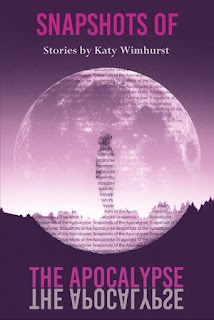
Katy Wimhurst, "Snapshots of the Apocalypse"


Katy Wimhurst’s first collection of short stories, Snapshots of the Apocalypse, is published by Fly on the Wall Press. Her short fiction has appeared in numerous magazines and anthologies including The Guardian, Shooterlit, Cafe Irreal, Ouen Press, Fabula Press, and Magic Oxygen Literary Prize. Her visual poetry has been published in The Babel Tower, 3am, Ric Journal, Steel Incisors, Trickhouse Press, and others. She studied social anthropology (and Mexican Surrealism at postgraduate level) and has worked in teaching and publishing. She lives by a pretty river, adores trees, and suffers from the neuroimmune illness M.E. Her website is here.


About Snapshots of the Apocalypse 

In these dark, witty short stories, Katy Wimhurst creates off-kilter worlds which illuminate our own. Here, knitting might cancel Armageddon. A winged being yearns to be an archaeologist. Readers are sucked into a post-apocalyptic London where the different rains are named after former politicians. An enchanted garden grows in a rented flat. Magical realism meets dystopia, with a refreshing twist.

More about Snapshots of the Apocalypse can be found on the publisher’s website here. Below, you can read an excerpt from one of the stories. 


From Snapshots of the Apocalypse, by Katy Wimhurst

Min despised the Tate Art and Refuge Centre. It contained little art and more refuse than refuge. She’d been approached by pimps in the café there, had witnessed fist-fights over chocolate, and had once seen an artwork used as a frisbee. But today, staring at the empty food cupboard in her squat, she knew she’d have to go there if she wanted to eat.

“Shit,” she muttered, slamming the cupboard door.

Cursing the guy who’d yet again failed to deliver the bootleg goods, Min grabbed her bag and slung on her black PVC cape and beret. She then padlocked her squat’s front door and marched down the long staircase.

On the ground floor, the sign on the wall read: THE ROYAL COLLEGE OF  URGEONS. If anyone asked ‘what she did’ these days, she said she was an ‘urgeon.’ A reasonable word, she thought, for how she kept urging herself on despite the relentless crap around – and indeed within – her. Fortunately, few asked her ‘profession’ these days. Had it really taken an apocalyptic world to end small talk?

The former Reception area was dusted with cobwebs, its blue carpet muddy with footprints. Min still recalled her first visit to this place years ago as a medical student, but she tried not to think of the past. That was a different era, before the floods and chaos, and she’d never finished her studies, anyway. It’d been how she’d known about this place though, and why she’d come here to hide when her flat near Tottenham Court Road had burnt down in a riot ...


Tuesday, 8 May 2018

Creative and Critical Digressions: On the Creative Writing PhD

By Paul Taylor-McCartney


I’m now a third of my way into a six-year part-time PhD in Creative Writing with Leicester University, working on a 50,000-word dystopian novel, entitled The Recollector, with an accompanying reflective commentary of 20,000 words exploring the function of memory and identity in works from across the genre, including my own. Ask any part-time doctoral researcher about setting aside some dedicated time to study and they’ll tell you it’s a slow-burn process – a little and often should do it. Indeed, taking a measured approach to formulating, creating, revising and continually reviewing sections of material, whilst receiving objective but supportive tutelage from an expert supervisor, comes with its challenges, but also a wealth of opportunities to explore and ideate to the heart’s content. 

For example, it’s taken the whole of my first year to get anywhere close to settling on an appropriate register for the creative piece. Third person - second person - then finally choosing first person and locating it entirely in the present tense. The course requires me to balance creative and critical interests, meaning I’m pursuing a range of digressionary journeys away from the core material, but each one actively deepening my appreciation of the processes and discipline required to achieve at this new level. A panel seminar at last year’s NAWE Conference has become an academic paper due to published later this summer. Last month, I returned to painting and the easel to create miniature canvasses to help define the sombre mood of my text’s dystopian setting - a setting in which the majority of the population suffer memory issues in one form or other, with a staggering rise in dementia cases. Elsewhere, drafting confessional poetry is helping sharpen the voice of the text, and I’m currently re-figuring the opening section of the novel as an installation piece for a small gallery in New York. This alone is asking me to re-engage with my previous performance work as both theatre director, actor and musician.  

At another extreme, I’m planning on producing a paper version of The Recollector using an antique 1930s Olivetti typewriter, in line with my protagonist’s need to avoid committing his memories to electronic devices of any description. 


Some may consider these various digressions unnecessary and even vain enterprises. For me, a PhD in Creative Writing is not simply about completing a full-length study suitable for publication across its creative and critical elements – although that is ultimately one criterion against which I’ll be measured. It is, more crucially, proving to be a fully-immersive exploration of the artistic process in its entirety, spiralling outwards from a central conceit – and the greatest expression of my writing career to date.     


Friday, 1 December 2017

Dystopian Workshop, Hosted by the University of Leicester Creative Writing Society

By Xenophon Kalogeropoulos


Remember, remember the ... 28th of November? Probably, because that is when we hosted our first workshop based on dystopia in collaboration with the David Wilson Library of the University of Leicester. And yes, true to the theme of dystopia, I started this article with a V for Vendetta reference.

 About two months before that important date, we were approached by the university library with a very interesting proposal. Since we are the Creative Writing society, they asked us if we would like to deliver a comprehensive workshop based on dystopia in the spirit of this year’s Read at Leicester project, which placed Naomi Alderman’s The Power - you guessed it: a dystopian novel - in every student accommodation of our university. This proposal was within the wider spectrum of getting people interested in reading, but also writing, with the first workshop’s theme being that of dystopia. We couldn’t have agreed more and so we began planning from the beginning of October. 

On the 28th November it was our brave secretary who took it upon himself to lead the session (yes, the same secretary who is writing this article and is definitely not biased in the descriptions of himself!). Attendance was good with many people attending who were not necessarily part of our society. 

We began from the ground up, starting with the basics of constructing a dystopian world, identifying what went wrong in that world, how did it affect the people in it, what its rules and antagonists are and finally, our main character(s). We tried to make the workshop as interesting and interactive as possible by asking our audience what their definitions of a dystopia were and what examples of dystopia in novels, film, games and popular culture they could find. They were amazing and identified many of the popular dystopian stories (1984, A Brave New World, Hunger Games, etc.) but they missed Children of Men. How can one miss Children of Men? As I mentioned when presenting, “CoM is a textbook dystopian story”:it contains all the elements of a dystopia as if the scriptwriters were checking them off a list. In fact, a lot of the workshop was built around following Children of Men’s structure and ways of going about delivering the cinematic experience of a dystopia.

All throughout the workshop we tried to encourage moving away from the established notions of what a dystopia is like, into more original territory (for example, we advised them to try and create a dystopian world that isn’t dark, completely industrialized and polluted, but rather sunny and green, for a change). Towards the end of the workshop we had a whole slide dedicated to dystopian clichés and avoiding them (e.g.: the antagonist is always a plutocratic, autocratic Big-Brother government of some kind), and that was when the audience roared up and intimidated me when I tried to criticize the Hunger Games! A dedicated fanbase indeed …!

Finally, we all took part in a writing task which would have each group (the audience was seated in specific tables-groups) try to create their own dystopian world based on what they had learned throughout the presentation. Each table presented us with amazing dystopian worlds like one where men were the minority after a major war and they were revered as god-like beings by women who were the majority and had replaced them in almost every way… Happy stuff...! 

After all was said and done, we shared with our audience a small literary competition we are hosting as a society which called for the submission of 3000-word dystopian short stories by the 5th of December, with the prize of a possible chance for publication and (what everybody likes) a £10.00 Amazon voucher.

All in all, it was a very interesting and enlightening experience for all involved and, we believe, everyone left equipped with all the necessary knowledge of how things could go wrong at any given moment ... Now, we’re waiting for the submissions for our competition to see how our creative audience chooses to employ all they learned with us at the workshop. 

For further details about the competition, including the rules, please email the society: su-creativewriting@leicester.ac.uk


About the writer

My name is Xenophon and I am from Hellas (Greece), on my second year of study here at the university. I am quite interested in history and writing and I like to see myself as an aspiring writer. Presently, I am serving as Secretary in the Creative Writing Society of the university, regularly leading creative writing workshops on a range of themes and literary genres.