Showing posts with label Isabelle Kenyon. Show all posts

Friday, 5 December 2025

"The Subtle Art of Short Fiction," ed. Isabelle Kenyon


About The Subtle Art of Short Fiction, ed. Isabelle Kenyon
The Subtle Art of Short Fiction explores the power of short fiction in today’s fragmented world. Renowned authors and critics offer advanced techniques for crafting nuanced, impactful stories.

Learn to master short story structure, subtext, micro-tension, and sensory minimalism. Ideal for experienced writers seeking to refine their skills in this sophisticated art form, or those who love short fiction, and want to learn about the craft behind it.

The book includes essays and writing exercises by Kerry Hadley-Pryce, Daisy Johnson, Matt Wesolowski, Sascha Akhtar, David Hartley, Mahsuda Snaith, Jonathan Taylor, Sarah Schofield, SJ Bradley and Farhana Shaikh, and has an introduction by Dr Paul March-Russell.

You can read more about The Subtle Art of Short Fiction on the publisher's website here


About the editor
Isabelle Kenyon is the Managing Director of Manchester publishing house Fly on the Wall Press, and was named a Leader of the Year by the Bookseller in 2025. Founded in 2018, she has led Fly on the Wall Press from Small Press of the Year finalist status at the British Book Awards 2021-23 to their win in the North, in 2024. She is the MA Module Leader for "Publishing in the 21st Century" at Arts University Bournemouth, and the author of psychological thriller The Dark Within Them and poetry collections including Growing Pains (Indigo Dreams).​ She previously coordinated the Northern Fiction Alliance and runs PR campaigns for writers and publishers under Kenyon Author Services


From The Subtle Art of Short Fiction

From The Art of Anticipation and Revelation

by Daisy Johnson

I have noticed something recently about children. It is the waiting that they love. My sons sit at the kitchen table watching me, spoons floating half way to their open mouths, eyes wide. I am doing something silly, making a noise or pretending to hide or doing a funny walk. Each time when I stop they call for me to do it again, again, again. I pretend not to, I cannot possibly, no, I am very busy, but they know I am lying. It is this moment of withholding that they find most joyous. The best short stories, for me, carve out most perfectly that delicious space of anticipation.

In Miranda July’s short story "The Metal Bowl," the protagonist describes herself acting in a porn video when she was younger. "I wasn’t directed so much as given a series of props to make my way through, like an obstacle course. A turquoise Teddy bear, a pillow, an empty beer bottle, a metal bowl. Not everything was clear to me (the bowl), but I was too nervous to speak." From this moment we move through the story with a growing question. What was the metal bowl for? The question is an elastic tension which connects us to the protagonist.

In Shirley Jackon’s "The Lottery," the very title of the story is a question which we go in asking: what is The Lottery? The people of a small village begin to gather in the square: "Bobby Martin had already stuffed his pockets full of stones, and the other boys soon followed his example." As with the mysterious metal bowl, we wonder, what are these stones for? Unlike July’s story it is clear that the characters know more than us, that the trembling, questioning tension belongs only to the reader ... 


Saturday, 10 February 2024

Isabelle Kenyon, "The Dark Within Them"


Isabelle Kenyon is a Manchester writer and editor, and the author of 5 poetry chapbooks including Growing Pains (Indigo Dreams) and one short story with Wild Pressed Books ('The Town Talks'). She has had work published internationally in journals such as Ink, Sweat and Tears and newspapers such as The Somerville Times and The Bookseller. She coordinates the Northern Fiction Alliance and runs PR campaigns for writers and publishers under Kenyon Author Services. She has performed at Cheltenham Poetry Festival and Verbose, Manchester, Leeds International Festival as part of the 'Sex Tapes,' Apples and Snakes and Coventry Cathedral's Plum Line Festival.


About The Dark Within Them, by Isabelle Kenyon

A TIGHT-KNIT MORMON COMMUNITY. 

Faith-healer Amber is hopeful about Lehi, the safe Mormon town to which she, her new husband and two kids have just moved. 

BODIES BURIED IN THE GARDEN. 

After the sudden death of her daughter, Amber discovers the community will do anything to keep its secrets.

ONE FAMILY DIVIDED. 

When nothing feels certain anymore, will Amber take a leap of faith, for love?

You can read more about The Dark Within Them on the publisher's website here. Below, you can read an excerpt from the opening of the novel. 


From The Dark Within Them

The Meeting, July 11th 2015

Chad

This was the kind of meeting all diaries were cleared for. Chad stood central in a horseshoe of bodies, an unlikely orchestrator. The floor was his but his tongue lay slack, hiding behind his lower teeth. There was a tremor in his wife’s shoulders which made him roll back his own, and clear his throat for silence. Each sound in the Temple reverberated off the pristine white surfaces.

“Thank you for being here today,” he begun. “I have great faith in the church community and its advice. Hell, we’ve all stood where I am now at one point or another, I’m sure. And today it’s my turn to ask for your help, with our Gilly.”

The open windows seeped humid twilight into the hall and beads of sweat formed under his cotton shirt. He talked slowly, using his hands as an offering. Holding his palms open showed he had nothing to hide: he’d been taught that by his uncle Jim. His audience gazed, unblinking. He wiped clammy paws on his jeans. He was forgetting people knew him here—since he could wobble around the neighbourhood on pudgy toddler legs—and that earned him a kind of immunity from judgement.

“Gilly’s fifteen. Young. She’s … she’s mostly a good kid. Anything badness in her? It didn’t come from her mothering. That’s not to blame,” he nodded with what he felt was warmth at his wife, her cheeks betraying a shade of fuchsia. “Perfect mother in my Amber. She made sure those kids grew up in a loving, attentive environment, and they wanted for nothing—don’t doubt that. But since Gilly moved to Lehi, with young Ivan and their mom, well, she’s been finding getting settled tough. This is a good neighbourhood—we all know that—and Amber and I, we’ve been wanting them to make friends. And these days…well, kids are always on their phones, right? Texting nonstop. She was texting at dinner and, erm,” he paused and pulled on his earlobe, “I asked to see her phone.” He felt Amber’s disapproval nettle his skin and revised: “I took her phone. And that’s when we saw the pictures.” He looked away from his wife’s shrinking form. “To be sending those kind of images to a boy—outside of the church—well, we’re all kind of cut up about it. There’s a kind of darkness in my home these days.”

He breathed out, realising his fingernails had been digging so hard into his palms that they had left indents…He flexed his hands, feeling for the back of a chair to sink into.

“Thank you, Chad,” Brett’s eyes crinkled, kind. “This is exactly the right space to discuss these kind of family dynamics in.” The circle nodded at these words, mumbling approval. “You’ve done the right thing.”

Amber wasn’t looking at him. He shuffled his chair closer to reach for her hand, but she pretended not to notice.


Tuesday, 5 April 2022

Isabelle Kenyon & Charley Barnes (ed.), "In Conversation with ... Literary Journals"


About In Conversation with ... Literary Journals, ed. Isabelle Kenyon & Charley Barnes

This is a series of personal, curated interviews with internationally-acclaimed literary editors. The book is the chance to widen your horizons as a writer, discovering new and established literary journals across the world. Sit down with these experienced editors to find out what they really want from a submission, and allow them to demystify the publishing process, across a wide range of genres.

This new book was inspired by In Conversation with ... Small Press Publishers, published by Fly on the Wall Press, in collaboration with Sabotage Reviews. It's suitable for writers of short stories, poetry, flash fiction and cross-genre artforms, at all stages of their career. It includes interviews with 40 international journal editors including: streetcake magazine, The New Verse News, Ink Pantry Publishing, IAMB, ZiN Daily, The Broken Spine, NEON Books, Reckoning Magazine, The Journal, Wildness, Blink-Ink, Tint journal, Long poem magazine, Idle ink, Rough Diamond Poetry Journal, Raleigh Review, Tahoma Literary Review, The Frogmore Papers, Squawk Back, Ambit, Flashback Fiction, Anthropocene, Fly on the Wall Press, Not Deer Magazine, Capsule Stories, GUTTER, Full House Literary Magazine, Ink, Sweat & Tears, Parhelion Literary Magazine, The Dawntreader Magazine & Sarasvati Magazine, Here Comes Everyone magazine, The Alchemy Spoon, Shooter Literary Magazine, Skirting Around Magazine, UP YOURS magazinePorridge, Foxglove Journal, Agenda poetry journalDear Reader, Seafront Press.

Below, you can read about the editors and a sample from the book. You can see more details on the publisher's website here


About the editors


Isabelle Kenyon is a northern writer and the author of  chapbooks: This is not a Spectacle, Digging Holes To Another Continent (Clare Songbirds Publishing House, New York, 2018), Potential (Ghost City Press, 2019), Growing Pains (Indigo Dreams Publishing Ltd, 2020) and one short story with Wild Pressed Books (Short Story ‘The Town Talks’, 2020). She is the Managing Director of Fly on the Wall Press, a socially conscious small press for politically-engaged poetry, fiction and anthologies. She has had poems and articles published internationally in journals such as Ink, Sweat and Tears and newspapers such as The Somerville Times and The Bookseller

​She was listed in the Streetcake Experimental Writing Prize 2020, and for The Word, Lichfield Cathedral Competition 2019. Her poems have been published in poetry anthologies by Indigo Dreams Publishing, Verve Poetry Press, and Hedgehog Poetry Press. She has performed at Cheltenham Poetry Festival and Verbose, Manchester in 2020, Leeds International Festival as part of the ‘Sex Tapes,’  Apples and Snakes’ ‘Deranged Poetesses’ in 2019 and Coventry Cathedral’s Plum Line Festival in 2018.

She is currently working on her first novel, Dark Energy, which has been funded by Arts Council England. She is a fierce dog lover and a confessed caffeine addict.
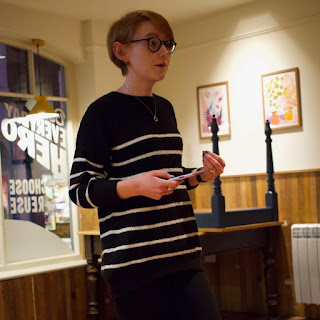


Dr Charley Barnes is an academic and author from the West Midlands, UK. She is the author of several poetry publications, including: A Z-hearted Guide to Heartache (V. Press, 2018), Body Talk (Picaroon Poetry, 2019), Hierarchy of Needs: A Retelling, co-authored with Claire Walker (V. Press, 2020), and Lore: Flowers, Folklore, and Footnotes (Black Pear Press, 2021). Charley has also authored three short fiction releases: Death Is A Terrible House Guest (The Black Light Engine Room Press, 2019), Burn The Witch (The Black Light Engine Room Press, 2020), and Go On A Road Trip (Wild Press Books, 2020). Under Charlotte Barnes, Charley writes crime fiction, including the titles: Intention; The Copycat; The Watcher; and The Cutter (Bloodhound Books, 2019-2021). She has had individual poems and fiction pieces published by the likes of Ink, Sweat and Tears, Riggwelter Press, and Bind Collective.

Charley is the current Managing Director of Sabotage Reviews, the editor of Dear Reader, and a lecturer in Creative and Professional Writing at the University of Wolverhampton. She has spoken and performed at events such as Verve Poetry Festival, Cheltenham Poetry Festival, and Tamworth Literature Festival, where she formed part of a panel to discuss the practicalities of publishing crime for a contemporary readership. Charley was the Worcestershire Poet Laureate 2019-2020. She is now the Writer-in-Residence for The Swan Theatre, Worcester, and their associated venues. When she isn’t writing, she’s likely drinking tea, eating cake, or walking her dog.


From In Conversation with ... Literary Journals

Ambit Magazine

In Conversation with … Kirsty Allison, Editor

Q. We know that your main focus is across poetry, stories and art, but do you ever accept submissions which verge on cross-genre or which are stylistically different to the rest of your publishing aesthetic?

A. Ambit was established in 1959. Past editors include JG Ballard, Carol Ann-Duffy, Eduardo Paolozzi, with early work from David Hockney, Linton Kwesi Johnson, Ralph Steadman. Some of our most radical works are cross-disciplinary.

When I came on board, we started using Poems, Stories, Art as a way of describing Ambit, nodding to the traditions of founder Dr Martin Bax, to offer thirty pages to each of these disciplines per issue. Traditionally, these areas have been headed up by separate editors, overseen by one — and in my mind, progressive literature and art has always occurred where there’s some sort of visionary overlap. I love the Invisible Years series in Ambit, the collaboration between Ron Sanford, Martin, JG Ballard and occasionally Mike Foreman. Culture moves, it is alive, and we are undoubtedly gatekeeping if people want to give it a go — but we are in a very different point to where we began, because anyone can publish their own work now, and that was not possible back when we began in 1959.

What we offer is stories on paper, that’s the core of Ambit. Ambit is a platform for publishing the best literature and art, and if someone chose to submit graphic stories, we’d see it and consider. There are many great artists, poets and writers that start with us — stories take many forms and we’re here to platform the best poetry, stories and art, but that isn’t to deny cross-over. Our only restriction is that we have ninety-six pages in our quarterlies where submission is open to all, and we clearly have an intention with the Annual Ambit Competition, which opened across disciplines for the first time in 2021, and will this year, with a theme as the framework.

Fiction is one way of telling stories, as is art, graphic art, auto-narratives in illustration, etc.  Anecdotes or philosophical questions are where many stories begin, so it’s generally about how well they transverse into black and white using language, the semiotics, these elements across disciplines are what we play with. Lifewriting is a spectrum: if you’re Bukowski or Anaïs Nin your stories are going to be interesting, and for me, that’s what makes a great writer. I had very little to share until I’d lived a bit. It’s not about disruption and colour all the time, but it helps if there’s some mastery. Form is a tool. Speech is a tool. I love these borderlines — where lyric and poetry crossover has been an obsession.


Wednesday, 18 March 2020

"Small Press Publishing: The Dos and Don'ts"

By Isabelle Kenyon


I started writing Small Press Publishing: The Dos and Don'ts because, when I started publishing anthologies at the end of 2017, there were no books or advice columns out there for new publishers. I contacted every single publisher on the Northern Fiction Alliance page (around 50 UK publishers) and offered to work for free, explaining that I had already taught myself a lot about the business, but now wanted to apply that knowledge to a professional team (in a small press, you often do every single part of the publishing process, but ideally, you have the budget to allocate roles and salaries, so I was intrigued to see how this worked). Unfortunately, only two people replied and they said they didn’t have the capacity to take me on.

This frustrated me because I knew I wasn’t a hindrance to their day-to-day activities – I’ve always worked hard and independently. Instead, I just tried harder to work through the legalities of becoming a sole trader, sorting out a distributor, developing relationships with bookshops, etc., myself. A lot of those publishers now book tables from me for the Northern Publishers’ Fair which I organise!

It’s entirely possible to build your own niche within a busy book market. You have to be organised, determined and have a supportive network, who are passionate about the kinds of books you produce. My network is predominately supportive US readers who I communicate with on social media, and book bloggers who give so much of their time to reviewing my titles (thank you!).

With this book, I wanted to help the many who are never given work experience, by talking them through the steps that I have gone down over the past two years. I’ve also interviewed a series of small publishers in various genres because all publishers run their businesses differently, and I wanted to show those varying models.

There is a lot more to succeeding as a publisher, and as a business, than a good idea. You need to maximise your chances of success. In this book, I take the reader through the process of branding, working with authors, the publishing schedule, marketing and distributing and how I started my business. For example, in one section we look at:


Important questions to ask yourself before you launch your press

What is it about your book or your publishing strategy that encourages customers to choose you? For example, I believe that, for Fly on the Wall Press, it’s the quality of the books and the diverse range of voices, which we represent.

As a publisher, you need a very clear idea about what your books represent and why your publishing niche is important in the industry.

Why do you want to open your own publishing press?

What previous work experience will help you to do this?

What qualifications or training do you have, which will help you with your business endeavour?

Which future training courses do you want to complete in order to develop your business?

Especially on a small press level, you are your own best advocate and if people are interested in your books, it is usually because they are interested in you and what you stand for. To begin selling books, you must be able to sell yourself as a business owner. Have confidence in what you are doing and really define what your press represents.


About the book

Small Publishing: The Dos and Don’ts, by Isabelle Kenyon

Start with a good idea.

Set up your own business.
  
Fill a niche in the publishing industry and turn your hobby into a full-time career.

If you feel passionate that you can fill a niche in the publishing industry, but you haven’t managed to get your lucky break so far, this book is for you.

If you have already started running your own online magazine, small press or are publishing your own work in book form professionally, this book is for you.

With interviews from Indigo Dreams Publishing Ltd, HVTN Press, Louise Walters Books, Newfound Journal, Ghost City Press, Broken Sleep Books, Mason Jar Press, Queen of Swords, Neon Books and more.

The book is available from Fly on the Wall Press here.


About the author


Isabelle Kenyon is a northern poet and the author of This is not a Spectacle, micro chapbook, The Trees Whispered (Origami Poetry Press) and Digging Holes To Another Continent (Clare Songbirds Publishing House, New York) and Potential (Ghost City Press). She is the editor of Fly on the Wall Press, a socially conscious small press for chapbooks and anthologies. In 2020, she will be published by Indigo Dreams - poetry chapbook Growing Pains - and Wild Pressed Books (short story 'The Town Talks').

​She was shortlisted for the Streetcake Experimental Writing Prize 2019 and for The Word, Lichfield Cathedral Competition 2019. Her poems have been published in poetry anthologies by Indigo Dreams Publishing, Verve Poetry Press, and Hedgehog Poetry Press. She has had poems and articles published internationally.

She will headline at Cheltenham Poetry Festival  2020 and has opened Coventry Cathedral's Plum Line Festival.  She has performed at Leeds International Festival as part of the 2019 'Sex Tapes' and for  Apples and Snakes' 'Deranged Poetesses' 2019.

​She is a fierce dog lover and a confessed caffeine addict.

Sunday, 21 January 2018

Please Hear What I'm Not Saying

A new poetry anthology tackling mental health issues, Please Hear What I’m Not Saying, edited by Isabelle Kenyon, is to be published in February. Proceeds will go to the charity MIND.


Isabelle Kenyon is a Surrey based poet and a graduate in Theatre: Writing, Directing and Performance from the University of York. She is the author of poetry anthology, This is not a Spectacle and micro chapbook, The Trees Whispered, published by Origami Poetry Press. She is also the editor of MIND Poetry Anthology Please Hear What I'm Not Saying. You can read more about Isabelle and see her work at www.flyonthewallpoetry.co.uk.

Isabelle writes: "I wanted to spread the word about the MIND Poetry Anthology which I have compiled and edited. Please Hear What I’m Not Saying will be available as an e-book and paperback on 8th February 2018. The anthology consists of poems from 116 poets and the book details a whole range of mental health experiences. The profits of the book with go to UK charity, MIND. The book came about through my desire to do a collaborative project with other poets and my desire to raise money for a charity desperately seeking donations to cope with the rising need for its work. I received over 600 poems and have narrowed this down to 180. As an editor, I have not been afraid to shy away from the ugly or the abstract, but I believe that the anthology as a whole is a journey – with each section the perspective changes. I hope that the end of the book reflects the ‘light at the end of the tunnel’ for mental health and that the outcome of these last sections express positivity and hope."

The anthology includes poems by Leicestershire-based writers, including Emma Lee, Sue Mackrell and Jonathan Taylor, as well as writers from the UK, US and elsewhere. 

For more information about the anthology, visit Isabelle's website, www.flyonthewallpoetry.co.uk.

Featured below is one of the poems from the anthology, by the editor herself:


Social Media invented Self Love

I’m not very good at this self love thing.

I always look for strangers,
thinking they could do it better,
and I don’t post about it online,
I forget,
I’m no use,
that girl with the juice blender and the personal trainer is far ahead of me –
that’s why people pay her
to promote beauty products
so other people can buy them
and love themselves too.

Isabelle Kenyon