Showing posts with label Poetry Business. Show all posts

Tuesday, 18 April 2023

Luke Samuel Yates, "Dynamo"


Luke Samuel Yates has published three pamphlets (with The Rialto, Smith | Doorstop, The Philadelphia Institute for Advanced Study), was a Poetry Society Foyle Young Poet on four occasions, and was selected for the Aldeburgh Eight. His first collection, Dynamo, won the 2022 Poetry Business International Book and Pamphlet Prize. He has recent poems in magazines including Poetry Wales, The Rialto, Anthropocene, Ambit and The North, and he has performed at Aldeburgh, Ledbury, Kendal Calling and on Radio 4. A lecturer in Sociology, he teaches and researches political movements, technology, and consumption practices. 


About Dynamo, by Luke Samuel Yates

Dynamo is a collection of poems expressing anxieties about nature, relationships and situations; and meditates on advice from philosophical teabags, men’s magazines, and the city of Birmingham. Over the course of the book, things break down, start again, light up, get stuck. Relationships stagnate, mountains and seas diminish, White nationalists fall over in Blackpool, and a wealthy couple’s house disappears one day, leaving them surrounded by their appliances, tanned and eating an egg. The book has three sections, each of which is actually three chunks of five poems, so the collection builds up in a kind of fractal shape, but you can still read it as you would something which did not do that. 

You can read more about Dynamo here. Below, you can read two sample poems from the collection. 


From Dynamo

Breakdown
 
The engine gave out when we reached the top.
We were on a B road going over the moors.
Horses grazing on their shadows off West
and in the other direction turbines
gesturing like air traffic controllers.
 
You walked down the road for a signal.
Mum stayed in the passenger seat
with the door open, drinking tiny sips of water.
Flies kept landing on her hands and hair.
I wanted to brush them away but didn’t want to startle her.
 
Some way off you found it and called me over.
A swarm the size of a Cantaloupe melon
clinging to the trunk of a hawthorn. A ball
of bees, chocolate and khaki, barely moving
but all pointing in the same direction.
 
A planet of traffic jams. Going somewhere
but also not going anywhere. We watched
as some left and others arrived,
ignoring us, figuring out
what to do next.
 
If only we could work together
to get out of this fix, you said
when we were back on the road,
back on the motorway, with all
the other people, in their cars. 


Song about putting a bird in a pie

 
A relaxed mind is a creative mind,
says my inspiring teabag. Yours advises
to empty yourself and let the universe fill you.
We pick up the empty flowerpot on the road
and a man in a dressing gown eating tomatoes
leans out of a window and demands
 
that we put it back. I ask him if it’s his pot.
Put it back, he shouts. Put it back.
Each smile is a direct achievement,
I remind him. He replies that gratitude
is the open door to abundance.
We carry on walking.
 
We get onto the future.
When should we panic?
Reading the tea leaves, you say that
happiness arrives when we overcome
the most impossible challenge.
Your bag has exploded.
 
You look at things in such a way that you are not
distracted by being looked at looking at things.
The blackbird sings a phrase then repeats it
like a monolinguist talking to a foreigner.
You can’t believe anybody would even
write a song about putting a bird in a pie.
 
The man from the takeaway under my flat
has climbed into his bin to compress
the rubbish in order to fit more in.
He walks from one side to the other
then back again, like an animal
trapped in the hospitality industry.
 

Friday, 24 March 2023

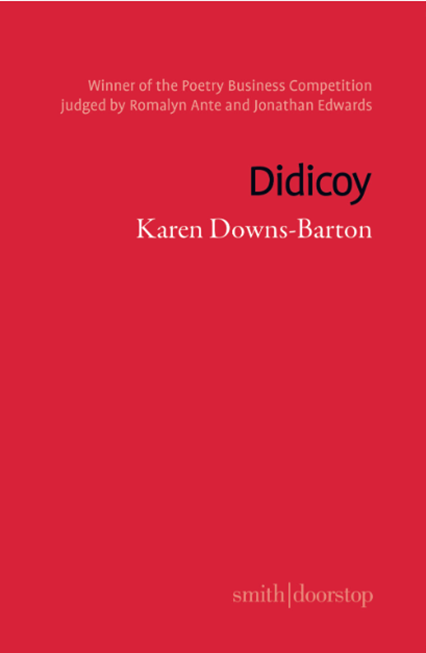
Karen Downs-Barton, "Didicoy"


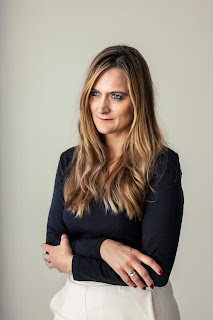
Karen Downs-Barton is an award-winning neurodiverse Anglo-Romani, poet, essayist, and prose writer. After a peripatetic childhood including times in the state childcare system, she now lives in Wiltshire. Karen is the winner of the 2022 International Book & Pamphlet Competition, Cosmo Davenport-Hines prize (2021) and Creative Future silver medallist (2022). She is a PhD candidate at King’s College London, exploring identity and diaspora through minority languages and multilingualism in entertainment industries. Her poetry is widely anthologised, most recently in Wagtail: The Romani Women’s Anthology, and has appeared in translation in Spanish, Farsi, and Russian. Karen’s poems have appeared in The NorthRattle, Tears in the FenceThe High WindowWild CourtInk, Sweat and TearsRiggwelter, amongst others. Her website is here.


About Didicoy, by Karen Downs-Barton 

Didicoy started life as an MA project that had originally been destined to be a collection about the Silk Route. However, during the induction day a lecturer was talking about her recent book about female writers of the 1970s and was asked why one of the writers gave up writing for secretarial work. The response was ‘To put bread on the table.’ I’ve never experienced a room shrinking before but that’s exactly what it felt like. The room shrank to that one statement but not about the writer in question. It shrank to the face of my mother who did what she did to put bread on the table, and the rest is history.  

Didicoy means a half Gypsy living outside the norms of Romani life, and Didicoy is the exploration of my early didicoy life living with my mother in a colourful, if precarious multiracial family. The poems focus on characters at the margins of society bringing their difference into contemporary themes of poverty, diaspora, and chosen identity. My work blends confessional poetics with lyricism and formal experimentation to find new ways to bring in people outside these experiences. The poems harness the sounds, tastes, and sensory delights of eating stolen dog biscuits from paper doilies or watching the ‘professional’ rituals of a mother and the night world she existed within and exploring what it is to belong.  


From Didicoy

Of the Men who Came as Shadows in the Night   

Do you remember the stealthy men   
that knocked at night, whispered negotiations,   
the metal rasp as the chain slid, the door opened. Or when they    
slipped that other world to shadow our days?   
   
They worked in shops Mum scurried past,   
leered from corners, or spilt    
like stale beer from pub doorways. Some spat    
remarks, she’d do her best to explain away.   
   
And always, at that stage,    
we’d move on    
to some fresh place, new start, that was the start    
of the same knocks, same remarks, just recycled.   
   
There’d be a new home, better or worse than the last,    
a new school, friends to make, and a new name   
to grow into, memorised to get it right   
on textbooks. Mum would wait at new school gates   
   
never quite fitting in   
but trying. Once, a policeman picking up children,   
laughed, said he almost didn’t recognise her   
with her clothes on.   
   
And when she said, ‘Not in front of my girls,’ I knew    
we’d be moving again. We were always    
running away from   
something.   


Dear Faye,  
  
ask me   
about the day we were caught stealing   
in auntie Barbara’s dining room  
her posh flat on Streatham Hill  
  
ask me  
about our guilt  
as horrified faces peered under  
the lace edged tablecloth   
and saw an open box  
of dog biscuits   
between us  
  
ask me  
about the bone shapes  
that smelt of Farley’s Rusks  
arranged in coloured rows  
on paper doilies   
  
the pinks were a disappointment   
like blown rose  
petals  
the blacks etched our teeth and tastebuds  
with the grit of fire grate  
ash  

Monday, 8 August 2022

Jackie Wills, "On Poetry: Reading, Writing & Working with Poems"


Jackie Wills has worked for newspapers, magazines and several universities. A former journalist, she’s also worked in business, schools, arts and community organisations, including Unilever, London Underground, Shoreham Airport, the Surrey Hills, the London Symphony Orchestra and Aldeburgh Poetry Festival. She has been a Royal Literary Fund Fellow and run reading groups.

Over three decades, Wills has organised live poetry events and mentored many emerging writers, consolidating her experience in The Workshop Handbook for Writers (Arc, 2016). Her poems feature in several anthologies including Writing Motherhood (Seren, 2017) and Poems of the Decade: An Anthology of the Forward Books of Poetry (Forward Arts Foundation, 2015). Wills has collaborated over many years with visual artist Jane Fordham.


About On Poetry: Reading, Writing & Working with Poems, by Jackie Wills

We begin with a drive to write something that’s never been said before, to protest, to offload, to challenge or catch the zeitgeist. We imagine we write like the poets we admire. Slowly we learn the craft, understanding eventually that a writer’s indentured for life.

Drawing on decades of experience as a poet and tutor, this compelling book is part hands-on guide and part reflection on ways that poetry can make a difference to how we live. It is also a survey of many varied and inspirational writers, especially women poets, especially from the end of the twentieth century. Jackie Wills is herself a brilliantly insightful poets; and, as the sections on writing workshops show, she is also an outstanding teacher. The final section of this unique book offers starting points and resources that will prove essential for new and experienced poets alike.

You can see more details about On Poetry on the publisher's website here. Below, you can read a short excerpt from the Introduction. 


From On Poetry

In the decade I was a mother with young children I bought a calendar with a quote from a poem for each of the 365 days to come. Sometimes reading a couple of lines was about all I could manage but it meant that in the middle of making breakfast, finding shoes under the sofa, combing hair and packing up lunches, I’d hear Emily Dickinson speaking to me from another century and she’d set off a line of thought that walked with me up the hill and down to their primary school. I was juggling writing with earning a living and bringing up children, was often exhausted, but even so, those lines attached to dates were reminders of how lucky I was, and still am, to have the means to read, write, publish. In the old-fashioned way, I stuck some into an exercise book and my homemade anthology lives on a shelf next to my desk holding its pinpricks of thought.

For more than 20 years I’ve sat with groups of people at different stages of their writing lives, experiencing the liberation of metaphor – a child realising they can find words for the other worlds in their head, a man or woman released from the constraints of caring, illness or addiction, from fear of the past and the future, from the demands of work, for an hour or so by listening to a poem and writing their own. Poetry allowed me to do this. And when I read for myself, sometimes flicking through an anthology, sometimes concentrating on a collection for a book group, I am in awe of human invention.

When I began to earn a living running writing workshops, this work kept me reading widely, looking for new poets or poems to use as examples. It focused me on form, on what worked in a poem and it helped me understand how we use the tools of metaphor and language. I used model poems in writing exercises because a mechanic learns to put an engine together by taking it apart. I remembered a big old engine from my Morris Traveller suspended out of its rightful place when the head gasket blew. A poem has to be oily and heavy too. When I embarked on this work, though, I realised how little I’d read. I’ve come to terms with never catching up, but pledged to stretch as a reader. It’s humbling to face this truth about yourself, that however much you think you’ve read, it’s not enough. The flipside is to enjoy the many different ways people express the world, and to accept that there’s some writing you’ll get on with and some you’ll dislike.

Friday, 4 March 2022

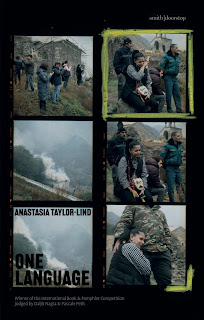
Anastasia Taylor-Lind, "One Language"


Anastasia Taylor-Lind is an English/Swedish photojournalist covering issues relating to women, war and violence. She is a National Geographic Magazine photographer, a TED fellow and a 2016 Harvard Nieman fellow. She writes poems about contemporary conflicts and the experiences she cannot photograph.


About One Language                                                                                                                 

From the perspective of a female photojournalist, these concise but complex and insightful poems draw on first-hand experience of war to explore how damage is generated and perpetuated. The book’s title expresses the contradiction between the lingua franca of photography and the equally universal language of violence. One Language comes to an understanding of personal history and global conflict in poetry that is as immediate and evocative as the most urgent of dispatches.

You can see more details about One Language on the publisher's website here. Below, you can read a sample poem from the collection.


From One Language, by Anastasia Taylor-Lind

Rewind

It’s 9/11 the first time you stay. 
In the morning you bring Taliban poems back to bed.
I drink cardamom coffee and you read their tender lines
‘May you not be hungry in the desert, my dear.’
Their loving as ordinary as mine.

I see wilding men shouldering RPGs 
by the swimming pool of a warlord’s compound 
and think they’re beautiful, watch a dentist 
fall to Earth from an aeroplane rising over Kabul. 

Human payload slipping from the undercarriage,
falling through swipes, scrolls and clicks.
Rewind the tapes, see the little man flying upwards, 
returning to his life, 
rewind the tapes.

Like Bruegel’s Icarus, he touches down with a splash
in a rooftop water tank 4km away, 
his suffering unnoticed except for a casual 
cell phone recording. Twenty years ago, 
the twin towers man fell too, 

twisting and turning, tie fluttering, 
past flames and smoke, for a moment head first 
over Manhattan. Rewind the tapes, 
see the little men flying upwards,
returning to their lives, rewind the tapes.

You and I lie under a marigold embroidered 
bedspread bought in Afghanistan. 
My old friend Tom took me on that shopping trip
in an armoured vehicle with his bodyguard

and I remembered the summer before the end of uni, 
how we sat up late, drinking Jameson, 
listening to Johnny Cash 
and imagining our own deaths, 

together, somewhere in a dusty alley,
all golden light, slow motion and elevated camera angles.
We took it in turns who was doing the dying 
and who was doing the cradling.