Showing posts with label dystopian fiction. Show all posts

Friday, 28 February 2025

Katy Wimhurst, "An Orchid in My Belly Button"


Katy Wimhurst is a writer and visual poet. She has had three collections of short stories published — An Orchid in My Belly Button (Elsewhen Press, 2025), Snapshots of the Apocalypse (Fly on the Wall Press, 2022) and Let Them Float (Alien Buddha Press, 2023). Her fiction has been published in numerous magazines and anthologies including The Guardian, Writers’ Forum, Cafe Irreal, Kaleidotrope, and ShooterLit. Her first book of visual poems, Fifty-One Trillion Bits, was published by Trickhouse Press (2023). She occasionally writes literary essays on speculative fiction and interviews writers for 3AM Magazine. Her website is here. She is housebound with the illness M.E.


About An Orchid in My Belly Button
These short stories savour the surreal, flirt with magical realism, dabble with dystopia. A boy sees the ghosts of dead crabs. A girl with a fox tail is bullied. A disenchanted woman sprouts orchids from her belly button. Fashion models pursue the trend of having plants as hair. Electronic goods amassing all over London herald an apocalypse. Darkness and wonder, the strange and the ordinary, interweave to offer an environmental and social portrait of our times. Guaranteed to evoke a response, whether a giggle, a gasp, or a nervous gulp, these stories will stay with you, enriching your perception of the world.

Surreal, absurdist, magical realist: Katy Wimhurst writes speculative fiction that meditates on our reality. Although bleak themes are examined – dystopian futures, the climate crisis, bullying – a quirky imagination and wry humour lift the tales above the ‘realm of grim.’

An Orchid in My Belly Button is published by Elsewhen Press. More about it can be found on the publisher’s website here. An extract from one story is below.


From An Orchid in My Belly Button, by Katy Wimhurst

Snow on Snow

Snow flutters down in her living room, even though the windows are closed. She blinks. The flakes pattern the carpet into white lace and dust the top of her cacti collection. She can’t afford to heat the flat, so she puts on a woolly hat and curls up on the sofa, tugging a tartan blanket around her. She gazes at the icy miracle. How remarkable! 

When the snow stops before bedtime, she makes hot chocolate and changes into fleece pyjamas. Snuggling under the covers with a hot water bottle, she remembers camping in the garden for a week one December when she was a teenager, sixty years ago; she preferred the quiet, cold tent to the heated rows of her parents. Before she drops off to sleep, the icy tingle on her face tells her more flakes are falling. 

She awakes to a flat carpeted in snow, which reaches a few centimetres up the skirting boards and collects footprints when she crunches over it. Nature has adorned the place festively, even if she hasn’t bothered to put decorations up. She puts on warm clothes, a woolly hat, mittens, a jacket, and boots. Her bones are chilly, but the magic of this arctic interior lifts her spirit. 

Hot porridge warms her. Then, using a pastry brush, she flicks the snow off her cacti collection—the Fairy Castles, Old Ladies, Moons, Stars, Bunny Ears, and Golden Barrels. Her ex-husband said they were like her, prickly but resilient. Worried about what the cold might do to the plants, she wraps strips of hessian around their bases, pricking her finger twice.

With a duster, she wipes the snow off a photo on the wall, revealing her niece and two great nieces in Montreal, Canada; so far away. She doesn’t bother wiping the one of her nephew and his family outside Tate Modern, London. 


Tuesday, 6 June 2023

Jordan Crandall, "Autodrive"


Jordan Crandall is Professor of Visual Arts at University of California, San Diego. He is the author of five books, including Drive, an anthology of his artworks, media installations, and theoretical writings published by Neue Galerie Graz and ZKM Center for Art and Media Karlsruhe. In 2011 he was the recipient of the Vilém Flusser Theory Award for outstanding research in media art and digital culture. Autodrive is his first work of fiction.


About Autodrive, by Jordan Crandall

Autodrive is a work of literary fiction that melds techno-scientific inquiry and storytelling, critical theory and comedy, speculative fiction and satire. It is a road novel of sorts, an odyssey along the highways at a time when a new form of superintelligence has emerged. This new form of artificial intelligence is not entirely distinct from the characters in the narrative — it is ingrained in the machines they already use, the vehicles they already take, the systems they are already part of, but cannot fully see. The human character who is typically at the center of the fictional world gives way to an eccentric cast of performers — an ensemble of people and machines.

You can see more information about Autodrive on the publisher's website here. Below, you can read an excerpt from the novel. 


From Autodrive

City Center West 

There was an accident at the construction site on the north side of the Crosstown. One of the excavation machines knocked a truck off the overpass. It created a huge bottleneck along the frontage road. We had to inch along in bumper to bumper traffic for nearly an hour. 

People were patient at first, but then a few of the passengers started complaining in a way that caused everyone else to start complaining. A strange phenomenon happens in situations like that, suddenly everyone unloads, it releases a feeling of anguish but also excitement. 

Everyone was speaking loudly in order to be heard above the noise. But it was hard to hear anything, you could only pick up bits and pieces of what people were saying. There was talk of accidents, anomalies, irrepressible crowds. A hearse chasing a group of tourists. A delivery truck menacing a passenger van. A parking lot brawl that got out of hand. 

A traveler in the adjoining seat started talking to me. I found it hard to engage with him because he was wearing one of those facepieces that hide your expression. The only part that moves is a mouthlike orifice, a slot over the mouth for eating. Sometimes it snaps open and shut and you expect a voice to come out, but the voice does not come from there, it comes from an embedded speaker that has no relation to the mouth. 

There is a much greater chance of misunderstanding if your face is hidden, I told him. It is better to have a transparent shield, like an astronaut. A bubble is better. 

He started telling me about a mysterious car that was trailing him. A Compiler-type model that did nothing but follow him around. It would pull up to the house and sit there. Park outside the office and wait. He said he could feel it out there waiting for him even if he could not see it—one of those things you just know, like when you can feel someone staring at you without having to turn around to look. 

I asked him if he had any idea of who might be in the car. 

He had the sense that there was no one operating the car. That it was self-determined in some other way. 

What way, I asked him. 

Like the cars in those old road movies, he said. The ones that had no drivers but were self-operated somehow—powered by an unknown force. Limousines and hearses, towncars and trucks that appeared out of nowhere and chased people. Plowed into traffic, mowed down pedestrians, bumped off policemen, slammed into cars. Messengers of catastrophe, he called them. Self-aware, self-willed, superintelligent machines ready to strike, turn on the people they were created to serve. 

A superintelligent machine would not act that way, I told him. It would be more like a conglomerate, more like a corporation than a vehicle. If you want to worry about a malevolent AI, that is what you should be concerned about. Not a machine that is out to get you, but an organization that is. 


Wednesday, 22 February 2023

Reality Is Not What It Seems: My Creative Writing PhD

By Kirsten Arcadio


The philosopher Yuval Noah Harari claims that "our future is in the hands of the social and digital media giants" and decisions are being taken by "a small international caste of business people, entrepreneurs and engineers." Governments have become "managers," he says. They have no vision, "whereas meet the people in Google, in Facebook, they have tremendous visions about the future, about overcoming death, living for ever, merging humans with computers. I do find it worrying that the basis of the future, not only of humankind, the future of life, is now in the hands of a very small group of entrepreneurs" (see Harari’s recent interview with the Guardian here).

Suffice to say, I agree. The idea that new technology will open the door to control of the masses is what propelled me towards pitching a PhD proposal to my supervisor, Jonathan Taylor, in late 2018. After several years writing speculative fiction in what I tend to think of as an amateur capacity, I was ready to take my writing to the next level and this theme had the potential to take me there. I was thrilled to be accepted onto a six-year part-time PhD programme in early 2019 as a result. 

The creative section of my PhD is a novel, Thrown, a socio-political tech-thriller which tells the story of what happens when a computer scientist with an ambiguous past is recruited to build a virtual reality for government services. My creative project uses fiction to examine a possible near-future dystopian scenario where the competing forces of government and online media giants use technology to manipulate society.

The idea of virtual reality is not new. However, the idea that elements of our society may be taken over by virtual and/or augmented reality is much closer than many realise (I believe). In some ways, my thesis is a cautionary tale, in others, a creative exploration. It's based on the idea that government services and virtual reality might one day combine to take complete control of society. My intention was to present this idea in a creative work rather than a factual one. It is my desire - as is the case of many science fiction writers before me - to use storytelling to bring a dry, technological plausibility to life. 

How have I approached this throughout my PhD journey? Fast forward to 2023 and I feel like a marathon runner tackling the last six miles. I’ve drafted a novel Thrown and its accompanying critical reflective commentary. I’ve written all the words … all 100,000 of them in draft form. As a digital communications professional, I’m used to writing and editing. Writing at pace doesn’t phase me. But a PhD is a completely different beast. It’s a journey into my own subconscious, an exercise in perfecting the craft, on contextualising my ideas and developing them in an interesting and engaging way.  It’s a lot - yes, I’ve come a long way, but I’ve still probably got a year’s work left to get to the end of this road. My biggest challenge now is to get the hard-hitting human challenges of my concept across, and indeed, as my novel has progressed, my mind has turned from concept to character. After all, stories are about the journeys we take as human beings and the challenges we have to overcome. Over time, my protagonist and her small crew of friends and (mostly) enemies, have grown with the work. My focus in recent months has turned to the characters’ own journeys, on their hopes and fears, on the stories they tell about themselves, and the ones they want to hide. Thrown is a high concept novel, but it’s also a character study, a journey into the subconscious mind, laid bare by the blurred lines between reality and virtual reality. 

I don’t know what questions readers will ask themselves after reading my PhD. Maybe they might include: to what extent are we already living in a VR? With one foot in an artificial reality, are we already partially "meta" - more about the stories we tell about ourselves than our real selves? Could a VR, therefore, end up being more real than the real world? But whatever the questions the thesis raises, I’m having fun writing it. 


About the author

Kirsten Arcadio has written three novels, each with a different speculative theme, Borderliners, Split Symmetry and WorldCult. Her fourth novel, Zeitgeist, is a coming-of-age adventure set in Germany against the backdrop of the fall of the Berlin Wall. She’s also a part-time poet, digital communications nerd and frazzled head of an Anglo-Italian family. After working for over fifteen years in digital communications, she returned to her twin first loves, literature and philosophy, in 2011. She’s passionate about the big questions in life and how these can be explored using speculative fiction and, to this end, has been working on a PhD in Creative Writing since 2019. When she’s not writing she’s obsessing about science fiction, she loves all things Italian, including her husband, and she once taught English in the Italian senate.


Wednesday, 3 August 2022

Peter Kalu, "One Drop"


Pete Kalu writes crime fiction, scifi and YA novels. He also pens short stories in styles ranging from realist to surreal to the carnivalesque. Until recently, he ran a carnival band called Moko Jumbies. More on his website here and on Twitter @peterkalu and Instagram @petekalu.


About One Drop, by Peter Kalu

One Drop is  Malcolm X meets George Orwell: a dystopian novel that looks through eyes of two black teenagers – Axel and Dune – at what might happen if demagogues gained power and used technology to crush resistance. In war-torn Britain, inseparable Black Radicals Axel and Dune are arrested. With SIMs implanted in their heads, they are placed in a prison camp for those who defy the Bloods’ white supremacist government. The SIMs start brainwashing them with the Bloods’ evil philosophy, and drones constantly monitor their movements and thoughts. 

In this living nightmare, the couple battle to keep their love alive and to break free. The odds on survival are long. Dune and Axel have very different takes on how to escape. But when things come to a head, will their love hold them together and set them free, or will it tear them apart?

Below, you can read a short sample from One Drop.


From One Drop

The London Wind

The London wind had got up and was blowing bomb smoke from the south, from far beyond the fences that held us in. The smoke was a wall, maybe half a mile high and wide enough to blow across the entire prison camp, which it did. Soon we were choking in it. I wanted to duck down but Dune said ‘No, let’s stay out.’ 

So we gauzed up our mouths and noses and sat there, squinting, letting it blow over us. It surged on, tugging in its wake everything that had been trapped within it, and lifting up new stuff. Cinder from the cooking fires, rust from burned-out cars, bits of plastic, rags, a fugitive wanted poster. The smoke storm hurtled along, carrying alarmed cries from the tent zone and the screeches of birds that were pulling away before the rolling wall of smoke. 

We held onto each other, me and Dune. It blew over fast. No longer than twenty seconds. When I slipped off my gauze, I saw Dune was twitching, the pupils of their eyes flexing, and their limbs stiffening.

 They nudged me. - I think I’m fading, the drones are gumming me again.

- You’re not. You’re right here. 

- No, I can feel it, Axel. They’re at  me. They always coming for me.

- C’mon, Dune. We lickle but we strong, right?

- Don’t joke. I know they’re gumming me. Remember me, Ax. If I’m totally gummed. 

- OK.

- Remember me, Ax.

It was one effect of the gumming. The repetition.

- You’re OK. It’s passed.

I could see it had passed. Dune was OK. Shaken but OK. 

- Am I?

- Watch.

I put Dune in a headlock the way they loved, and they laughed and pretended to struggle, squirming and bucking and laughing into my halter top all at the same time.

I didn’t know it then but soon Dune would be gone and that would be the last time I headlocked them. Right now, their legs were kicking, their hips jerking, their lips rubbing the cotton straps at my collar bone, their Afro tickling my chin. 

- No way can you wriggle free, I got moves on moves!


 gif by Akinyemi Oludele, inspired by the book


Friday, 7 January 2022

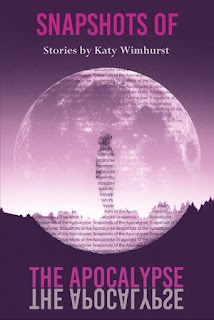
Katy Wimhurst, "Snapshots of the Apocalypse"


Katy Wimhurst’s first collection of short stories, Snapshots of the Apocalypse, is published by Fly on the Wall Press. Her short fiction has appeared in numerous magazines and anthologies including The Guardian, Shooterlit, Cafe Irreal, Ouen Press, Fabula Press, and Magic Oxygen Literary Prize. Her visual poetry has been published in The Babel Tower, 3am, Ric Journal, Steel Incisors, Trickhouse Press, and others. She studied social anthropology (and Mexican Surrealism at postgraduate level) and has worked in teaching and publishing. She lives by a pretty river, adores trees, and suffers from the neuroimmune illness M.E. Her website is here.


About Snapshots of the Apocalypse 

In these dark, witty short stories, Katy Wimhurst creates off-kilter worlds which illuminate our own. Here, knitting might cancel Armageddon. A winged being yearns to be an archaeologist. Readers are sucked into a post-apocalyptic London where the different rains are named after former politicians. An enchanted garden grows in a rented flat. Magical realism meets dystopia, with a refreshing twist.

More about Snapshots of the Apocalypse can be found on the publisher’s website here. Below, you can read an excerpt from one of the stories. 


From Snapshots of the Apocalypse, by Katy Wimhurst

Min despised the Tate Art and Refuge Centre. It contained little art and more refuse than refuge. She’d been approached by pimps in the café there, had witnessed fist-fights over chocolate, and had once seen an artwork used as a frisbee. But today, staring at the empty food cupboard in her squat, she knew she’d have to go there if she wanted to eat.

“Shit,” she muttered, slamming the cupboard door.

Cursing the guy who’d yet again failed to deliver the bootleg goods, Min grabbed her bag and slung on her black PVC cape and beret. She then padlocked her squat’s front door and marched down the long staircase.

On the ground floor, the sign on the wall read: THE ROYAL COLLEGE OF  URGEONS. If anyone asked ‘what she did’ these days, she said she was an ‘urgeon.’ A reasonable word, she thought, for how she kept urging herself on despite the relentless crap around – and indeed within – her. Fortunately, few asked her ‘profession’ these days. Had it really taken an apocalyptic world to end small talk?

The former Reception area was dusted with cobwebs, its blue carpet muddy with footprints. Min still recalled her first visit to this place years ago as a medical student, but she tried not to think of the past. That was a different era, before the floods and chaos, and she’d never finished her studies, anyway. It’d been how she’d known about this place though, and why she’d come here to hide when her flat near Tottenham Court Road had burnt down in a riot ...


Tuesday, 8 May 2018

Creative and Critical Digressions: On the Creative Writing PhD

By Paul Taylor-McCartney


I’m now a third of my way into a six-year part-time PhD in Creative Writing with Leicester University, working on a 50,000-word dystopian novel, entitled The Recollector, with an accompanying reflective commentary of 20,000 words exploring the function of memory and identity in works from across the genre, including my own. Ask any part-time doctoral researcher about setting aside some dedicated time to study and they’ll tell you it’s a slow-burn process – a little and often should do it. Indeed, taking a measured approach to formulating, creating, revising and continually reviewing sections of material, whilst receiving objective but supportive tutelage from an expert supervisor, comes with its challenges, but also a wealth of opportunities to explore and ideate to the heart’s content. 

For example, it’s taken the whole of my first year to get anywhere close to settling on an appropriate register for the creative piece. Third person - second person - then finally choosing first person and locating it entirely in the present tense. The course requires me to balance creative and critical interests, meaning I’m pursuing a range of digressionary journeys away from the core material, but each one actively deepening my appreciation of the processes and discipline required to achieve at this new level. A panel seminar at last year’s NAWE Conference has become an academic paper due to published later this summer. Last month, I returned to painting and the easel to create miniature canvasses to help define the sombre mood of my text’s dystopian setting - a setting in which the majority of the population suffer memory issues in one form or other, with a staggering rise in dementia cases. Elsewhere, drafting confessional poetry is helping sharpen the voice of the text, and I’m currently re-figuring the opening section of the novel as an installation piece for a small gallery in New York. This alone is asking me to re-engage with my previous performance work as both theatre director, actor and musician.  

At another extreme, I’m planning on producing a paper version of The Recollector using an antique 1930s Olivetti typewriter, in line with my protagonist’s need to avoid committing his memories to electronic devices of any description. 


Some may consider these various digressions unnecessary and even vain enterprises. For me, a PhD in Creative Writing is not simply about completing a full-length study suitable for publication across its creative and critical elements – although that is ultimately one criterion against which I’ll be measured. It is, more crucially, proving to be a fully-immersive exploration of the artistic process in its entirety, spiralling outwards from a central conceit – and the greatest expression of my writing career to date.     


Friday, 1 December 2017

Dystopian Workshop, Hosted by the University of Leicester Creative Writing Society

By Xenophon Kalogeropoulos


Remember, remember the ... 28th of November? Probably, because that is when we hosted our first workshop based on dystopia in collaboration with the David Wilson Library of the University of Leicester. And yes, true to the theme of dystopia, I started this article with a V for Vendetta reference.

 About two months before that important date, we were approached by the university library with a very interesting proposal. Since we are the Creative Writing society, they asked us if we would like to deliver a comprehensive workshop based on dystopia in the spirit of this year’s Read at Leicester project, which placed Naomi Alderman’s The Power - you guessed it: a dystopian novel - in every student accommodation of our university. This proposal was within the wider spectrum of getting people interested in reading, but also writing, with the first workshop’s theme being that of dystopia. We couldn’t have agreed more and so we began planning from the beginning of October. 

On the 28th November it was our brave secretary who took it upon himself to lead the session (yes, the same secretary who is writing this article and is definitely not biased in the descriptions of himself!). Attendance was good with many people attending who were not necessarily part of our society. 

We began from the ground up, starting with the basics of constructing a dystopian world, identifying what went wrong in that world, how did it affect the people in it, what its rules and antagonists are and finally, our main character(s). We tried to make the workshop as interesting and interactive as possible by asking our audience what their definitions of a dystopia were and what examples of dystopia in novels, film, games and popular culture they could find. They were amazing and identified many of the popular dystopian stories (1984, A Brave New World, Hunger Games, etc.) but they missed Children of Men. How can one miss Children of Men? As I mentioned when presenting, “CoM is a textbook dystopian story”:it contains all the elements of a dystopia as if the scriptwriters were checking them off a list. In fact, a lot of the workshop was built around following Children of Men’s structure and ways of going about delivering the cinematic experience of a dystopia.

All throughout the workshop we tried to encourage moving away from the established notions of what a dystopia is like, into more original territory (for example, we advised them to try and create a dystopian world that isn’t dark, completely industrialized and polluted, but rather sunny and green, for a change). Towards the end of the workshop we had a whole slide dedicated to dystopian clichés and avoiding them (e.g.: the antagonist is always a plutocratic, autocratic Big-Brother government of some kind), and that was when the audience roared up and intimidated me when I tried to criticize the Hunger Games! A dedicated fanbase indeed …!

Finally, we all took part in a writing task which would have each group (the audience was seated in specific tables-groups) try to create their own dystopian world based on what they had learned throughout the presentation. Each table presented us with amazing dystopian worlds like one where men were the minority after a major war and they were revered as god-like beings by women who were the majority and had replaced them in almost every way… Happy stuff...! 

After all was said and done, we shared with our audience a small literary competition we are hosting as a society which called for the submission of 3000-word dystopian short stories by the 5th of December, with the prize of a possible chance for publication and (what everybody likes) a £10.00 Amazon voucher.

All in all, it was a very interesting and enlightening experience for all involved and, we believe, everyone left equipped with all the necessary knowledge of how things could go wrong at any given moment ... Now, we’re waiting for the submissions for our competition to see how our creative audience chooses to employ all they learned with us at the workshop. 

For further details about the competition, including the rules, please email the society: su-creativewriting@leicester.ac.uk


About the writer

My name is Xenophon and I am from Hellas (Greece), on my second year of study here at the university. I am quite interested in history and writing and I like to see myself as an aspiring writer. Presently, I am serving as Secretary in the Creative Writing Society of the university, regularly leading creative writing workshops on a range of themes and literary genres.