Showing posts with label PhD in Creative Writing. Show all posts

Tuesday, 29 July 2025

Laura Besley, "sum of her PARTS"

Congratulations to Laura Besley, University of Leicester PhD student and MA Creative Writing graduate, whose new collection, sum of her PARTS, has just been published by V. Press!


Laura Besley (she/her) is the author of Sum of her PARTS, (Un)Natural Elements, 100neHundred – shortlisted for the Saboteur Awards – and The Almost Mothers. She is an editor with Flash Fiction Magazine and runs The NIFTY Book Club - a monthly online book club wherein participants read & discuss novellas-in-flash. Currently, she is a Creative Writing PhD student at the University of Leicester. Having lived in the Netherlands, Germany and Hong Kong, she now lives in land-locked central England and misses the sea. Her website is here.    


About sum of her PARTS, by Laura Besley
sum of her PARTS is a collection of 30 micro pieces, each exactly 50 words with a one-word title. They explore female body parts and how they are used and abused by those around them, as well as celebrated.  

You can read more about sum of her PARTS on the publisher's website here. You can read a review of the collection on Everybody's Reviewing here. Below, you can read two sample pieces from the collection. 


From sum of her PARTS

solitary

most days
I like
living alone, 
no one 
to moan
about my
lack of 
culinary skills
or clothes
strewn around; 
only when 
a robin - 
breast aglow - 
frolics in 
a birdbath
or I
almost choke
on a 
piece of 
molten cheese
on toast
do I 
regret certain 
decisions made
long ago.


bold

It's an hour before sunrise when I wake and discover I've turned into a trombone, my body shiny-sleek. I try out my new mouthpiece, a short shy toot at first. Subsequent blows grow in length and volume until I am blaring, brass-band loud. This is my voice. Hear me. Listen. 


Thursday, 4 July 2024

Run Your Tongue: Spoken Word Night

By Rob Reeves


My friend Bethany Patience started Run Your Tongue in 2012 in Kettering, but it was rather short-lived after we both moved away. I then spent six months in Paris, where I began performing at a spoken word night. When I returned home, I missed performing regularly and decided to start RYT back up in Kettering, following a similar format to the night in France. We moved to the Three Cocks Inn, which was home to us for over five years. We had some great nights there with headliners such as Atilla the Stockbroker, Jess Green and Jonah Matranga.  

During the lockdowns of 2020, I began to hold Run Your Tongue online, which allowed me to connect with poets from all over the world. When we were able to have live events again, I asked Rosa Fernandez to become my co-host, and we moved to an art gallery in Leicester for a year before settling at our current home at Watson’s Cocktail Bar on Granby Street, Leicester. We’ve welcomed a couple of poets we met during the online Zoom days to headline in real life: Jeff Cottrill all the way from Canada and Clive Oseman all the way from Swindon.

The Leicester poetry scene is really thriving, and there are some great other nights, each with its own flavour. Word! is the most well-known and longest-running, Some-Antics is a really fun and popular night, and Get Mouthy is a great new night at the Big Difference. In fact, last month, Word! invited a host from each of the other nights to headline at their event. The whole scene is really supportive and collaborative. We try to make sure our events don’t clash, and we always try to support each other’s events when we can.  

We try to make RYT welcoming and don’t take ourselves too seriously, which I hope helps people feel at ease. I know how hard it is to get up and perform – I used to be absolutely terrified of public speaking and would avoid it at all costs, so I know that just getting up on stage is a win. I always say that anything goes at our events as long as it involves words. While most performers read and perform poetry, we also welcome comedians, singer-songwriters and storytellers. It’s a great place to try out new material to a welcoming crowd.

I always wanted to keep RYT accessible to all, so it’s always been pay-as-you-feel. However, we still believe in paying our headliners, especially if they have come from further afield. Everything we take on the door goes to them, and we also hold the world-famous Rob’s Raffle in the hope of raising a little more. Sometimes it’s difficult to balance paying our headliners with making the night accessible to everyone, but we somehow have made it work for over a decade.

Our events are usually on the first Thursday of the month, but we are holding them bi-monthly until the end of the year. We have an extra event in October with Cathi Rae, and there might even be a special event in the summer.  

The night has taken many forms over the years in various venues, and even when it takes a break for a while, it always returns. I’m really proud of the night, and I know that as long as people keep coming down, I’ll keep putting it on.   

If you’d like to stay updated with events, please follow our Instagram and Facebook pages. Our next event is with Ciarán Hodgers on Thursday, July 4th. 


About the author
Rob Reeves is a poet and musician based in Leicester. Rob started writing poetry in 2012 while taking his MA in English at the University of Leicester, where he is now studying for his PhD in Creative Writing.


Monday, 1 July 2024

Cathi Rae, "Just This Side of Seaworthy and Other Poems" and "Rock, Paper, Scissors and Other Poems"

Congratulations to UoL PhD Creative Writing student Cathi Rae, who has just published two new poetry pamphlets!


Cathi Rae is a poet, spoken word artist and educator. She is currently in the final stages of a practice led/creative PhD at the University of Leicester, where she was also a graduate of the MA in Creative Writing. She has performed throughout the UK, including readings at Womad Festival, The Houses of Commons, Chiltern Arts Festival and many spoken word and poetry events up and down the M1 and M6. She has just published two new pamphlets of poetry with Two Pigeons Press: Just This Side of Seaworthy and Other Poems, and Rock, Paper, Scissors and Other Poems. You can read about these two new collections and a sample poem from each below.  


About Just This Side of Seaworthy and Other Poems, by Cathi Rae
Just This Side of Seaworthy and Other Poems is a pamphlet collection which explores ageing, ageism and how older people navigate the world. It challenges the ageist notions that older people have less validity or become invisible.


From Just This Side of Seaworthy and Other Poems

Just this side of seaworthy

I could be  you
another older woman    our bodies bearing 
one carefully cherished child

just the one
no time to make another
no time to try again

I was akin to you     almost kin to you
recognising this stony skerry
where you stand                washed up
I too have swum these currents

tides that trick and tease
entice you on towards the shore

I feel your           unsteady      steps
across a beach
a beach in name alone
black blasted rock ground down to grey
 
somehow 
I avoided this      this destination    this depression
with frantic paddling     bailing out
keeping my head above the water
watching you and those like you
who submerged beneath the sea 
and emerging
found themselves      sea changed

the boat    the tides    the landing
repeat    repeat        repeat
a life on endless loop
your coracle
just this side of seaworthy
crafted from a faded photograph

gives up the ghost and floats in-land
oars that drop and drift away


your gasping    grasping breath 
presence of pain    still presence of a sort
knocked backwards   you attempt to stand again

fingers clutch at the last remaining 
half remaining    almost-memory  of     croft  wall
grip slipping on moss slick stone
peering out to sea     myopic     in mist that never lifts
cataract-vision 

and on this chain that reaches back
to meet the mainland
I’m standing on another island
larger     the trees a little taller 
hints of green and growth
holding on
hoping     knowing    
that this must pass.


About Rock, Paper, Scissors and Other Poems, by Cathi Rae
Rock, Scissors, Paper and Other Poems is a taster selection from my PhD work, a collection of poems based on conversations and interviews with individuals who shared their lived experience with me.

From Rock, Scissors, Paper and Other Poems

Brick Dust

You tell me about the brick fields 
where red dust earth and red brick dust become impossible to separate 
and paint the little boys in red dust too 
little boys who work for food 
and you tell me what happens to little boys who work for food 
and now I can’t unknow that 
You tell me about the onion factory 
where you peeled skins and were in turn 
unpeeled yourself 
and as we talk I’m crying onion tears 
and I try to keep the sobs inside and silent 
as you too must have done when you were small 
You tell me about the coming here 
boys packed into room too tight 
to house so many bodies 
you sent that hard-earnt money home 
planned triumphant returns full pockets and a sharp new suit 
until one day home was here but never truly here and no longer there 
You tell me about marriage love and madness 
times when you were racked with shame 
but didn’t have the words to name the fears in any language 
but Djiin or ghost seems closest 
the boy you used to be 
still haunts this broken self 
You tell me about love 
your wife become a tree in whose shade you hide 
shelter from a burning sun and later still the British rain 
your children never hungry safe you say and loved 
their lives a world away 
from red dust brick dust onion peeled boys

Friday, 29 March 2024

Spring News from Creative Writing at Leicester

It's been a few months since our last news post (which you can read here), so we thought it was time for an update, now we're at the end of the Spring term. There are some great news stories to share from Creative Writing and the Centre for New Writing. Wishing everyone a great Easter break!


General News from Creative Writing at Leicester

There have been some great events, guest talks and masterclasses at the University over the last few months. You can read about some of them here - and there are still more to come next term. Do take a look.

As part of this year's amazing Literary Leicester Festival, we ran our third annual Creative Writing Student Showcase. It was a lovely event, featuring brilliant readings from BA, MA, PhD Creative Writing students and graduates, including Beth Gaylard, Grace Klemperer, Hannah Mitchell, Lisa Williams, Kathy Hoyle, Jack Peachey, Laurie Cusack, Daneil Hibberd, Tracey Foster, Rob Reeves, Isobel Copley, Alexander Osani, Oleksandra Korshunova and Laura Besley. 

The final results of the "Nature, the Environment & Sustainability" Short Story Competition were also announced at Literary Leicester Festival. Congratulations to joint winners Lee Wright and Sophie Sparham, as well as Alice Newitt who was specially commended, and runners-up Sam Dawson and Carol Rowntree Jones. Joint winner Lee Wright is a current PhD in Creative Writing at the University of Leicester, and Sam Dawson is one of our MA Creative Writing graduates. You can read about the final results on Creative Writing at Leicester here.  

Congratulations to Creative Writing graduates Sam Bouch, Matt Walton, Nina Walker and all those involved in the writing and publication of the inaugural issue of Amateur Hour, a zine of poetry and prose by members of the eponymous writing group in Leicester. You can read more details about the zine on Creative Writing at Leicester here

Thank you to all the Creative Writing students and graduates, Kristy Diaz, Georgia Sanderson, Kathy Hoyle, Laura Besley, Hannah Mitchell and Grace Klemperer, all of whom came to talk to our External Examiners, Chris Jones and Karen Stevens, on Monday 18 March. It was a really insightful and fascinating discussion. 

Recently, our review website Everybody's Reviewing passed 375,000 readers and Creative Writing at Leicester is about to hit 250,000 readers. Our Facebook group has over 1,600 members. Thanks to all our contributors, authors, reviewers, editors, members, designers and readers! 


Student News from Creative Writing at Leicester

On Tuesday 23 April, PhD Creative Writing student Joe Bedford will be appearing at Waterstones Cardiff, and again on Wednesday 24 April at The Tabernacle, Mumbles (Swansea), promoting his novel A Bad Decade for Good People (Parthian Books, 2023).

MA Creative Writing graduate Laura Besley's story, "Conditions for Living," has recently been published by Gone Lawn here

MA Creative Writing graduate Constantine is continuing his work as editor and co-founder of Coalville C.A.N. Community Publishing. The organisation is a resource for local writers, with special consideration given to neurodiverse and disabled writers and those from under-represented backgrounds. You can read a blog by Constantine here and can view Coalville C.A.N. Community Publishing's website here.  

PhD Creative Writing graduate Laurie Cusack has had a beer (6.5%) named after his book, The Mad Road. The beer was sold at the Ale Stone Pub on Aylestone Road, Leicester, over Christmas. Proceeds went to the Emerald Centre in Leicester. Cheers, Laurie!

MA Creative Writing student Kristy Diaz will be co-authoring An Untold History of UK Emo (working title), to be published through independent record label Big Scary Monsters, anticipated release in 2025.

Congratulations to PhD Creative Writing graduate Tim Hannigan, whose book The Granite Kingdom was shortlisted for the Edward Stanford Travel Book of the Year 2024.

Congratulations to PhD Creative Writing student Kathy Hoyle whose story "Cockleshell Girl" is published in South Florida Poetry Journal here

Congratulations to MA Creative Writing graduate Tionee Joseph whose work was featured at the International Working Class Story Festival at Upstairs at the Western and online on March 23rd-24th. The festival was a showcase of talent from working-class artists and academics in the UK, USA and Australia.

Congratulations to Grace Klemperer, BA English with Creative Writing student, who performed her poetry at the "Run Your Tongue" open-mic poetry evening in Leicester. This regular open-mic poetry evening is run and compered by PhD Creative Writing student Rob Reeves. 

Congratulations to Creative Writing graduate Amrita Manku, whose play The Incident was performed at the Discovery Showcase Event at The Curve Theatre in Leicester on Friday 1 March. You can see more details here.

Amirah Mohiddin, PhD Creative Writing student, recently presented a conference paper at the Historical Fictions Research Annual Conference (2024), in Malmo, Sweden. Her paper was entitled "A Thousand and One Nights Meets Morocco’s Fight for Independence in a Historical Fantasy," and explored how Young Adult fantasy can be a powerful mode to decolonise history. The paper is linked with her practice-based research, where she is writing a YA fantasy novel interrogating storytelling as a mode of heroism and salvation. You can read more about Amirah's PhD here

Congratulations to PhD Creative Writing graduate Karen Powell-Curtis, whose poem "Mary Wilson" has been published in the new issue of Allegro Poetry Magazine. You can read the poem here.  

Congratulations to PhD Creative Writing student Jane Simmons whose poem "The Poet Writes an Abecedarian for her Maiden Aunt" won third prize in the Mslexia Poetry Competition

Congratulations to Charlie Wilkins, MA Creative Writing student, whose latest novel, History Is a Haunted House, was recently published. You can read more about it here


Friday, 1 December 2023

Laurie Cusack, "The Mad Road"

Congratulations to Laurie Cusack, University of Leicester PhD Creative Writing graduate, whose debut collection of short stories, The Mad Road, has just been published by Roman Books, as part of its Stretto Fiction series!


Laurie Cusack (PhD) hails from Leicester. He studied Creative Writing at Leicester University. He writes from the gut −  The Mad Road is published by Roman Books, and is his debut collection of short stories. The stories were first drafted as part of his PhD thesis at Leicester.


About The Mad Road, by Laurie Cusack

The Mad Road is a collection of short stories that deals with raw Irish experience in a ‘Fairy Tale of New York’ meets Trainspotting sort of fashion. There is a comic-toughness about Cusack’s narratives that keeps you turning the page. They are working class in nature and aren’t for the fainthearted. 

You can read a review of The Mad Road on Everybody's Reviewing here. Below, you can read an excerpt from one of the stories. 


From The Mad Road

Usher’s Well

“Do you want the shamrock on the cream, Davey?”

“What?”

“Brewery directive.”

“Just give me the fucking drink, Hughie.”

“We’re like Sainsbury’s now. We have to ask.”

“Brand Ireland, eh?”

“Now you said it.”

It was just the two of them in The Angel. For the last fifteen years, Hughie O’Connor had been the landlord of the Irish pub tucked in the back streets of Hackney. Traditional music often thrived within its walls.

“Was I missed?” Davey Murray whispered, trying to gauge Hughie’s mood.

Hughie gave his old friend an odd look followed by a shrug. He liked order, liked being kept in the loop. He kept a tight rein on things; a no messing policy; barred meant barred. No early-doors; no late ones. But Davey was the exception to his rules. Hughie often wondered why. Maybe it was because they had been on the shovel together during Hughie’s early days in London. Demolition. Dusty and dangerous work. And most of their wages went on drink in and around the pubs of Cricklewood.

“There were a few asking for you, come to think of it.”

Davey hadn’t shown his face for ages. Unusual. Not a sight or a whiff of him. Hughie had scratched his head a good few times during the past few weeks.

“Look… I had to split, alright?”

“Going off grid is a mortal sin, nowadays.” 

“Am I daft or stupid, Hughie?”

“Now − that, might take a long time to answer, Davey.”

“Ruffled a few feathers?”

“You could say that.”

“Who?”

“Your manager − coming in here, making a show, Where’s the fucking bollix?”

“Eejit.”

Davey’s manager, Rory Higgins, was a character who handled Irish, showbands and other novelty acts. The Impresario of Kilburn High Road − that was what they called him. He had the knack for smelling money. He was always bucking the trend. Davey would still be busking tube stations if Higgins hadn’t chanced upon him ...

Wednesday, 12 July 2023

Tim Hannigan, "The Granite Kingdom: A Cornish Journey"

Congratulations to UoL PhD English and Creative Writing graduate, Tim Hannigan, whose book The Granite Kingdom has recently been published by Head of Zeus!


Tim Hannigan was born and brought up in the far west of Cornwall. After starting his working life as a chef, he eventually made it to the University of Gloucestershire to study Journalism, after which he moved to Indonesia where he began his writing career as a travel journalist. His first book, Murder in the Hindu Kush, was published in 2011, and he subsequently wrote several books on Indonesian history. In 2016 he started work on a critical-creative PhD at the University of Leicester, supported by the Midlands4Cities DTP. This project produced his book The Travel Writing Tribe, published by Hurst in 2021. He lives in the west of Ireland and combines his writing with part-time teaching roles at the Technological University of the Shannon and the University of Hull. His website is here


About The Granite Kingdom

From Daphne du Maurier to Doc Martin, and from the romantic melodrama of Poldark to gritty TV depictions of the modern fishing industry, Cornwall is densely laden with images, projections and tropes. But how does all this intersect with the real place, its landscapes, histories, communities and sense of identity? In The Granite Kingdom, Tim Hannigan sets out on a meandering, 300-mile journey to find out, travelling on foot from the banks of the River Tamar to his childhood home near Land’s End. 

Combining travel writing, memoir, history and literary criticism, the book explores the varied landscapes of Britain’s westernmost region and grapples with the complex idea of Cornwall itself – a cosy English seaside destination for some, a fiercely independent Celtic nation for others and one of Britain’s most impoverished post-industrial regions for others still. It considers the way literary narratives from without have sometimes informed identities from within – including the author’s own – and asks awkward questions about what it means to be “Cornish” in the twenty-first century.

Below, you can read an excerpt from The Granite Kingdom.


From The Granite Kingdom, by Tim Hannigan

Chapter One: Bordering

If you stand at the threshold of Number 2 Cyprus Well, you have a choice. It is the middle cottage of three in a little terrace facing a bank of sycamore saplings on a steep lane called Ridgegrove Hill. Above the single ground-floor window, a plaque records that ‘Charles Causley, Poet’ lived here from 1952 to 2003. They might have added the word ‘Cornish’ to the description, for that is the adjective most commonly associated with Causley. And indeed, he lived in Cornwall – right here in Launceston, in fact – not just for fifty-one years, but for almost his whole life. 

But if you stand at the threshold of Cyprus Well and turn left, you can see Devon. 

It shows beyond the point where the lane bends downhill: a gathering groundswell of trees and pasture. From the doorstep of Causley’s cottage, it seems natural to turn that way, to go with the flow. At the bottom of Ridgegrove Hill you’ll meet the little River Kensey. Within a mile, the Kensey will carry you to the Tamar, and the Tamar will bear you away south, between dark woods to the grey docks and end-of-terrace pubs of Plymouth, with the busy waters of the English Channel beyond. But if it’s Cornwall that you want, then you have to turn against gravity, against nature, pull steeply up Ridgegrove Hill then on up Angel Hill to pass, breathless, beneath the fortified arch on Southgate Street. And if it’s a decent prospect to the westward that you’re after, you’ll need to cross to the other side of Launceston and climb the motte of the castle. 

On a midsummer morning, I stood on the pavement outside Number 2 Cyprus Well. It was early, and up the hill Launceston gave off the faint hum of a small town readying itself for the working day. To the east, the valleys were liquid with yellow mist. A few intersecting ridges rose above the flood, trees and hedges in dark profile. But it wasn’t clear to whom they belonged. I glanced left and right, fiddled with the straps of my backpack, looked at the map. Then I turned downhill, into the mist ....


Thursday, 30 March 2023

Joe Bedford, "A Bad Decade for Good People"

Congratulations to Joe Bedford, University of Leicester PhD Creative Writing student, whose debut novel, A Bad Decade for Good People, is going to be published by Parthian Books in June 2023!


Joe Bedford, photograph by Deborah Thwaites


Joe Bedford is an award-winning author from Doncaster, UK. His short fiction has been published widely and has won numerous prizes including the Leicester Writes Prize 2022. He has an MA in Creative Writing from Lancaster University, and is currently undertaking a PhD at the University of Leicester. A complete history of his publications and awards, with links to published stories, is available on his website here. His debut novel A Bad Decade for Good People is available to pre-order now here.


About A Bad Decade for Good People
This is a fiercely hopeful novel about family, sexuality, grief and how we as individuals can rediscover our political agency in the face of continued uncertainty.

Brighton, 2016. Laurie wears the scar given to her by a policeman’s baton as a mark of pride among her circle of bright young activists. Her conscionable but sensitive brother George should be a part of that circle, until the appearance of enigmatic Spanish migrant Antonio threatens to divert him from his sister’s world of marches and moral accountability.

As the clouds gather over Brighton and the EU referendum accelerates both Laurie’s political zeal and Antonio’s ambiguous desires, George is faced with the fact that their city of parties and protests is suddenly a place where the possibility of saving the world – as well as the people around him – is in jeopardy of being lost forever.

At once a letter of support to everyone disillusioned by British politics, and a deeply perceptive snapshot of modern relationships, A Bad Decade for Good People is a captivating state-of-the-nation tale that begs the question: when it feels like the world is falling apart, how do you keep those you love from doing the same?


From A Bad Decade for Good People, by Joe Bedford
If the policeman’s baton had found Laurie half an inch lower she would be blind in one eye. Instead it left her with a long, crescent-shaped scar, which she wore like a medal, never hiding it and never knowing how it made my stomach flip. Every time I saw it I had to shake off the memory of her blood running down over her eyelids and onto her jacket, and afterwards the stitching and the gooey rivets it left behind and the halo of yellow bruising that hung around the socket for weeks. 

Her scar was all I could see while she pleaded with me by the side of the road, until we were lit in the headlights of Dad’s car and then running, slipping, gripping each other’s clothes in the ditch. I remember the sound of Dad’s voice carrying over the hum of the engine, the faint warmth coming through Laurie ’s jacket as she held me, the smell of mud and silage. The hills opposite looked like the silhouette of a man sleeping on his side, cut against the stars – the kind of thing you notice at midnight in the countryside, with someone who makes you feel as though things could be better. That and the raw feeling that your failure isn’t yet total but just another blip in time, waiting to pass.

Wednesday, 22 February 2023

Reality Is Not What It Seems: My Creative Writing PhD

By Kirsten Arcadio


The philosopher Yuval Noah Harari claims that "our future is in the hands of the social and digital media giants" and decisions are being taken by "a small international caste of business people, entrepreneurs and engineers." Governments have become "managers," he says. They have no vision, "whereas meet the people in Google, in Facebook, they have tremendous visions about the future, about overcoming death, living for ever, merging humans with computers. I do find it worrying that the basis of the future, not only of humankind, the future of life, is now in the hands of a very small group of entrepreneurs" (see Harari’s recent interview with the Guardian here).

Suffice to say, I agree. The idea that new technology will open the door to control of the masses is what propelled me towards pitching a PhD proposal to my supervisor, Jonathan Taylor, in late 2018. After several years writing speculative fiction in what I tend to think of as an amateur capacity, I was ready to take my writing to the next level and this theme had the potential to take me there. I was thrilled to be accepted onto a six-year part-time PhD programme in early 2019 as a result. 

The creative section of my PhD is a novel, Thrown, a socio-political tech-thriller which tells the story of what happens when a computer scientist with an ambiguous past is recruited to build a virtual reality for government services. My creative project uses fiction to examine a possible near-future dystopian scenario where the competing forces of government and online media giants use technology to manipulate society.

The idea of virtual reality is not new. However, the idea that elements of our society may be taken over by virtual and/or augmented reality is much closer than many realise (I believe). In some ways, my thesis is a cautionary tale, in others, a creative exploration. It's based on the idea that government services and virtual reality might one day combine to take complete control of society. My intention was to present this idea in a creative work rather than a factual one. It is my desire - as is the case of many science fiction writers before me - to use storytelling to bring a dry, technological plausibility to life. 

How have I approached this throughout my PhD journey? Fast forward to 2023 and I feel like a marathon runner tackling the last six miles. I’ve drafted a novel Thrown and its accompanying critical reflective commentary. I’ve written all the words … all 100,000 of them in draft form. As a digital communications professional, I’m used to writing and editing. Writing at pace doesn’t phase me. But a PhD is a completely different beast. It’s a journey into my own subconscious, an exercise in perfecting the craft, on contextualising my ideas and developing them in an interesting and engaging way.  It’s a lot - yes, I’ve come a long way, but I’ve still probably got a year’s work left to get to the end of this road. My biggest challenge now is to get the hard-hitting human challenges of my concept across, and indeed, as my novel has progressed, my mind has turned from concept to character. After all, stories are about the journeys we take as human beings and the challenges we have to overcome. Over time, my protagonist and her small crew of friends and (mostly) enemies, have grown with the work. My focus in recent months has turned to the characters’ own journeys, on their hopes and fears, on the stories they tell about themselves, and the ones they want to hide. Thrown is a high concept novel, but it’s also a character study, a journey into the subconscious mind, laid bare by the blurred lines between reality and virtual reality. 

I don’t know what questions readers will ask themselves after reading my PhD. Maybe they might include: to what extent are we already living in a VR? With one foot in an artificial reality, are we already partially "meta" - more about the stories we tell about ourselves than our real selves? Could a VR, therefore, end up being more real than the real world? But whatever the questions the thesis raises, I’m having fun writing it. 


About the author

Kirsten Arcadio has written three novels, each with a different speculative theme, Borderliners, Split Symmetry and WorldCult. Her fourth novel, Zeitgeist, is a coming-of-age adventure set in Germany against the backdrop of the fall of the Berlin Wall. She’s also a part-time poet, digital communications nerd and frazzled head of an Anglo-Italian family. After working for over fifteen years in digital communications, she returned to her twin first loves, literature and philosophy, in 2011. She’s passionate about the big questions in life and how these can be explored using speculative fiction and, to this end, has been working on a PhD in Creative Writing since 2019. When she’s not writing she’s obsessing about science fiction, she loves all things Italian, including her husband, and she once taught English in the Italian senate.


Sunday, 12 February 2023

Bloodlines: Exploring Family History Through Poetry: A Creative Writing PhD

By Karen Powell-Curtis


I didn’t follow the conventional route to a PhD: I was fifty-six when I collected my student ID card and attended the PGR induction event. Forty years earlier, the school careers teacher told me that O-levels were my academic limit and suggested a ‘nice job in an office.’ I didn’t like school and couldn’t wait to move into the grown-up world of work so that’s what I did with my eight O-levels. In my early twenties, I felt that something was missing in my life – it was education. My return to study led to an A-level, two degrees, a PGCE and a career as a primary teacher. Still hooked on education, I followed my interest in Creative Writing and completed a Certificate in Creative Writing followed by an MA. I thought about a PhD for several years but life and imposter syndrome got in the way. 

Eventually, I approached Jonathan Taylor with an idea and, with his encouragement, registered for a PhD in Creative Writing. It was one of the best decisions I’ve ever made. My PhD gave me the opportunity to combine my three passions, or obsessions, depending on your point of view: poetry, family history, and academic study. 

Bloodlines is a collection of poems and combines memoir and matrilineal family history through the generations back to my seventh great-grandmother. As a child, I was curious about how family members were related to me and to each other, and the questions I asked were the first steps towards my fascination with genealogical research. The inspiration for the poems came from archival documents, photographs, artefacts and memories of my mother’s memories. 

There are several themes running through the collection including motherhood, secrecy, identity and loss, and there is a sequence of poems exploring how mental health issues have been experienced across the generations. There are poems that reflect on the artefacts and memories we leave behind, and some that touch on realm of the uncanny. Throughout the collection there is a hint of ghostliness, a sense of being haunted by the voices and the psychological trauma across the generations. At the heart of Bloodlines is a sequence of poems about Lilla, my maternal grandmother. For as long as I can remember, I have felt a special connection to Lilla, although I only knew her through photographs and my mother’s memories. Throughout my childhood and teenage years, I imagined her as my guardian angel, watching over me and keeping me safe, a spiritual grandmother. These poems are my attempt to understand her life and death, and my feelings towards her.

For me, the most challenging part of the PhD was writing the commentary. My thesis was practice-led and I focussed on issues that had arisen through my genealogical research and through writing the poems. This led me to research and write chapters on topics that were new to me, including life-writing, the use of ‘I’ in poetry, and found poetry. To use Margaret Atwood’s words, Bloodlines involved both excavating and setting down the past (Negotiating with the Dead, p.xix).  Throughout my research and writing, my ancestors, in a sense, lived alongside me and, at the same time, I have been able to lay their ghosts to rest. For me, particularly with regard to Lilla, Bloodlines is an act of remembrance and of closure.

The following poem was inspired by a photograph of Lilla on her wedding day.


Wedding Day, 1922

Her father, in crisp suit and hat,
offers his arm and Lilla lowers her eyes 
to focus on her steps towards the church.

With the waterfall of carnations and ferns
to occupy her anxious fingers
and the folds of her veil to blur
the sharp lines of her thoughts
she could easily be mistaken
for any nervous young bride. 

In the front pew, her fur-draped mother
closes her mind against doubt,
watches the groom across the aisle,
approves of his polished shoes.


Friday, 11 November 2022

From Organic Farm to a PhD in Creative Writing

By Joe Bedford


Joe Bedford, photograph by Deborah Thwaites

In some ways, I feel like an unlikely PhD candidate. My PhD journey began ten years ago in South Africa, on a commune run by a family of hippie Afrikaners. I went there to learn how to live outside of the usual parameters of society, and while this desire was probably just a product of living in central London, I was still starving for meaning. What I found in South Africa was a farm of a few dozen acres, planted in sandy ground about an hour’s drive from Cape Town and battling a tangle of invasive Port Jackson willow. The farm provided for two small families – both Afrikaner – and was worked according to the principles of permaculture (organic farming). Other than these three adults and four children, the only other visitors were farmers from other settlements, labourers from Cape Town and illegal economic migrants who lived in the nearby township. Within this limited community – off-grid and with little contact with the outside world – I thought I had found a version of the life I wanted to live.

In my experience, there are two things that motivate people to rearrange their relationship with society. In the simplest terms, the first is love of family, community and nature; the second is frustration with human behaviour. Speak to anyone who has made or wishes they could make radical changes in their relationship with society and you will often find expression of one of these two things, usually both. "I want my children to know the names of the plants in our garden." "I’m sick of the way politicians allow our environment to be trashed." "When I’m in nature, I find an inner-peace I can never find in the city." "The new development at the edge of town has destroyed that poppyfield." At its extremities, this kind of love produces people who are blissfully reconciled to their place in the natural world. But what is at the other extreme?

In South Africa, I found a group of people who had decided to escape the city, just as I had. They did so because they loved their children and wanted them to have a relationship with nature that had been unavailable to them in Cape Town. They also did so because they felt the life they were escaping from was degenerative, corrupt and void of meaning. While driving on the motorway between Cape Town and Malmesbury, we almost hit a resident of a township through which the motorway passes. Rather than walk several miles to the nearest footbridge, he had chosen to run between the highspeed traffic on his way to the other side – a common sight on that stretch of road. The farmer I was travelling with had to swerve, and without blinking shouted a common racist expletive at the top of his voice. What followed was a tirade about human stupidity, immorality, uncleanliness and poverty. This farmer’s anger came not just from the complex racial dynamics of post-apartheid South Africa but from a deep-seated frustration with how human beings cannot take care of themselves. "It is no surprise we are trashing the planet – we can’t even take care ourselves."

This might sound like the product of a damaged political system, but it may not be that simple. The seeds of misanthropy are sown widely in our cultural lexicon, including in our nature writing and nature fiction – at least, that is one argument of my thesis. In the ten years since my experiences in South Africa, I’ve seen countless examples of how the dual motivations of love and frustration drive our relationship with nature and its continued degradation. How can you not be angry when you see raw sewage contaminating our rivers? How can you not feel hatred when you see unnecessary rail projects tearing through the green-belt? When something you love is under threat, your instinct is to raise your fists to protect it. Which is exactly what activists on both the left-wing and right-wing are doing.

With the encouragement of my lead supervisor Jonathan Taylor I began to approach these themes with a creative and critical eye, which led me to Bernhard Forchtner’s work on the ecology of the far-right and to ecocritics like Jonathan Skinner. A year into working with this team has left me invigorated, writing more than ever and reading some of the most stimulating literature I’ve found in years. I write this blogpost from south London, the city I had wanted to escape from when first arriving in South Africa ten years ago. Outside the window there are schoolchildren walking back from the nearby academy and a man who circles the estate shouting in Jamaican patois. Beyond them is the corner of the park where luminescent ring-necked parakeets – a population of escapees who have thrived in the city – chase each other through the plane trees. From that corner you can see the Shard, rising up from the edge of the Thames. It is in every sense a thousand miles from Malmesbury, but it feels like a thousand times more where I am supposed to be today.  


About the author
Joe Bedford is a writer from Doncaster, UK. His short stories have been published widely, and have won various awards including the Leicester Writes Prize 2022. He is currently working on a composite novel focused on the intersections between English rural fiction and right-wing attitudes to nature, supervised by Dr Jonathan Taylor (Leicester), Dr Bernhard Forchtner (Leicester) and Dr Jonathan Skinner (Warwick). His debut novel A Bad Decade for Good People will be released by Parthian in Summer 2023. His website is here

Thursday, 15 September 2022

Paul Taylor-McCartney, "Sisters of the Pentacle"

Congratulations to University of Leicester PhD Creative Writing graduate Paul Taylor-McCartney, whose debut children's novel has just been published!


Dr. Paul Taylor-McCartney is a writer, researcher and lecturer living in Cornwall. He recently completed a PhD in Creative Writing with Leicester University. His interests include dystopian studies, children’s literature and initial teacher education. His poetry, short fiction and academic articles have appeared in print and electronic form, including: Aesthetica, The Birmingham Journal of Language and Literature, Education in Practice & Writing in Practice (National Association of Writers in Education), Dyst: Literary Journal, Intima: A Journal of Narrative Medicine, The Crank and Bandit Fiction. His debut children’s novel, Sisters of the Pentacle, was recently published by Hermitage Press. His website is here.


About Sisters of the Pentacle

Sisters of the Pentacle is set in the picturesque, coastal town of Tenby (Wales) and opens on twelve-year old Mary Harries, a practising white witch and recently orphaned. Each day she helps adult volunteers remove the corpses of plague victims from the town square and bury them on a nearby island. That is, until one day a prophecy is spoken that requires Mary to leave her home and journey into a mysterious ‘light ring’ she thinks is the work of fairies but is actually a wormhole connecting her world with a future version of Tenby. As the story unfolds, Mary discovers she is actually one of three female witches that the Mother Goddess has called upon to help save Earth from climatic destruction. Once united, the girls become good friends, master their powers and take on members of the Rees-Repton coven, malevolent witches whose aim is to re-assemble the Harries Sacred Pentacle and claim dominion over all mortals. 

Below, you can read an excerpt from the beginning of the novel. 


From Sisters of the Pentacle, by Paul Taylor-McCartney

Chapter One

Tenby, Wales, 1650

At first light, the winding streets of Tenby resemble a graveyard, eerily silent and etched in grey tones. Beyond the high stone walls that mark the town’s perimeter, villagers gather in their dozens. They shuffle forward in silence. Some crave news, others bear food parcels and all are desperate to let loved ones know they’re never far from their thoughts, for the town is in the grip of a terrible plague. Even the guards have their visors down to keep the contagion spreading any further than the boundary lines set out by Cromwell when he stormed the castle just two years ago and claimed it for England.

On the cobbled path that stops short of the town’s main gate, a twelve-year-old girl appears from nowhere. Grimy ankles and feet protrude from the dark cloak she hopes will hide her from prying eyes on the lookout for someone – anyone – to blame for the town’s current problems. She focuses on the guards, who know her well by now, confident they will merely wave her through so she can carry out her important work.

‘Look!’ one villager says, pointing directly at the girl and drawing the attention of others nearby. ‘It’s Mary – Old Nancy’s granddaughter. She’s a witch, I tell you! May the Lord strike me down if I’m telling a lie!’

Aggression soon ripples through the crowd like an incoming wave, taking everyone with it. Mary instinctively raises a hand to her face as the first of the missiles – a pebble from the nearby beach, she guesses – finds its mark and meets the edge of her palm, making her cry out in pain. As a Knowing One, she’s blessed with the gift of foresight, which she uses now to navigate a path out of harm’s way. She wants to defend herself, tell them that witches didn’t create the plague. Instead, she remains silent, slipping away from the crowd and into the town itself.

A cold wind whistles and moans, as if to herald a grim angel lifting knockers on doors and climbing down chimneys in search of more victims. Mary is carried along on one such gust, pausing now and then to slip into gaps between houses as a door creaks open, or a window slides upwards. Not so long ago, a witch could walk these streets with an easy mind. To some, they were even considered a force for good that could help a person in their hour of need. How times have changed for witchkind.

Mary soon arrives at the town square. All around her stand volunteers who’ve come to make themselves useful. Some are talking in small groups, others are stood away from people, preferring to work alone. Mary’s first task of the day is not for the faint-hearted but one she’s carried out many times before. She has to count the bodies of victims who have died overnight and been added to the pile, from a distance appearing like a jumble of unwanted clothes.

Wedged between one dead body and the next, she checks the children first. She hovers over each frozen figure like a guardian spirit. Occasionally, she stands aside so an adult can smooth their eyelids closed, something Mary finds she’s unable to do herself without crying.

Looking up, she sees Owen Stevens, a local farmer and one of her only friends. Mary watches in silence as he patiently moves corpses from the road and onto the back of his cart. He speaks seldom but when he does it’s always with authority. ‘Pastor says there’s no space left in the churchyard for new graves, so we’re moving these to Caldey Island, Mary. You can tag along if you like?’

To this point, the outbreak has claimed the lives of over three hundred locals. Among that number had been Mary’s very own mother and father, taken suddenly one night. The memory of discovering them is suddenly with her. She’d woken early to prepare them a special breakfast of eggs and bacon – their absolute favourite. She’d called out to them a few times and thought nothing of the peculiar hush coming from their room until she went to try to rouse them herself. But as she opened the door, she was confronted with the blackened, scorched skin of each lifeless body, their bedclothes twisted into knots and covered in a rancid liquid, as if her parents had been melted down as they both slept. Just like wax candles, Mary had thought at the time.

‘What’re you thinking about now?’ asks Stevens, snapping the young girl back to the present.

Mary lifts a wriggling baby from its dead mother’s breast and places it in the farmer’s hands, saying warmly, ‘They must have cast him out with his mother and now he has no one to take care of him.’

Stevens takes the baby from Mary and hands it to another volunteer, a woman whose maternal instincts and gentle smile seem to fool the baby into thinking it’s been reunited with its parent.

A short time later, Mary falls in behind Stevens’ cart. She thinks for a second she sees her parents among the pyramid of inert bodies, opaque eyes rolled back into each skull as if calling out to her. Water forms at the edges of her eyes, welling up from a place deep within her. Within seconds, she regains control, finally shaking free of the memory and raising her lamp high in the air. Against the silence, she calls out, ‘Bring out your dead! Bring out your dead!’

Mary looks up at one window to spot a boy laughing to himself. Her right eye is already stinging with a ball of salty spit.

‘There you go, witch! I brung something out for you!’

Mary merely raises her right hand, using one edge of her cloak to remove traces of the boy’s hatred from her vision.

‘And there’s more where that came from!’ crows the boy. But, with a flick of her wrist, Mary uses magic to have a second bout of phlegm halt mid-air, about turn and land in the boy’s gaping mouth, making him tumble backwards into the inky darkness of the room beyond. With another flick of her wrist, Mary has two wooden shutters swing shut, thereby preventing the boy from causing any more mischief.


Monday, 6 June 2022

Recent Creative Writing Student Successes

Here (below) are just a few recent University of Leicester Creative Writing student successes, publications and so on. Congratulations to all!


BA Journalism and Creative Writing student Ayan Artan has recently had articles published in the Metro here, and Meeting of Minds here

PhD Creative Writing student Joe Bedford has continued his excellent series of interviews with authors, Writers on Research, here.

MA Creative Writing student Laura Besley's book, Un(natural) Elements, was published by Beir Bua Press. You can read details here. Her second collection of short fiction, 100ne Hundred, was shortlisted for the Saboteur Award for Best Short Story Collection 2022.  

Both Laura Besley and Kathy Hoyle (MA Creative Writing graduate) were longlisted for the Free Flash Fiction Competition 2022. Kathy was subsequently shortlisted for it too. You can see the longlist here

MA Creative Writing student Elizabeth Chell's poems "Vespula Vulgaris" and "Formica Lugubris" have been published in Coneflower Cafe Magazine, Spring 2022, here. Her poems "The Emperor Dragonfly," "The Marsh Fritillary," and "The Stag Beetle" are published in the new issue of Otherwise Engaged: A Literature and Arts Journal available here

Kassie Duke, MA Creative Writing graduate, has published her first collection of poetry, Word Bath. You can see details here

MA Creative Writing graduate Kate Durban has written about her experience of the Dissertation in Creative Writing here. She has also reviewed Martin Figura's recent poetry pamphlet, My Name Is Mercy, on Everybody's Reviewing here

MA Creative Writing student Tracey Foster's poem "Second-Best Jewellery Box" has been published by Ayaskala Magazine here. Her poem "Yin Yang Pond" is also in Fish Barrell Review vol. 4 here. She also has three poems in vol. 6 of Alternate Route magazine here.

On Everybody's Reviewing, PhD Creative Writing student Beth Gaylard reviews Judith Allnatt's novel A Mile of River here.

BA student Hannah Mitchell won second prize in the Strands International Flash Fiction Competition for her story "Happy Birthday, Eileen." You can read it here.  

Alyson Morris graduated from her PhD in Creative Writing in Spring 2022. You can read about her project here.  

PhD Creative Writing student Cathi Rae has written various reviews for Everybody's Reviewing, including a recent one of The Fox's Wedding, by Rebecca Hurst and Reena Makwana here.

Jane Simmons wrote a review of Swimming to Albania by Sue Hubbard for Everybody's Reviewing here.

Three poems by MA Creative Writing graduate Laura Sygrove are published on Creative Writing at Leicester here.

Paul Taylor-McCartney recently passed his PhD in Creative Writing. You can read about an earlier blogpost about his project here

Lisa Williams, MA Creative Writing graduate, has written various reviews for Everybody's Reviewing, including one of The Lost Daughter by Elena Ferrante here.

PhD Creative Writing student Lee Wright wrote a review of Howard Jacobson's performance at Literary Leicester Festival for Everybody's Reviewing here


.... And finally, thanks to all the BA, MA and PhD Creative Writing students who took part in the Creative Writing Student Showcase event at Literary Leicester Festival in March. You can read about it here.  


Thursday, 27 January 2022

My PhD in Creative Writing: "You'll Fall Through All Those Boys"

 By Alyson Morris


About me

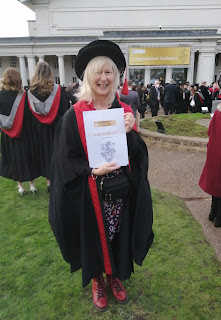
As a young woman, I travelled around Asia and settled in Australia for ten years. In those early days, I temped in offices and made clothes for market stalls. In my spare time, I wrote poetry and dabbled in storytelling. When I returned to the UK, I was thirty-four when I graduated with a BA in Teaching, Design and Computer Studies. For the following eight years, I lived in London working for a publishing company. After that, I did a TESOL course, which led me into university lecturing. I taught English before running my own course, a BA in English and Creative Writing. After studying for an MA in Creative Writing, I never imagined myself doing a PhD. However, in 2015, I took an idea to Jonathan Taylor at the University of Leicester. Then I spent six years studying for a PhD in Creative Writing, while continuing my work as Course Director. In January 2022, at the age of 63, I graduated with a Doctor of Philosophy. 


About my PhD

My PhD is a family memoir, and the thesis is on truthfulness. I found time to study by having a non-teaching day each week. Then, every two months I spent hours in a café talking to my supervisor about memoir, research, and how to write a truthful portrait of my parents before I was born. 

The memoir explores the effect of war on my parents, and starts in 1943. I alternate the chapters, so their stories run alongside each other until they meet in 1949. The structure reveals their differences, and how their experiences and losses led to a hasty marriage. My young father, a Coldstream Guardsman, is posted to Germany. His mission is to repatriate Displaced Persons (DPs), mostly Poles, and send them home. He also escorts POWs to trial, and guards the German borders, stopping anyone trying to escape Stalin and his troops in Poland. While in Germany, he falls in love with a woman and has a child. Meanwhile, in North Devon, my mother, like many women during the war, falls in love with a GI. The US army are training in Woolacombe. Her story follows this affair, and time spent at her grandmother’s luxury hotel.    

My PhD explores truthfulness in life writing. In the memoir, I am a ghost from the future, following my young parents, observing their behaviour and narrating their stories. However, immersing myself in their stories, at a time before I was born, goes against the grain of much nonfiction writing. For me, though, my mind travelled backwards in time, and I experienced scenes, people and emotions, as if present. My spectral presence tapped into a different kind of truthfulness I was unable to find through writing a more traditional type of memoir. I could explore the 1940s like a time-traveller. My mind became a movie of my parents’ young lives. I found my ghost narration flowed naturally, unravelling memories that appeared obscure but true. 

I found all this puzzling until I read about the concept of Postmemory. Postmemory is when children acquire the memories of their parents, which become embedded within their own memories. Through ghost narration, I was drawing from my postmemory experiences as a child. I grew up with my mother’s constant retelling of her wartime experiences, and my father’s silence about his, which resulted in his violent behaviour.  

I called the memoir You’ll Fall Through All Those Boys. My great grandmother said this to my mother when the GIs first arrived in Woolacombe. My mother was a sophisticated seventeen-year-old at the time. And the title works for my father’s story too, as a soldier in the Coldstream Guards.  

Below is an extract from one of my mother’s chapters in the memoir. 


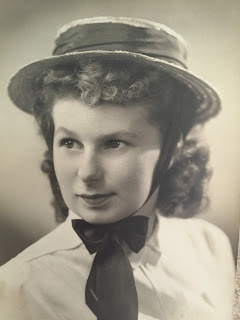
My Mother, Elizabeth Worthington, c. 1946


From You'll Fall Through All Those Boys

The grandfather clock chimes twice in the hall. We hear it from the porch at Combeside, where I wait with my mother. This afternoon, she is wearing a blue velvet dress with a white collar. The day is warm, and her coat is lying next to us on the bench. 

‘Hey, Bet!’ we hear Bud shout, as he runs up the steps. ‘Beautiful day.’ 

He removes his cap and blushes. To cover it up, he points to a jeep parked across the road. 

‘Hope you don’t mind,’ he says, ‘it’s the best I could get.’ 

His words stretch out like a Southern-American folk song.

‘It’s fine,’ says my mother with a big smile, ‘but only if you let me drive.’

I am now in the back of a jeep, bumping up and down, and sideways too. We pass the toilet block at the top of Mortehoe Hill and see the roof has been blown off.

‘Apologies, ma’am,’ shouts Bud. ‘We had a little accident yesterday.’ 

Why are toilets such a popular target for the US army?

The jeep’s canvas has been pulled back, and I laugh to see my mother’s hair blowing about. She clings to her hat with one hand, while driving with the other. 

This is fun, I think.

Ilfracombe, ten miles north of Woolacombe, is full of GIs too. Military vehicles are lining the streets here, and soldiers clog up the pavements. It is worse in the evenings, when buses arrive full of the soldiers based in Woolacombe. Everyone heads for the George and Dragon, which is where we are now. 

Bud and my mother chat away all afternoon, at ease in each other’s company. From a little window at the back of the George, I hear waves crashing against the rocks below. My mother seems happy. Perhaps the happiest I have seen her since she first met Bud, and skipped all the way back to her grandmother’s hotel ...


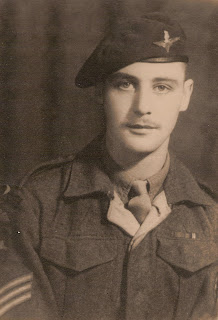
My father, Clive Morris, c. 1946