Showing posts with label anthology. Show all posts

Friday, 24 July 2026

Ellistown Primary School, "The Sum of Our Parts"


About The Sum of Our Parts
The Sum of Our Parts is a new anthology of Creative Writing by Year 6 students at Ellistown Primary School in Coalville. It is published by Coalville C.A.N. Community Publishing. Congratulations to all the students involved! The anthology is edited by Constantine, University of Leicester MA Creative Writing graduate. 

You can read more about the anthology here. Below, you can read the foreword by the headteacher of the school, and two of the stories from the anthology.


From The Sum of Our Parts


Foreword
by Simone Fellows (Headteacher)

Once again, it has been a pleasure to work with Coalville Community Publishing, to give our year 6s this fantastic opportunity - a chance for our young people to receive feedback from an author/publisher in Constantine and to see work that they are proud of in print. It is especially exciting for the children, knowing that a copy of their anthology will be held at the National Library alongside the works of some of their favourite authors!

Having a real-world audience and knowing that their work would be published creates a real buzz in class, inspiring even our most reluctant writers to aim high. Some of our children sent multiple drafts and received feedback two or three times in pursuit of a finished piece they can be proud of. This created a real discourse between writer and editor and enabling the children to develop their resilience and set high expectations for themselves.
 
As ever, a heartfelt thank you to Coalville C.A.N. and Coalville Community Publishing for this opportunity. Special thanks to Constantine, for your patience and support in bringing this together over many months. It is a pleasure to work with you on this important project and your openness about being neurodiverse gives our children permission to embrace their own individuality and to find a voice they may not have known they had. Every time we create an anthology together, you help Ellistown Primary School children see their own potential.


The Beach of Hell

by Myles H

Decades have passed since D-Day. I fought in many battles after that. I even fought in Vietnam.

But D-Day? That was a hell of its own.

Normandy: Dead bodies everywhere, bullets ricocheting … Up above Germans stood behind turrets firing at anything that moved.

The objective: There was a wall which offered some cover, getting there was the job.

I waited for the boat door to collapse open. A soon as it did a soldier in front collapsed to the floor: between his eyes was a gaping hole where a bullet had shot through. I dived forward to shake of the fear. As I stormed through the water a bullet screeched past the man in front and rebounded off something before slashing through my foot. A throbbing pain shot through my body.

"Medic!" I screamed over and over again before something grabbed me and dragged me behind the wall. There a medic stood holding my foot before strapping a belt around my ankle.

"It needs amputating!" he shouted in my face. I had no idea what that meant.

I know now. I know what amputation means. When I wake in the night it still takes me a moment to remember that I only have one foot.


Her

By Layla T

Walking through the heart of the field, as the sun dipped behind the clouds, I carried my backpack trying not to look too interested. Football practice was ending, but one player was still out there-running drills after everyone had long packed up.

Her. The girl who played football like it was part of her heartbeat.

She sprinted, slowed, set the ball and shot. The sound echoed through the field-sharp and perfect. I stood there for a moment, watching her determination, the way her ponytail swung with each stride, she didn't seem to care that the sky was turning gold.

She glanced up and noticed me. I froze.

She jogged over, wiping sweat from her forehead.

“Hey," she said with a breathless smile, "you need the field?”

I shook my head. "No ... um ... I mean I'm just walking home."

She laughed softly, not in a teasing way, but like she found your awkwardness kinda cute.

 "I'm Layla," she said tapping her boots on the grass.

"I'm Johnathan," I replied with a smile, "You're really good." And I meant it; I thought she has great potential.

“Thanks," her eyes lit up with pride, the kind only passion can give. "I love the game.”

I hesitated then added, "I can tell! ...The way you play - it's like you were born with a ball at your feet."

She was shocked, "That's the nicest compliment ever ... I mean everyone normally says I am just a girl."

“I see a lot of potential here ... in you ..." I replied. "So, sign this form, and come this Friday.”

Her face lit up like Christmas morning. "OMG... NO WAY!" she cried.

"Yes way," I said smiling.

"Thank you so much .... I .... I will be there," she said happily.


Friday, 5 December 2025

"The Subtle Art of Short Fiction," ed. Isabelle Kenyon


About The Subtle Art of Short Fiction, ed. Isabelle Kenyon
The Subtle Art of Short Fiction explores the power of short fiction in today’s fragmented world. Renowned authors and critics offer advanced techniques for crafting nuanced, impactful stories.

Learn to master short story structure, subtext, micro-tension, and sensory minimalism. Ideal for experienced writers seeking to refine their skills in this sophisticated art form, or those who love short fiction, and want to learn about the craft behind it.

The book includes essays and writing exercises by Kerry Hadley-Pryce, Daisy Johnson, Matt Wesolowski, Sascha Akhtar, David Hartley, Mahsuda Snaith, Jonathan Taylor, Sarah Schofield, SJ Bradley and Farhana Shaikh, and has an introduction by Dr Paul March-Russell.

You can read more about The Subtle Art of Short Fiction on the publisher's website here


About the editor
Isabelle Kenyon is the Managing Director of Manchester publishing house Fly on the Wall Press, and was named a Leader of the Year by the Bookseller in 2025. Founded in 2018, she has led Fly on the Wall Press from Small Press of the Year finalist status at the British Book Awards 2021-23 to their win in the North, in 2024. She is the MA Module Leader for "Publishing in the 21st Century" at Arts University Bournemouth, and the author of psychological thriller The Dark Within Them and poetry collections including Growing Pains (Indigo Dreams).​ She previously coordinated the Northern Fiction Alliance and runs PR campaigns for writers and publishers under Kenyon Author Services


From The Subtle Art of Short Fiction

From The Art of Anticipation and Revelation

by Daisy Johnson

I have noticed something recently about children. It is the waiting that they love. My sons sit at the kitchen table watching me, spoons floating half way to their open mouths, eyes wide. I am doing something silly, making a noise or pretending to hide or doing a funny walk. Each time when I stop they call for me to do it again, again, again. I pretend not to, I cannot possibly, no, I am very busy, but they know I am lying. It is this moment of withholding that they find most joyous. The best short stories, for me, carve out most perfectly that delicious space of anticipation.

In Miranda July’s short story "The Metal Bowl," the protagonist describes herself acting in a porn video when she was younger. "I wasn’t directed so much as given a series of props to make my way through, like an obstacle course. A turquoise Teddy bear, a pillow, an empty beer bottle, a metal bowl. Not everything was clear to me (the bowl), but I was too nervous to speak." From this moment we move through the story with a growing question. What was the metal bowl for? The question is an elastic tension which connects us to the protagonist.

In Shirley Jackon’s "The Lottery," the very title of the story is a question which we go in asking: what is The Lottery? The people of a small village begin to gather in the square: "Bobby Martin had already stuffed his pockets full of stones, and the other boys soon followed his example." As with the mysterious metal bowl, we wonder, what are these stones for? Unlike July’s story it is clear that the characters know more than us, that the trembling, questioning tension belongs only to the reader ... 


Thursday, 6 April 2023

Abi Curtis (ed.), "Blood & Cord: Writers on Early Parenthood"


About Blood & Cord: Writers on Early Parenthood, ed. Abi Curtis

A child is born and everything is made anew. In this blur of new beginnings there are tears and laughter, new words and new silences: this is an unmaking and remaking of the self. From short stories about unnerved fathers and lost mothers, to poems about ‘half-built Lego palaces’ and friends who share their deepest secrets, Blood & Cord is a raw exploration of new parenthood. Voicing silenced conversations about loss, grief, and loneliness, as well as the joys and laughter that are part and parcel of becoming a parent, the stories told within offer a refreshingly honest account of life after new life. This collection is a hand in the dark, offering comfort and solidarity to any new parent.

You can read more about Blood & Cord on the publisher's website here. Below, you can read about the editor and two sample pieces from the collection, by Abi Curtis and Liz Berry. 


About the editor


Abi Curtis is Professor of Creative Writing at York St John University. She has won an Eric Gregory Award and Somerset Maugham Award for her poetry collections, Unexpected Weather (Salt, 2009) and The Glass Delusion (Salt, 2013). She has a PhD in Creative and Critical Writing and is inspired by art, psychology, science and the environment. Her first novel, Water & Glass, a speculative climate-change fiction was published by Cloud Lodge Books in 2017. In 2022 Abi’s short fiction was commended in the Bridport, Fish and Alpine Fellowship Prizes, and a poetic sequence on the subject of a medieval anchoress, set to music by David Lancaster, was performed by the Ex Corde Vocal Ensemble.


From Blood & Cord

On my son, falling asleep 

Your tomcat face is wide, unwhiskered.
Your skull weighty as a coconut  
or the globe. Your ears: shells that sing
not the sound of a shore, but laughter
and sussi, uh, tuks, babbi. 
Your belly swells with cheese and blackberries,
heels of bread, stubs of potato. 

Air purrs inside you, engine-bright.
Milk-white canines tip the hot gums;
you feel for mine with a sharp thumb
to know what your mouth might become,
touch the sighs, the questions.
 
Zipped up with toes in a bunch, 
I lay you down 
heavy as a marrow 
fingers star-fishing for daytime things. Wrapped in the dark. 
Waiting for the strangest dreams.

- Abi Curtis


Godspeed 

When we fuck in sweet darkness  
I leave my body behind, rising 
from her as smoke rises  
from the forging fire. 
Godspeed, I tell her,  
as we part like lovers 
on the threshold.  
I want to begin again, 
move as the creatures  
of the air do, birds, moths, 
ghosts shimmering 
in the empty streets, 
the theremin song of the trees
as they shed their inhibitions
against the gold light. 
The blood and jewelling 
of the body, its grief 
and burden, abandoned
like a unreadable book. 
I wish I could take you with me,  
but one of us must stay  
behind, keep watch  
upon the darkness,  
our sons’ warm limbs  
reaching like tendrils 
from their cots. 

- Liz Berry

Friday, 20 January 2023

Sabyn Javeri (ed.), "Ways of Being: Creative Non-Fiction by Pakistani Women"


About Ways of Being: Creative Non-Fiction by Pakistani Women, ed. Sabyn Javeri

Does writing have a nationality? Are writers defined by geography, language, religion, gender and ethnicity alone, or are there other attributes that identify them? Fifteen of the most articulate and creative non-fiction writers from Pakistan eloquently demonstrate that, as Sabyn Javeri says, "Who you are is more accurately represented by what you stand for, than by where you are from."

Large-scale migration and transnational mobility have rendered national borders porous, while the Internet has internationalised communication in a way that practically erases territorial boundaries. Questions about "being" and "belonging" acquire an urgency that demands articulation: how does a writer relate to her context, whether at "home" or "away," and locate herself and her writing in it? For the purposes of this anthology, Javeri believes that "A Pakistani writer is one who feels a connection to the land either by origin or by sensibility."

This rich and fascinating collection of reflections, reminiscences, musings—and excellent writing—features Taymiya R. Zaman, Hananah Zaheer, Feryal Ali Gauhar, Sadia Khatri, Saba Karim Khan, Soniah Kamal, Kamila Shamsie, Saybn Javeri, Rukhsana Ahmad, Humera Afridi, Muneeza Shamsie, Uzma Aslam Khan, Shahnaz Rouse, Noren Haq and Bina Shah. They are among the best creative non-fiction writers anywhere.

Below, you can read an excerpt from the Introduction to the anthology. 


About the editor


Sabyn Javeri is Senior Lecturer of Writing, Literature & Creative Writing at New York University, Abu Dhabi. She is the author of Hijabistan and Nobody Killed Her, and has edited two multilingual anthologies of student writing, The Arzu Anthology of Student Voices (Vols. I & II). Her writing has been widely anthologised and published in the London Magazine, Litro, Bookends Review, South Asian Review, Journal of Commonwealth Literature and Wasafiri, among others. She has an MSt from the University of Oxford and a PhD in Creative Writing from the University of Leicester. Her research interests include transcultural feminism, South Asian literature & literary translation, inclusive pedagogy and Creative Writing.


From Ways of Being

Encounters with Life: An Introduction

By Sabyn Javeri

When the idea of putting together an anthology of Pakistani women writer’s creative non-fiction was put to me by the feminist publisher, Ritu Menon, I hesitated. The first question that ran through my mind was, but who is a Pakistani writer? Who has the right to call herself a Pakistani writer? Someone who lives in the country, or someone who carries the country within her? Upon a quick search I found that I was not the only one deliberating this point. The question of who a Pakistani writer is has dominated many a discussion in recent debates on global anglophone literature—but it has raised more questions than answers.  

I found myself wondering who, in this age of mass displacement, when very few of us have the luxury to be rooted in one place, can claim to belong solely and wholly anywhere at all? To complicate matters, the rise of the Internet has shrunk traditional borders, making the question of identity even more fraught. Economic migration, religious persecution, emerging right-wing nationalism and populism, pandemics and lockdowns have forced many of us to reckon with a new plurality of identities, where the boundaries of nationality or a singular cultural identity are no longer relevant in the context of our dynamic times. It is, instead, a question of voice that matters. I found myself thinking: who you are is no longer a question of "where you are from"; rather, who you are is more accurately represented by "what you stand for." A Pakistani writer, therefore, for the purposes of this anthology, is one who feels a connection to the land either by origin or by sensibility.

Although the idea of separating writers by gender does not appeal to me, it is with some trepidation that I admit that there is a tradition of women’s writing in Pakistani anglophone literature that merits a place of its own. It provides the reader with a different point of view, a minority outlook, an underdog history, parallel yet complementary to the historical context and the socio-political journey of the country and its diaspora. Although it fits into the larger tradition of Pakistani women’s writing, it has some distinct features of its own. For one thing, English as a language is equivalent to currency in a country like Pakistan and those who make a choice to write in it, do so consciously. The legacies of British colonialism that manifest themselves linguistically 70 years after Partition mean that many of us grew up in households where English was the norm. For others it is an English medium education that leads to a natural inclination to write in the language they think in. Therefore, the choice and skill to write in English not only changes the readership, it bestows a slightly different lens to the reception. Many anglophone writers have been criticised for the fact that class privilege, global education and an international audience influence their themes, which seem to be more global than local. This criticism is often unfounded as it oversimplifies the subtle subtext of the writing. Writers should not be expected to be mouthpieces or representatives of their ethnicity. They should not be dictated to or prejudiced by expectations for they are artists, not activists, and accountable only for the authenticity of their work not the congeniality of their subject matter. 

In this anthology, the essays reflect the experience of the writers and what matters to them. They represent the diversity of the Pakistani woman’s experience, and they embrace any such differences of topic and language as celebratory rather than flawed. At times they may present a wider political view, and at other times a narrower perspective in the form of the local and the personal. The themes are varied, but what they have in common is that they shatter the stereotype of the submissive Pakistani woman and speak for a cross-section of society, across generations and from around the globe. Another characteristic is the ability of these writers to view the world bilingually. This adds a certain filament to Pakistani anglophone writing which makes it distinct from the vernacular, but still "accented" as opposed to standard English writing. This is because the writing leans towards a postcolonial turn, falling into the category of "other Englishes" as a form of artistic resistance. Many Pakistani anglophone writers do great justice in translating the local flavour and dismantling the exoticism or orientalism of the subcontinent in contemporary English literature. 

Although the anglophone tradition differs from that of Urdu or vernacular women writers in Pakistan, it does not mean that it fits wholly into the tradition of western women’s writing. The starting point for this has to be an acknowledgement that while women all over the world share many universal values and oppressions, not all women are the same. With apologies to George Orwell, "All women are born equal, but some women are more equal than others." Just as class plays a huge part in the experience of gender, so does race. This varies the experience of what it means to be Pakistani, especially as an immigrant. It diversifies their concerns, their self-perception and outlook. For the diasporic or second-generation Pakistani woman writer, who may find English the natural choice of language, the experience of being a minority still places her writing outside the mainstream. For the local writer, pressures of representation add to the dilemma of speaking up and finding one’s true voice. "Criticise your culture and you are pandering to the West, praise your country and you are pandering to the patriarchy…" as the wonderfully outspoken Fahmida Riaz said in an interview once. Like her, many Pakistani women writers find themselves in a situation where their individuality is negated for they inevitably become representatives of their "kind." And if they deviate from the dominant narrative they risk being accused of inauthenticity.  And so it is that the most damning difficulty they face is overcoming an implicit bias—sometimes on the part of critics and reviewers, other times in the form of self-censorship. These factors distinguish Pakistani women writing in English from their counterparts in other parts of the English-speaking world.

To a large degree, Pakistan’s short but complex socio-political history still plays a part in defining a woman writer's identity, her values, her subject matter, and most importantly, the reception of her work. Despite many women poets, journalist and writers, speaking up, we still experience a tradition of silencing. We have gruesome, politically motivated murders like that of Sabeen Mahmood who is credited, among many other wonderful legacies, with having revived the literary scene in Karachi through her initiative, The Second Floor. While social media have provided a forum for many women to speak out from the safety of their screens, they still encounter immense trolling, and we still have "honour-killing" victims like Qandeel Baloch who pay with their lives for publicly raising their voices. But we also have survivors like Malala Yousufzai who carry the beacon of hope for Pakistani women, fighting for female literacy and the right for women to tell their stories through the written word—who can forget that Malala’s writing journey began with a blog on BBC urdu.com. One cannot deny that technology has impacted Pakistani women writers. The outreach of their voices has expanded via easy access to the Internet in urban cities, and through it, a rising feminist consciousness is challenging gendered violence and patriarchal gender norms. Whether through the Aurat March or through social media activism such as the #MeToo and #GirlsattheDhaba movements, they are finding new ways to tell their stories ...


Tuesday, 5 April 2022

Isabelle Kenyon & Charley Barnes (ed.), "In Conversation with ... Literary Journals"


About In Conversation with ... Literary Journals, ed. Isabelle Kenyon & Charley Barnes

This is a series of personal, curated interviews with internationally-acclaimed literary editors. The book is the chance to widen your horizons as a writer, discovering new and established literary journals across the world. Sit down with these experienced editors to find out what they really want from a submission, and allow them to demystify the publishing process, across a wide range of genres.

This new book was inspired by In Conversation with ... Small Press Publishers, published by Fly on the Wall Press, in collaboration with Sabotage Reviews. It's suitable for writers of short stories, poetry, flash fiction and cross-genre artforms, at all stages of their career. It includes interviews with 40 international journal editors including: streetcake magazine, The New Verse News, Ink Pantry Publishing, IAMB, ZiN Daily, The Broken Spine, NEON Books, Reckoning Magazine, The Journal, Wildness, Blink-Ink, Tint journal, Long poem magazine, Idle ink, Rough Diamond Poetry Journal, Raleigh Review, Tahoma Literary Review, The Frogmore Papers, Squawk Back, Ambit, Flashback Fiction, Anthropocene, Fly on the Wall Press, Not Deer Magazine, Capsule Stories, GUTTER, Full House Literary Magazine, Ink, Sweat & Tears, Parhelion Literary Magazine, The Dawntreader Magazine & Sarasvati Magazine, Here Comes Everyone magazine, The Alchemy Spoon, Shooter Literary Magazine, Skirting Around Magazine, UP YOURS magazinePorridge, Foxglove Journal, Agenda poetry journalDear Reader, Seafront Press.

Below, you can read about the editors and a sample from the book. You can see more details on the publisher's website here


About the editors


Isabelle Kenyon is a northern writer and the author of  chapbooks: This is not a Spectacle, Digging Holes To Another Continent (Clare Songbirds Publishing House, New York, 2018), Potential (Ghost City Press, 2019), Growing Pains (Indigo Dreams Publishing Ltd, 2020) and one short story with Wild Pressed Books (Short Story ‘The Town Talks’, 2020). She is the Managing Director of Fly on the Wall Press, a socially conscious small press for politically-engaged poetry, fiction and anthologies. She has had poems and articles published internationally in journals such as Ink, Sweat and Tears and newspapers such as The Somerville Times and The Bookseller

​She was listed in the Streetcake Experimental Writing Prize 2020, and for The Word, Lichfield Cathedral Competition 2019. Her poems have been published in poetry anthologies by Indigo Dreams Publishing, Verve Poetry Press, and Hedgehog Poetry Press. She has performed at Cheltenham Poetry Festival and Verbose, Manchester in 2020, Leeds International Festival as part of the ‘Sex Tapes,’  Apples and Snakes’ ‘Deranged Poetesses’ in 2019 and Coventry Cathedral’s Plum Line Festival in 2018.

She is currently working on her first novel, Dark Energy, which has been funded by Arts Council England. She is a fierce dog lover and a confessed caffeine addict.


Dr Charley Barnes is an academic and author from the West Midlands, UK. She is the author of several poetry publications, including: A Z-hearted Guide to Heartache (V. Press, 2018), Body Talk (Picaroon Poetry, 2019), Hierarchy of Needs: A Retelling, co-authored with Claire Walker (V. Press, 2020), and Lore: Flowers, Folklore, and Footnotes (Black Pear Press, 2021). Charley has also authored three short fiction releases: Death Is A Terrible House Guest (The Black Light Engine Room Press, 2019), Burn The Witch (The Black Light Engine Room Press, 2020), and Go On A Road Trip (Wild Press Books, 2020). Under Charlotte Barnes, Charley writes crime fiction, including the titles: Intention; The Copycat; The Watcher; and The Cutter (Bloodhound Books, 2019-2021). She has had individual poems and fiction pieces published by the likes of Ink, Sweat and Tears, Riggwelter Press, and Bind Collective.

Charley is the current Managing Director of Sabotage Reviews, the editor of Dear Reader, and a lecturer in Creative and Professional Writing at the University of Wolverhampton. She has spoken and performed at events such as Verve Poetry Festival, Cheltenham Poetry Festival, and Tamworth Literature Festival, where she formed part of a panel to discuss the practicalities of publishing crime for a contemporary readership. Charley was the Worcestershire Poet Laureate 2019-2020. She is now the Writer-in-Residence for The Swan Theatre, Worcester, and their associated venues. When she isn’t writing, she’s likely drinking tea, eating cake, or walking her dog.


From In Conversation with ... Literary Journals

Ambit Magazine

In Conversation with … Kirsty Allison, Editor

Q. We know that your main focus is across poetry, stories and art, but do you ever accept submissions which verge on cross-genre or which are stylistically different to the rest of your publishing aesthetic?

A. Ambit was established in 1959. Past editors include JG Ballard, Carol Ann-Duffy, Eduardo Paolozzi, with early work from David Hockney, Linton Kwesi Johnson, Ralph Steadman. Some of our most radical works are cross-disciplinary.

When I came on board, we started using Poems, Stories, Art as a way of describing Ambit, nodding to the traditions of founder Dr Martin Bax, to offer thirty pages to each of these disciplines per issue. Traditionally, these areas have been headed up by separate editors, overseen by one — and in my mind, progressive literature and art has always occurred where there’s some sort of visionary overlap. I love the Invisible Years series in Ambit, the collaboration between Ron Sanford, Martin, JG Ballard and occasionally Mike Foreman. Culture moves, it is alive, and we are undoubtedly gatekeeping if people want to give it a go — but we are in a very different point to where we began, because anyone can publish their own work now, and that was not possible back when we began in 1959.

What we offer is stories on paper, that’s the core of Ambit. Ambit is a platform for publishing the best literature and art, and if someone chose to submit graphic stories, we’d see it and consider. There are many great artists, poets and writers that start with us — stories take many forms and we’re here to platform the best poetry, stories and art, but that isn’t to deny cross-over. Our only restriction is that we have ninety-six pages in our quarterlies where submission is open to all, and we clearly have an intention with the Annual Ambit Competition, which opened across disciplines for the first time in 2021, and will this year, with a theme as the framework.

Fiction is one way of telling stories, as is art, graphic art, auto-narratives in illustration, etc.  Anecdotes or philosophical questions are where many stories begin, so it’s generally about how well they transverse into black and white using language, the semiotics, these elements across disciplines are what we play with. Lifewriting is a spectrum: if you’re Bukowski or Anaïs Nin your stories are going to be interesting, and for me, that’s what makes a great writer. I had very little to share until I’d lived a bit. It’s not about disruption and colour all the time, but it helps if there’s some mastery. Form is a tool. Speech is a tool. I love these borderlines — where lyric and poetry crossover has been an obsession.


Monday, 4 April 2022

Tom Conaghan (ed.), "Reverse Engineering"

By Tom Conaghan, publisher of Scratch Books


About Reverse Engineering

It’s easy to get obsessive about short stories. Done well they’re near perfect, done badly they’re a little insulting. Maybe, in such a contained space, the stakes are just naturally higher. 

I’ve been the fiction editor at Bandit Fiction for a few years now. I also judge submissions at US magazine The Story, and for The Word Factory’s Apprenticeship Award. In all these organisations, we were declining a great deal more writing than we accepted. All the time, I was reading incredible stories in The New Yorker, Granta, The White Review, Electric Literature and others. What was it that these successful writers doing that so many others weren’t? 

The question prompted me to start a series of interviews at The Word Factory, asking amazing authors how did you write that? Their answers were eye-opening in many ways: Chris Power rewrote his ending to ‘The Crossing’ fifty times; Mahreen Sohail’s first draft she calls draft zero; present-day Jon McGregor would like to teach his younger self that what he thought was ambiguity was just prevarication.

But, above all this, what came through was how various their craft was. Bringing together their principles did not point towards a single perfect story; as I wrote in the introduction to the book (available to read in 3am Magazine), there is no single state of short storydom – it is a perennial Newfoundland. 

As a consequence, I found that talking to brilliant authors didn’t show me how to write a great story, but – like a great short story – it did help me formulate better questions. And, ultimately, the one thing I did understand about the short story is that its endless permutations mean that, for me, it will stay an obsession.

You can see more details about Reverse Engineering on the publisher's website here. You can receive a 15% discount when you buy Reverse Engineering online with the special discount code: Leicester15


Tuesday, 8 March 2022

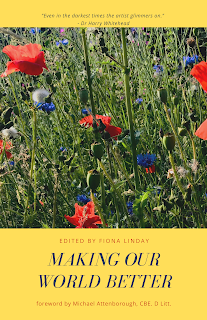
Fiona Linday (ed.), "Making Our World Better"


About Making Our World Better, ed. Fiona Linday

The Making Our World Better Project was launched in April 2021. Fiona Linday led this Arts Council England supported writing activity across the University of Leicester campus. The resulting collection presents the expressive writing of learners from the Attenborough Arts Centre. They were joined by many service users of Leicester Arts in Mental Health, Leicestershire Partnership NHS Trust, and several Creative Writing students from Leicester’s Centre for New Writing

For a year, workshops prompted these three groups to respond to the title of Making Our World Better. Fiona helped develop these pieces of work, by encouraging wide engagement and collaboration. The contributors were inspired to write poetry and flash fiction reflecting on their wellbeing during lockdown while considering their future within our environment.

The anthology features work by Mark Gwynne Jones, the commissioned poet from the partner organisation Renaissance One and guest author Matthew Tett. Fiona also models her writing alongside sharing that of others, joining in this active learner challenge by contributing new poetry and stories. The anthology includes creative work by University of Leicester students Isobel Copley, Will Preston, Laura Besley, Tracey Foster and Sam Bouch. 

Below, you can read about the editor, and a sample from the Foreword to Making Our World Better. You can find more details about the anthology on the publisher's website here


About the editor


Fiona Linday’s background is in school learning support. She is a Creative Mentor with the Mighty Creatives. Fiona presents this second Leicester anthology collaboration extended to students. That project comes after a decade of the freelance facilitating of vocational creative writing to lifelong learners. In 2019, her first commissioned anthology, Family Matters, featured a dozen new Attenborough Arts Centre writers alongside established guest authors. The Arts Centre offers a diverse arts programme to inclusive learners. With the help of several partners and Dahlia books, during lockdown she adapted her practice to achieve comprehensive engagement through delivering blended workshops.


From Making Our World Better, ed. Fiona Linday

Foreword, by Michael Attenborough, CBE 

Amidst the widespread chaos and distressing scale of deaths, the current pandemic has coincidentally thrown up a number of valuable indicators for our collective future. The concern for people’s mental health; the thrilling revelation of a cleaner environment; the scale and sense of loss at the absence of the creative arts; the importance of an enriching education; a greater appreciation of the natural world.

Climate change has brought us to the brink of self destruction. We now need, as a matter of urgency, a creative response from humanity. Focused, articulate and passionate.

Creativity lies at the epicentre of that humanity. It nurtures the invisible part of our health; our emotional, psychological and spiritual health.

Our ability and freedom to express ourselves is a basic human right, one which feeds humanity’s understanding of itself and its relationship with the rest of the world. Cultural communication has the capacity to enlighten, challenge, excite and inspire. It expresses our individual and collective identities, needs and aspirations. A civilised society is one that is in constant dialogue with itself, one of evolutionary discovery and growth.

This exciting new anthology is one vital part of this creative movement.


Wednesday, 9 February 2022

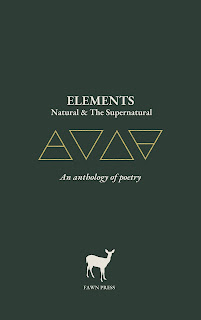
Scarlett Ward Bennett (ed.), "Elements: Natural & The Supernatural"


About Elements: Natural & The Supernatural, ed. Scarlett Ward Bennett

Elements is an anthology of poetry inspired by the natural and supernatural elements of the universe and beyond. From the molecular chaos of running water and the impatient budding of leaves in Spring, to the whispering aether that fills the darkness of night, this anthology explores and celebrates the natural world, spiritual entities, and the forces at work all around us. It is the first title published by new publisher, Fawn Press, and is edited by Scarlett Ward Bennett with the help of Lexia Tomlinson and Konnie Colton.  


About the editor

Scarlett Ward Bennett is a poet, workshop facilitator, editor and Director of Fawn Press. She founded Fawn Press in August 2021, with a vision of helping to bring beautiful poetry anthologies, pamphlets, and collections into the world. Her debut poetry collection Ache was released in 2019 with Verve Poetry press, and her work has featured in Under the Radar, Eyeflash Poetry, and Burning Eye. She is a workshop facilitator for Writing West Midlands and Homegrown 31, and visits schools around the country to deliver fun and engaging workshops to young people. She has worked as editor for On Your Doorstep Magazine and has worked as an editor for single-poet projects. She came runner up in 2019’s Verve Community competition, judged by Joelle Taylor, and the Wolverhampton Literature Festival Competition, judged by Roy McFarlane. Scarlett was nominated for a Sabotage Award for Best Spoken Word Artist in 2018, and in 2016, her poetry evening Cafe Del Nino was nominated for Best Spoken Word event.


About the publisher

New publisher Fawn Press aims to publish beautiful books of exceptional poetry, as we believe that poetry has the power to change lives through that transcendental connection between writer and reader. Storytelling lies at the very soul of our experience as human beings, connecting us since the dawn of time. We hope to be a platform that welcomes all writers, rejecting elitist and pompous attitudes to publishing in favour of an inclusive approach, whilst maintaining a high quality of exceptional writing that excites and inspires: “Poetry that takes you by the hand and leads you into the woods.” Fawn Press emerged from a passionate love of books and literature, as well as the recognition that the world needs more representation of new and under-represented poets. We are dedicated to the continual growth, education, and application of diversity.

Below, you can read two sample poems from our new anthology.


From Elements

Oxygen

Think of a million mouths pursed into an O
and inhaling together, one giant in-suck.

Forget that dream where you always wake
gasping and clutching at your throat.

Think of bubbles rising in a lake –
like them we must release ourselves towards air.

Now that the cool has come, the edges
have softened in the garden a little, our wren

is at ease with herself and we of late
have taken to sitting out, fanning ourselves

and watching the deepening shadows.
There is an art to this – to breathing easy;

half lung-capacity and half blind faith
that the next breath will come, 

that we will not flounder and choke
on our filthy emissions, on sticky particulates,

that we will, somehow, mostly, get it right.
Not unlike like that river fish, the pike,

who lords it over his river underlings,
his green slime-shimmer stalled among the weeds,

his razor- jaws, so cruel, so cannibal,
his habit, or if you like, his trick

of flicking his prey to swallow it head first,
and whole, and live.

How he only rarely misjudges, gags,
thrashes a little, turns belly up and dies.

- Róisín Tierney

Ode to the Mirror Carp

I.
Look! How they spin, fins vibrating and O-mouthed, 
scales beating in a blood-rush. 

Mother asks: have you ever heard a fish scream? 
It’s like a body rupturing, eating itself whole before re-entering the womb.

This is how girl becomes woman.

II.
There’s a burning in their stomachs only death can cure.
Their hunger? Watch it rage, it’s the only thing that draws fish out of water. 

See their bodies pirouette for the last time,
they’ll stop squirming soon. 

This is how a woman lives. 

III.
Mother reels them in. 
I have her hands – I know, mine are just as impossible to hold.

Dinner will be served soon. 
I open and close my mouth, and swim, and swim. 

This is how we survive. 

- Nabeela Saghir

Friday, 26 November 2021

Ian Humphreys (ed.), "Why I Write Poetry"


About Why I Write Poetry: Essays on Becoming a Poet, Keeping Going and Advice for the Writing Life, ed. Ian Humphreys

What motivates poets in the 21st century? How do they find their voice? What themes and subject matters inspire them? How do they cope with set-backs and deal with success? What keeps them writing? Why I Write Poetry, edited by Ian Humphreys, combines twenty-five lively and thought-provoking essays, along with individual writing prompts to help you create your own new poetry.

The book includes essays by Romalyn Ante, Khairani Barokka, Hafsah Aneela Bashir, Leo Boix, Vahni Capildeo, Mary Jean Chan, Jo Clement, Sarah Corbett, Jane Commane, Rishi Dastidar, Jonathan Edwards, Rosie Garland, W. N. Herbert, Ian Humphreys, Keith Jarrett, Zaffar Kunial, Rachel Mann, Andrew McMillan, Kim Moore, Pascale Petit, Jacqueline Saphra, Clare Shaw, Daniel Sluman, Jean Sprackland, and Jennifer Wong.


Ian Humphreys, photograph by Sarah Turton

About the editor

Ian Humphreys’s debut collection Zebra (Nine Arches Press, 2019) was nominated for the Portico Prize. He is the editor of Why I Write Poetry (Nine Arches Press, 2021) and the producer/ co-editor of a forthcoming anthology on Sylvia Plath (Nine Arches Press, 2022). His work has been highly commended in the Forward Prizes for Poetry and won first prize in the Hamish Canham Prize. A fellow of The Complete Works, Ian’s poems are showcased in Ten: Poets of the New Generation (Bloodaxe).

You can read more about Why I Write Poetry on the publisher's website here. Below, the editor Ian Humphreys shares an anecdote about an encounter and advice he received, and his own later instinct to "voice the unsayable." 


From the Introduction to Why I Write Poetry

The late poet John Ash once pleaded with me not to take up poetry. 

It was 1983. He had cornered me in the newly renovated kitchen of a house in Whalley Range. John rented the adjacent room. My friend Tarik rented a room on the second floor. Another friend Mark was pirouetting by the dishwasher when John stormed in to complain about the noise. 

We had been giddily fixing 3am snacks while attempting an off-key rendition of ‘Love Pains’ by Yvonne Elliman, so it was a fair cop. John didn’t stay angry for long. He asked what I was studying, what my plans were, and seemed relieved to hear they did not involve poetry. 

‘Good choice, very sensible. Whatever you do, please don’t become a poet! Stick to something where you can earn a bit of money.’ I remember laughing to myself. At that moment, I honestly could not think of anything I would enjoy less – an occupation that seemed duller – than writing poetry. 

While researching this book, I discovered that around the time we met, John had written a short essay about his collection The Goodbyes (Carcanet, 1982). The piece was republished two decades later in Don’t Ask Me What I Mean: Poets in Their Own Words (Picador). 

One part of the essay, in particular, caught my eye: ‘… many of the poems were written to the accompaniment of the kind of music you might hear at parties or in good nightclubs, that is to say, songs of August Darnell, Ashford and Simpson or the Chic Organisation, and on occasion the words of these songs have found their way into the poems.’ 

If only John had mentioned this during his pep talk. Perhaps I wouldn’t have waited thirty years before starting to write poetry myself. At school, we were taught the Romantics, nothing modern. After sitting my A-levels, I did not pick up a book of poems for two decades. I was unaware that contemporary poetry celebrated popular culture, that a ‘serious’ lyric poet could be inspired by August Darnell aka ‘Kid Creole’ of Kid Creole and the Coconuts. 

John and I hardly spoke again. Once, over burning toast, he recommended Prince’s overlooked early albums. A year or so later, I heard he had moved to New York where he became associated with the New York School of poets. 

Several poems in my debut collection Zebra (Nine Arches Press, 2019) explore my coming of age in 1980s Manchester. The gay club I had frequented the night John advised against poetry as a vocation is a touchstone in the book. I began to write about those early days on and around Canal Street, I think, to try and work out something about my formative years. For sure, there was joy, exhilaration and freedom. But there was also fear; a background dread that we accepted back then as part of life’s rhythm, as relentless as the four-on-the-floor beat of those Hi-NRG hits we lived for. It was fear of the unknown. Fear of illness. Fear of society’s disapproval which at any moment could mutate into danger.

Such contradictory emotions can be difficult to articulate, as slippery as a lager-soaked dancefloor. What I longed to communicate was feeling not fact, and this seemed best conveyed through the shimmering medium of poetry. 

The need to voice the unsayable – reach for the ungraspable – is one of the main reasons I write poetry. It’s a motive I share with many of my peers. When I turned to social media to ask why poets do what they do, many replied with answers along the lines of: 

To make sense of life. 
To make sense of the world. 
To connect with my inner world. 
To say things I could not otherwise express.

Another response that came up, again and again, was compulsion: 

I write poetry because I must. 
It is a thing I do, like breathing. 
I wrote poetry before I could write. 
I can’t help myself. 

Over one hundred poets responded, with variations on these two themes accounting for around ninety percent of all answers put forward. This posed a question: how could we prevent our contributors from writing multiple versions of the same essay? 

The answer? Jane [Commane] and I identified what we most admired in the work of the selected poets. We then asked each of them to explore a theme reflecting this idiosyncratic quality as they riffed on their craft. 

As you will discover, the tactic worked wonders. The resulting twenty-five essays are fascinating and varied. There’s little repetition, and thankfully even less navel-gazing. 

Each piece is unique in its approach to the trials, tribulations and pleasures of writing poetry. The mix of styles is satisfyingly rich, from the informal to the academic, the lyric to the dreamlike. Together, the compositions stand as testament to the robust state of poetry in 21st century Britain. 

Had I not started writing eight years ago, I would have missed out on so much, including the chance to curate and edit this book. As such, I am delighted I listened to instinct rather than advice, and eventually shimmied my way towards a calling, of sorts, in poetry. 


Friday, 24 September 2021

Dan Coxon and Richard V. Hirst (ed.), "Writing the Uncanny: Essays on Crafting Strange Fiction"


About Writing the Uncanny

From M.R. James to Shirley Jackson, the Uncanny has long provided fertile ground for writers – and recent years have seen a notable resurgence in both literature and film. But how does the Uncanny work? What can a writer do to ensure their fiction haunts the reader’s imagination?

Writing the Uncanny sees some of the best contemporary authors explain what drew them to horror, ghost stories, folklore and beyond, and reveal how to craft unsettling fiction which resonates. Authors such as Jeremy Dyson, Alison Moore, Jenn Ashworth and Catriona Ward share their insights on psychogeography, fairy tales, cultural tradition and the supernatural, and offer practical advice on their different approaches to the genre.

Writing the Uncanny is an essential guide for both the casual reader and the aspiring writer of strange tales. It features essays by: Jeremy Dyson, Alison Moore, Nicholas Royle, Gary Budden, Catriona Ward, Jenn Ashworth, Robert Shearman, Claire Dean, Michele Roberts, Lucie McKnight Hardy, Rowan Hisayo Buchanan, Chikodili Emelumadu and Timothy J. Jarvis.


About the editors


Dan Coxon is an editor and writer based in London. His anthology This Dreaming Isle was shortlisted for both a Shirley Jackson Award and a British Fantasy Award, and his debut short story collection, Only the Broken Remain (Black Shuck Books, 2020), was nominated for two British Fantasy Awards. His non-fiction has appeared everywhere from Salon to The Guardian.


Richard V. Hirst is based in Manchester. He is the editor of We Were Strangers: Stories Inspired by Unknown Pleasures and That’s the Colour: Stories Inspired by Low, both published by Confingo Publishing. His writing has been published in The Guardian, the Big Issue, Time Out and others.

You can find out more about Writing the Uncanny on the publisher's website here. Below, you can read an excerpt from the Introduction to the book.


From the Introduction to Writing the Uncanny, by Dan Coxon and Richard V. Hirst

Just over a hundred years ago, in 1919, Sigmund Freud published ‘The Uncanny’ (Das Unheimliche), a paper which developed a theory for a particular kind of response to certain phenomena: a mixture of fear, repulsion and distress, all of which, Freud argued, are rooted in our everyday experiences. The paper took in inanimate figures that seem to be alive, severed limbs, doppelgӓngers and – perhaps most importantly for our purposes – storytelling.

In exploring his topic, Freud undertook a psychoanalytic deconstruction of E.T.A. Hoffman’s short story ‘The Sandman,’ eventually concluding that the peculiar potency Hoffman’s story holds over its reader was an ‘unheimlich’ one – that is, specifically in opposition to ‘heimlich,’ which can mean homely and familiar but also secret and concealed. The ‘uncanny,’ therefore, was not merely something unknown, but something that had been hidden or repressed. He famously called it ‘that class of frightening which leads back to what is known of old and long familiar.’

‘The Uncanny’ remains a relatively minor component in Freud’s overall legacy, yet in the artistic world it has become a key text and its influence remains significant, creating an ever-spreading shadow which stalks our mainstream culture. While Sir Walter Scott defined the literary style of the nineteenth century with his tales of Romantic heroism, it is Edgar Allan Poe’s obscure Gothic tales that have the longer-lasting legacy; although The Great Gatsby regularly tops readers’ polls of their favourite twentieth-century novels, few would deny that Franz Kafka, with his patchwork oeuvre of anxiety and surrealism, feels like the bracingly authentic voice of the age; and while the dominance of post-war Hollywood glitz seemed to find its apotheosis in the films of Steven Spielberg, it is David Lynch’s demented and dreamlike Americana that presents the more truthful vision. Increasingly, the owls are not what they seem.

It’s not only in the cinema that the Uncanny has come to prominence. On the printed page it has become one of the most persistent and adaptable literary modes of the twentieth and early twenty-first centuries, bubbling to the surface in Arthur Machen’s weird supernatural tales in the late 1800s and in M.R. James’s ghost stories at the start of the nineteenth century. H.P. Lovecraft then adapted the Uncanny to terrifying ends in his Cthulhu mythos tales, before it resurges in Shirley Jackson’s short fiction in the late 1940s – as well as in her novels The Haunting of Hill House and We Have Always Lived in the Castle – and in the ‘strange stories’ of Robert Aickman in the 1960s and ’70s. The course of children’s fiction in the past century has also been guided by a strong current of the Uncanny, with novels like Alan Garner’s The Weirdstone of Brisingamen, Joan Aiken’s The Wolves of Willoughby Chase and Susan Cooper’s The Dark is Rising proving hugely influential and instilling a lasting appreciation of the Uncanny among legions of impressionable readers.

In more recent times, the Uncanny has increasingly seeped through into mainstream ‘literary’ fiction. It might easily be detected in writers committed to horror like Ramsey Campbell and James Herbert, but when Andrew Michael Hurley’s The Loney won the Costa First Novel Award in 2015, it proved that the Uncanny was no longer simply a footnote in the history of modern literature – it has become one of its dominant features, easily spotted on high street shelves in new releases by Daisy Johnson, Sarah Hall and David Mitchell. In its sense of disquiet and unease, the Uncanny may be the perfect genre for the modern era, reflecting the political uncertainty of our times – and the disordering of our everyday world that has accompanied the outbreak of the coronavirus pandemic. 


Monday, 13 September 2021

Michelene Wandor, "Critical-Creative Writing: Two Sides of the Same Coin: A Foundation Reader"


Michelene Wandor is a playwright, poet, fiction writer and cultural critic. She has taught Creative Writing for over three decades, currently as tutor on the Distance Learning MA at Lancaster University. Her most recent poetry collection is Travellers (Arc Publications).

You can read more about Travellers on Creative Writing at Leicester here. Below, you can read about her new book, Critical-Creative Writing: Two Sides of the Same Coin.


About Critical-Creative Writing, by Michelene Wandor

Critical-Creative Writing: Two Sides of the Same Coin is a unique Reader, bridging the gap between Creative Writing (CW) how-to handbooks, and anthologies of Literary and Cultural Theory. This ground-breaking collection reveals the historical roots of many of the pedagogic concepts which underlie the critical study of CW. 

Graven images from the Old Testament are echoed in classical disquisitions on mimesis, which, in its turn, resonates within nineteenth-century realism and naturalism, all presaging one of CW’s most familiar mantras, ‘write what you know.’ The twentieth-century development of literary criticism travels alongside, and into, the philosophical and linguistic foundations of Literary and Cultural Theory, exploring received concepts of text, genre and point of view.

This is an indispensable text for CW lecturers, under- and post-graduate students. The Reader shows how seminal writers and thinkers have, over the centuries, considered imaginative writing: Aristotle, Plato, Montaigne, Milton, Sidney, Shakespeare, Pope, Browning, Wordsworth, Keats, Kant, Burke, Wollstonecraft, James, Ruskin, Quiller-Couch, T. S. Eliot, F. R. Leavis, Woolf, Barthes, Bakhtin and many others provide a roll-call of searching, sometimes contesting, voices.


Monday, 6 September 2021

Paul McVeigh (ed.), "The 32: An Anthology of Irish Working-Class Voices"


About The 32

The Observer recently described Kit de Waal’s My Name Is Leon and Paul McVeigh’s The Good Son as the 'exceptional working-class novels from the last few years' so it seems apt that Kit passed the baton from her bestselling Common People anthology to Paul McVeigh to edit The 32: An Anthology of Irish Working Class Writers.

Like Common People, The 32 is a collection of essays and memoir, bringing together sixteen well-known writers from working-class backgrounds with an equal number of new and emerging writers from all over the island of Ireland. There are contributions from Kevin Barry, Roddy Doyle, Lisa McInerney, Danielle McLaughlin and Eoin McNamee to name a few.


About the editor

Paul's debut novel, The Good Son, won The Polari First Novel Prize and The McCrea Literary Award, and was shortlisted for many others including The Prix du Roman Cezam. 

Paul began his writing career as a playwright and comedy writer. His short stories have been in numerous anthologies, journals and newspapers, as well as on BBC Radio 3,4 & 5, and Sky Arts. He co-founded the London Short Story Festival and is associate director of Word Factory, London, ‘the UK's national organisation for excellence in the short story’ (The Guardian). He co-edited the anthology Belfast Stories, and edited Queer Love & The 32: An Anthology of Irish Working Class Voices. He has judged numerous literary prizes, including The Edge Hill Short Story Prize, The Dylan Thomas Prize and, currently The V. S. Pritchett Short Story Prize for the Royal Society of Literature. His writing has been translated into seven languages. His website is here

Below, you can read an excerpt from Paul's Introduction to The 32, which introduces this brilliant collection of personal essays and memoir.


From the Introduction to The 32, by Paul McVeigh

If one of the defining characteristics of the wealthier members of our society is the desire to pass on their riches and privileges to their progeny to maintain the status quo, I find that for the working class who’ve achieved success in the arts, many become passionate, if not warrior-like, about passing on their wealth in precious knowledge to those of their feather who are following behind, to bring about change; the cartography for navigating the obstacles on the way to joining them. I’ve also described it as ‘leaving a trail of breadcrumbs’ and Kerry Hudson recently in the Guardian as ‘send[ing] the elevator down.’ As a working-class artist, it can often feel that on your journey you watch others flying past because they have a car while you are on foot, watch others waved through at gatekeepers’ check points while you are stopped and found to be carrying the wrong papers. Successful working-class artists often travel between worlds and are likely to pull over and offer you a lift. 

Kit de Waal is a prime example. Having gotten a substantial three-book deal on the back of her debut, My Name is Leon, Kit de Waal used some of the money to set up an annual scholarship at a London University for a student from a marginalized background. She also came up with the idea, and raised the funding for, Common People: An Anthology of Working-Class Writers. The book contained thirty-two pieces of memoir about working-class life, sixteen established and sixteen new writers, including an essay by Dave O’Brien on the impact that class background has on your chances of breaking into the publishing industry as a whole. The statistics are shocking in the UK and you can check out that essay, or, online, find numerous surveys conducted by a number of organisations, such as the Society of Authors, some including data on Northern Ireland. Though some research has been done in Ireland recently, the statistics are largely unknown but you can read an essay which raises the subject at the end of this book from Dr Michael Pierse.

How did The 32 come about? The short version is, Common People was a huge success and while touring festivals in Ireland with the book, Kit de Waal was asked on many occasions ‘will there be an Irish version?’ and voilà! It was by no means a simple transplanting, however. Some questions I’ve been asked might be best answered here, briefly. The name change. The phrase ‘common people’ didn’t have the same connotations in Ireland as it did across the water, so we needed a new title. As there were thirty-two contributors and the book would be all-island, I thought The 32 would work and changed ‘writers’ to ‘voices’ as there were a couple of contributions that wouldn’t be from writers. 

Those commissioned were chosen due to a number of factors. Most, I, or in some cases Kit, had worked with in the past, we knew their background and interests, and that they could be persuaded to come on board to lend their talent and literary weight to the topic and the project. I tried to find a spread around the island and a variety of forms and genres. The expression ‘you have to see it to be it’ was on my mind. As a working-class boy from Belfast, I never thought I could be a writer. This may sound strange to some, but if I’d known a working-class boy from the north became the Books Editor of The Irish Times, I think it would have impacted what I thought might be open to me ...