Showing posts with label nine arches press. Show all posts

Tuesday, 19 May 2026

Daniel Sluman, "Pain Songs"


Daniel Sluman is a poet and disability rights activist. He co-edited the first major UK Disability poetry anthology Stairs and Whispers: D/deaf and Disabled Poets Write Back and he has three previous poetry collections published by Nine Arches Press. His most recent book, single window, was released in 2021 and was shortlisted for the TS Eliot Prize.


About Pain Songs, by Daniel Sluman
Pain Songs, Daniel Sluman’s fourth poetry collection, is written through the personal experience of chronic pain, examining the ways the body and the world interact and intersect. Tender and often sensual, we encounter the internal weather systems and shifting states of the bodily self, challenging conventional ideas of wellness and illness.

You can read more about Pain Songs on the publisher's website here. Below, you can read two sample poems from the collection. 


From Pain Songs

Chronic


god whispered in my ear


but the only word I caught

was pain


lord      I have learnt

to suffer well


                                                            to keep silent


as the lit nerve stirs my body

into meaning each morning


it begins

like a murmur


gathers itself

into a loose gust pushing


the window open


& say I understand the lesson

this life has taught me


to know myself

to the root of each hair


to cherish this feeling


pale & seized around the suffering

I’m drunk on


well what kind of surrender is this ?


crumpled in the footwell

of my father’s car


as he drives me to the hospital


how do I explain

how lucky I am


to be the husk this life passes through

like a sweat or splinter


how I hang over myself

in bed at night


& watch the pain climb inside me

                                                            whilst I sleep


& if there is faith

it is the faith required


to keep waking inside

            this immovable reality


this ache that tells me

to love loudly


the body on fire


On leaving the pain clinic

                                     summer was over


I watched the light

in the building


slip clean

from the windows


darkness resting


over steel drawers

filled with scalpels 


rolls of gauze

& tiny bottles of anaesthetic


the storm clouds spilled over

the slick


of afternoon traffic


                                    the sensation of a lit cigarette

pressed into my left hip


kept me here in the car

rain sifting through hedgerows  


the knowledge of my pain

always intact


this stubborn sense


that I will forever

be wedged between the life


we’re making


& the one we’ve carefully set

aside


at the interchange

my mind drifts to thoughts


of you in your dress                

of orange flowers


when I am pulled whole

through the cotton


by the noise


of the truck’s wheels

swerving before me


the spray


of water lifting my car

off the road   


            held momentarily

neither in pain or at ease


between the ground

                        & the air


Tuesday, 2 September 2025

Gregory Leadbetter, "The Infernal Garden"


Gregory Leadbetter’s new collection of poetry is The Infernal Garden (Nine Arches Press, 2025). His previous books and pamphlets include Caliban (Dare-Gale Press, 2023), a New Statesman Book of the Year 2023; Balanuve, with photographs by Phil Thomson (Broken Sleep, 2021); Maskwork (Nine Arches Press, 2020), longlisted for the Laurel Prize 2021; The Fetch (Nine Arches Press, 2016), and The Body in the Well (HappenStance Press, 2007). Recent work for the BBC includes the extended poem Metal City (Radio 3, 2023). A song-cycle featuring poems from The Fetch by the composer and pianist Eric McElroy has been performed internationally, and a recording with the tenor James Gilchrist was released in 2023. As a critic he publishes widely on the history and practice of poetry, and his book Coleridge and the Daemonic Imagination was awarded the University English Book Prize 2012. He is Professor of Poetry at Birmingham City University.


About The Infernal Garden, by Gregory Leadbetter
In The Infernal Garden, Gregory Leadbetter’s poetry leads us into dark and verdant places of the imagination, the edge of the wild where the human meets the more-than-human in the burning green fuse of the living world. This liminal ground becomes a garden of death and rebirth, of sound and voice, in poems that combine the lyric with the mythic, precision with mystery.

Responding to the intricate crisis in our relationship to our planet and the life around us, the garden here assumes a haunting, otherworldly aspect, as a space of loss, grief and trial, which nonetheless carries within it the energies of regeneration and growth. At the heart of this bewitching book is the force of language itself – at once disquieting and healing – through which we are drawn to the common roots of art, science, and magic, in exquisite poetry of incantatory power.

You can read more about The Infernal Garden on the publisher's website here. Below, you can read two sample poems from the collection. 


From The Infernal Garden

Alchemy

To separate the subtle from the gross
without injury either to spirit or body
I clip dead flowers to release the ghosts
that rise through the stem in green alchemy:
take that word, Arabic al-kimiya,
prune further, into late Greek and Coptic
to kemet, ancient Egyptian black:
the dark root of the art of elixir.
Sceptical of the power of language
to convey the quintessence of wisdom,
language itself learned how to speak hidden –
to sound both the word and its umbrage:
a darkness conducting the central fire:
a form, like a flower, for its signature.

Wight

A soft body rises from a forest litter
floor, damp with crumbled leaf – rises from the morning
in skins of light too cold for a sun to enter.
A body, out of place – a mushroom in the spring.

Naked, still unknowing, it wakes to naked things
in splayed and hanging shapes that people from the trees.
Their hard silence loosens: a shadow flies and sings.
The startled body moves – the thing the shadow sees.

It shivers like a man, as if the first to feel
this earthen air so close – a wound that will not heal.
Maybe a man can grow like mould from fallen wood.

He takes a step, almost – breathes and sends a pale mist
that writhes and disappears: he sees himself exist.
If someone asks, say he is born. Do not say dead.

Saturday, 15 April 2023

Rishi Dastidar, "Neptune's Projects"


Rishi Dastidar is a fellow of The Complete Works, and a consulting editor at The Rialto magazine. A poem from his debut Ticker-tape was included in The Forward Book of Poetry 2018. A second book, Saffron Jack, was published in 2020, and he is editor of The Craft: A Guide to Making Poetry Happen in the 21st Century. He is also co-editor of Too Young, Too Loud, Too Different: Poems from Malika’s Poetry Kitchen (Corsair). His third collection, Neptune’s Projects, is published by Nine Arches Press.


About Neptune's Projects, by Rishi Dastidar

In the blurb for Neptune’s Projects, I’ve said that the poems are a ‘post-apocalyptic jig and reel.’ The apocalypse bit is important, in that I’m thinking of the book as ‘apocalyptic poetics’ rather than eco poetics. Mainly because I’m not sure ‘ecopoetics’ as a phrase quite gets the alarm we should be feeling – it feels passive to me. I concede that ‘apocalyptic poetics’ is not particularly active either, and absolutely is an overclaim and hyperbole – right now – but in that gap, I thought there was some interesting space to explore; how do you raise concerns about the environment in a new way? Can finding a tone that isn’t bystanding and handwringing per se achieve more, anything? Is there space for, dare one say it, jokes? Hence why Neptune, my main protagonist / avatar this time round, is world weary, sarcastic, and very aware of its limitations – a register I’ve found great for accessing bleak, black humour.

You can read more about Neptune's Projects on the publisher's website here. Below, you can read a sample poem from the collection. 


From Neptune's Projects

Dhow

Are you bored yet, bored of your desk,
your window, the same vista, not even 
a breeze to make the starling fly faster? 

I am bored of performing when I should
be meeting; I don’t know where my eyes 
even go anymore. Only boring people are 

ever bored, a boring person once said, 
and sure my imagination isn’t locked down, 
but then all I could think about was being 

on a dhow right now, a kamal for a heart, 
a lateen the only future, the infinite same 
different from this. I can’t even swim.


Monday, 26 September 2022

Tania Hershman, "Still Life With Octopus"


Tania Hershman, photography by Grace Gelder


Tania Hershman's second poetry collection, Still Life With Octopus, was published by Nine Arches Press in July 2022 and her debut hybrid novel, Go On, is forthcoming from Broken Sleep Books in Nov 2022. Tania is Arvon's writer-in-residence for Winter 22/23, and is putting together an anthology of prize-winning flash fictions to raise funds for fuel poverty charities. Her poetry pamphlet, How High Did She Fly, was joint winner of Live Canon's 2019 Poetry Pamphlet Competition and her hybrid particle-physics-inspired book and what if we were all allowed to disappear was published by Guillemot Press in March 2020. Tania is also the author of a poetry collection, a poetry chapbook and three short story collections, and co-author of Writing Short Stories: A Writers' & Artists' Companion (Bloomsbury, 2014). She is co-creator of the @OnThisDayShe Twitter account, co-author of the On This Day She book (John Blake, 2021), and has a PhD in Creative Writing inspired by particle physics. Her website is here.  


About Still Life With Octopus

Tania Hershman’s Still Life With Octopus is an exquisitely-attuned second collection, a philosophical and poetic interrogation of the boundaries of animal and human worlds and the intimate nature of time, being and joy. Exploring the slippage between the life of the mind and the life of the body – in particular, those belonging to women – Hershman wonders what might happen if we let go of our preconceptions of both reality and language, taking nothing for granted and starting again from first principles, with fresh eyes.

While trying to fathom our physical and metaphysical existence, Hershman doesn’t ignore the other forms of intelligent life we share our planet with; her octopus is envisioned both as a creature within and alongside us and as a way to consider our place as humans within a greater chain of co-existence. 

You can see further details of Still Life With Octopus on the publisher's website here. Below, you can read two sample poems from the collection. 


From Still Life With Octopus, by Tania Hershman


Still Life With Octopus (I)

There is an octopus in my chest, trying 
to give my heart to you. She will not listen 

when I say I need it. I have to keep 
prying her from my vena cava, the pulminary 

veins. I ask what makes her think 
you’d want it anyway. She shakes her head, her colour 

shifts to indicate disappointment, hope, 
connection. Finally, I let her take it. Once 

it’s gone, she settles in its place, exactly the right 
cardiac muscle shade. I worry about where my heart 

is now, did it even reach you? Let go, whispers the octopus 
in my chest. These things are not in your control.  


How to Make a Buttonhole Hand Stitch, 3 minutes 15 seconds, Feb 21, 2018

// You only see her hands / She doesn’t speak / doesn’t say / as they all do / Today I’m going to show you how / She sews / for three minutes fifteen seconds / in silence/ But there is noise / Behind her / dogs are barking / children shout / at one point there’s a siren / the sound of drilling / Because you have nothing but her fingers / (nails shaped but not quite clean) / you imagine / Some city in America / (sirens, dogs) / A woman who has told her family / Don’t bother me / I’m filming / And for three minutes fifteen seconds / she unlistens / to the children / dogs / sirens / drill / til she finishes that buttonhole for you //

Friday, 26 August 2022

Suzannah Evans, "Space Baby"


Suzannah Evans, photograph by Joe Horner

Suzannah Evans is a poet, Creative Writing tutor and editor based in Sheffield. Her poetry has been widely published in magazines including Magma, The Rialto, The North, Poetry Review, Butcher's Dog, Poetry Wales and The Guardian's Poem of The Week. Her debut collection Near Future was published by Nine Arches Press in November 2018. Suzannah was the winner of a Gladstone’s Library residency for this book and spent a month living and writing at the library in 2019. In 2021 she received a Northern Writers’ Award for her work-in-progress collection Space Baby, awarded by Andrew McMillan, published by Nine Arches Press in June 2022.


Cover by Ayham Jabr

About Space Baby

Space Baby, the second collection by Suzannah Evans, asks difficult questions about the Earth, its beings, and what lies ahead for them: how do we look to the future on a planet that’s burning? How do we come to terms with our grief, and what can we believe in? If the human race destroys what we have, where will we go?

In this dystopian, searching book, Evans mixes absurdity and wit with speculative, and serious themes. Here, we encounter artificial intelligence and robots that will ‘cuddle you to sleep,’ the melting permafrost and all the surprises it reveals, as well as the very first human baby born in space. Ultimately, Evans writes to acknowledge our responsibilities and interconnectedness with earth and all its lifeforms, as well as to our future generations. These are vivid, prescient poems of existence, and survival, which ask how we can still find joy on a ruined planet.

You can see more information about Space Baby on the publisher's website here. Below, you can read two poems from the collection. 


From Space Baby, by Suzannah Evans

That smile 

                  is yours, that frown
is mine – he’s ours
and we are changed – we pace 
gallantly across the landing 
to check on him when he cries
we lay aside our bedtime reading
we marvel at the workings 
of his tiny body
we smell faintly of rusks. 

The moors have been on fire
for weeks now, the sheep
got coughs and were evacuated
we take first-birthday photos
under a bitumen sky. He’s heavier 
every time I pick him up. 
Cement-coloured pigeons feast
urgently on the bird table
while he observes for hours.

When I take him out to play
I carry a mum-satchel packed
for all eventualities. It bashes
at my hip when I try to walk anywhere.
I change his nappy on a park bench
and people walking cavachons
stop to tell me I’m doing it wrong. 
He rips the heads off damp daisies
pockets snail shells and pinecones

won’t let me throw any of it away.
Pamba he says Polabar, Sealine 
and as he learns their names 
they disappear forever. It’s not his fault
but the coincidence is unsettling. 
I cuddle him, he says Armuddyloo 
wetly into my neck. I give him milk
and mashed banana. Dairy farming! 
He exclaims. Food miles! 

Ash fairies from the fires 
are falling on the flowerbeds
we watch them before bedtime
as they glow in the blue-black,
scrunch up like cooling stars.
We’ve invented a game 
in which we dust the kale plants 
and carrot tops every morning.
His laugh is like the tap water
it chuckles before it gets going. 

Skip to the End

Betelgeuse looks ordinary 
up on Orion’s shoulder 
as I walk home with shopping bags 
that sink red dents into my hands. 

Maybe it’s already gone
supernova and down here 
we’re just making the best of it,
waiting for the visuals. 

Who doesn’t want to witness 
the last vomit of a star 
splashed lurid across the cosmos 
like an overripe peach leaking 

wet and gold on a fresh shirt.
Come on I say as if that 
can nudge the star through each decay
it has yet to experience.

I often find myself racing 
to the ends of things. 
I hate that I won’t be there  
as my friends clink and toast my life

she was a planner they’ll say 
a worrier as the sky 
above them bursts formidable 
into an oil painting on fire. 

Thursday, 25 August 2022

Peter Raynard, "Manland"


Peter Raynard is a disabled, working-class poet and editor. His previous two books of poetry are Precarious (Smokestack Books), and The Combination: A Poetic Coupling of the Communist Manifesto (Culture Matters), both in 2018. He edited Proletarian Poetry: Poems of Working Class Lives, for five years, featuring over 150 contemporary poets. His second collection Manland was published by Nine Arches Press in 2022.


About Manland
Peter Raynard is a skilled observer, and these razor-sharp poems document parenthood through the lens of a stay-at-home dad, attempt to tell the truth about men and depression, study our cultural, social and medical relationships with drugs and drug-taking, and lay bare the realities of life at the sharpest edges of society. By turns frank, painful and bleakly funny, this humane and brilliant book encompasses pride and prejudices, the bonds between lads and dads, the toxic pressures of masculinity and the way illness and poverty irrevocably shape lives.

You can see more information about Manland on the publisher's website here. Below, you can read a poem from the collection.


From Manland, by Peter Raynard

You Talking to Me?

'The whole problem with the world is that fools and fanatics are always so certain of themselves, and wiser people so full of doubts' - Bertrand Russell.

Discussion unfolds like a front page scoop
that knits the purl of a bloody dispute.

In the fruit bowl of cups of tea couple of pints
breaking bread sat at a table on your knees

nose-to-nose problems arise when unused
to another’s game play. Such noise also flows

under arrogant bridges spanning two richly
educated rivers where the ‘they’ in ‘they said

is oracle, bulleted with ‘nothing of the kind’ 
& ‘puh-leeze’ - privileged weapons against empathy

until you’re told to wipe that political position
off your working class rowing boat. Full stops

include: ‘it’s always been a one-way street as far
as I’m concerned.’ or ‘I don’t care what you say

about smoking, my nan lived till she was ninety.
If all else fails to persuade, there’s always the ‘but still

the fine detail trump-of-all-cards not to be played
too early for fear of an undisputed spat that lets

the lions loose in your own den of antiquity. But still
if none of such floats your throat there’s always

the dulcet twist to be found in the space between
what you believe, what you say, and what the fuck

you are going to do about it. Now who wants a fight?


Thursday, 9 December 2021

Angela France, "Terminarchy"


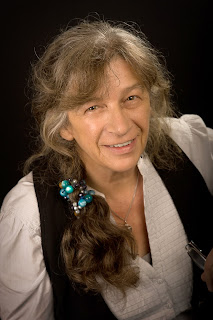
Angela France, photograph by Derek Adams


Angela France has had poems published in many leading journals and has been anthologised a number of times. Her publications include Occupation (Ragged Raven Press, 2009), Lessons in Mallemaroking (Nine Arches Press, 2011), Hide (Nine Arches Press 2013) and The Hill (Nine Arches Press 2017). The Hill was developed into a live multi-media poetry show which Angela toured, funded by Arts Council England. Her latest collection, Terminarchy, was published by Nine Arches Press in July 2021 and launched at Ledbury Poetry Festival. She has an M.A. in Creative and Critical Writing and a PhD from the University of Gloucestershire. Angela teaches Creative Writing at the University of Gloucestershire and in various community settings.


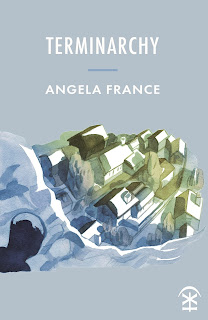
Cover by Fumio Obata


About Terminarchy, by Angela France

Angela France’s distinctive new collection of poems, Terminarchy, eloquently considers the troubling terms of existence in an age of climate catastrophe and technological change. How do we negotiate a world where capitalism and greed threaten a fragile earth, where technology seems to promise us connection but might also fuel isolation? Where even finding solace in nature reminds us that the seasons can no longer be trusted? How is human urge and want hastening us towards our own ‘endling’ – and what might it mean to be the ‘last’? 

In reframing ecopoetics in her own instinctive, radical, lyrical form, France juxtaposes the accelerated, all-consuming speed of contemporary and future times with the ‘longtime’ and ancient, and considers whether, rather than collison-course, there might be a better way to coexist. Where extinction threatens, these wry, alert poems and their eloquent, earthy voices try to find a way through and look for hope.

You can read more about Terminarchy on the publisher's website here. Below, you can read three poems from the collection. 


From Terminarchy

Endlings

             drift over the earth, gather
in loose clusters, their calls echo
        then cease.
Predators don’t notice prey, run together,
scan and scent the ground on hill and heath
in widening circles until they tire and lie down
alone.
      The Thylacine doesn’t try; he’s released
the need and drive, has given up and found
a place to lie still as he blurs and fades
to become just a shadow 
                                         on the ground.

On a branch above, 
             the passenger pigeon waits;
her claws no longer able to uncurl,
tree-bark patterning feathers as if braided
in mist. Moths and butterflies whirl
between leaves; don’t settle or rest,
ignored by the birds. The Laughing Owl,
the Forest Thrush, circle the sky
                                                possessed
by an undeniable need and scarred
by hope, until exhaustion brings peace
  in death.

A Barbary Lion calls in the hills unmarked
and Sparrow weeps for the want of an ark.

Small Gods

Our gods are poor things, these days,
insubstantial, weak in sinew and bone,
worshipped through clicks and clichés
and starved though we try to atone
through getting and losing, the sacrifice
of things we don’t need. We’ve grown
past thunder and threat, gods in disguise
to walk among us as man or bull; strength
only known or used as a way to victimise
different thoughts or ways to enhance
helpless lives. We’ve lost Thor’s hammer
Apollo’s bow and Odin’s mead, take offence
at any prick to our comfort while we clamour
on keyboards for anything to fill the holes
they’ve left.  We may edit a page’s banner
to signal who we are but try to control
anything real, of blood and flesh,
by pinning to screens where we can scroll
past whatever disturbs.  Copy, paste, refresh,
we are a worn people whose shrivelled gods
are enshrined in phone lenses as we try to possess
any thing to salve a communal sense of loss.


Down Piggy Lane

The path skulks round the back end of a housing estate,
hidden by overgrown shrubs and tattered trees
either side of the sullen brook. Scraps and patches  
of land line the trail, one-proud fences sagging between.
Pig arks are empty, fading grass straggling 
up the sides. Competing cockerels shout
from pens, hidden by a clutter of buckets,
upturned feed tubs and a green-scummed bath. 

Every patch has a shed or shelter, all alike
in their difference. Walls patched 
with multi-coloured iron, rust collecting
in the corrugations. Here an old front door 
with a fanlight and ghost of a number,
there the lichened side of a caravan.

My foot catches in the muddy ruts and humps
of the path and I stumble into a memory
of dreaming through afternoon school,
waiting for when nine-year-old legs could pump 
the bike pedals, carrying a Tupperware beaker 
of milk for feral kittens and windfall apples
stuffed under my jumper for a shaggy piebald pony. 

How have I forgotten all I wanted then?
To own one of those fields, to live 
in a ramshackle shed with the kittens 
and the pony’s head looking through 
feed-sack curtains, a few large dogs,
a nest of slow worms under the floor
and any other creature who found me.
How once such things were enough.   

Friday, 26 November 2021

Ian Humphreys (ed.), "Why I Write Poetry"


About Why I Write Poetry: Essays on Becoming a Poet, Keeping Going and Advice for the Writing Life, ed. Ian Humphreys

What motivates poets in the 21st century? How do they find their voice? What themes and subject matters inspire them? How do they cope with set-backs and deal with success? What keeps them writing? Why I Write Poetry, edited by Ian Humphreys, combines twenty-five lively and thought-provoking essays, along with individual writing prompts to help you create your own new poetry.

The book includes essays by Romalyn Ante, Khairani Barokka, Hafsah Aneela Bashir, Leo Boix, Vahni Capildeo, Mary Jean Chan, Jo Clement, Sarah Corbett, Jane Commane, Rishi Dastidar, Jonathan Edwards, Rosie Garland, W. N. Herbert, Ian Humphreys, Keith Jarrett, Zaffar Kunial, Rachel Mann, Andrew McMillan, Kim Moore, Pascale Petit, Jacqueline Saphra, Clare Shaw, Daniel Sluman, Jean Sprackland, and Jennifer Wong.


Ian Humphreys, photograph by Sarah Turton

About the editor

Ian Humphreys’s debut collection Zebra (Nine Arches Press, 2019) was nominated for the Portico Prize. He is the editor of Why I Write Poetry (Nine Arches Press, 2021) and the producer/ co-editor of a forthcoming anthology on Sylvia Plath (Nine Arches Press, 2022). His work has been highly commended in the Forward Prizes for Poetry and won first prize in the Hamish Canham Prize. A fellow of The Complete Works, Ian’s poems are showcased in Ten: Poets of the New Generation (Bloodaxe).

You can read more about Why I Write Poetry on the publisher's website here. Below, the editor Ian Humphreys shares an anecdote about an encounter and advice he received, and his own later instinct to "voice the unsayable." 


From the Introduction to Why I Write Poetry

The late poet John Ash once pleaded with me not to take up poetry. 

It was 1983. He had cornered me in the newly renovated kitchen of a house in Whalley Range. John rented the adjacent room. My friend Tarik rented a room on the second floor. Another friend Mark was pirouetting by the dishwasher when John stormed in to complain about the noise. 

We had been giddily fixing 3am snacks while attempting an off-key rendition of ‘Love Pains’ by Yvonne Elliman, so it was a fair cop. John didn’t stay angry for long. He asked what I was studying, what my plans were, and seemed relieved to hear they did not involve poetry. 

‘Good choice, very sensible. Whatever you do, please don’t become a poet! Stick to something where you can earn a bit of money.’ I remember laughing to myself. At that moment, I honestly could not think of anything I would enjoy less – an occupation that seemed duller – than writing poetry. 

While researching this book, I discovered that around the time we met, John had written a short essay about his collection The Goodbyes (Carcanet, 1982). The piece was republished two decades later in Don’t Ask Me What I Mean: Poets in Their Own Words (Picador). 

One part of the essay, in particular, caught my eye: ‘… many of the poems were written to the accompaniment of the kind of music you might hear at parties or in good nightclubs, that is to say, songs of August Darnell, Ashford and Simpson or the Chic Organisation, and on occasion the words of these songs have found their way into the poems.’ 

If only John had mentioned this during his pep talk. Perhaps I wouldn’t have waited thirty years before starting to write poetry myself. At school, we were taught the Romantics, nothing modern. After sitting my A-levels, I did not pick up a book of poems for two decades. I was unaware that contemporary poetry celebrated popular culture, that a ‘serious’ lyric poet could be inspired by August Darnell aka ‘Kid Creole’ of Kid Creole and the Coconuts. 

John and I hardly spoke again. Once, over burning toast, he recommended Prince’s overlooked early albums. A year or so later, I heard he had moved to New York where he became associated with the New York School of poets. 

Several poems in my debut collection Zebra (Nine Arches Press, 2019) explore my coming of age in 1980s Manchester. The gay club I had frequented the night John advised against poetry as a vocation is a touchstone in the book. I began to write about those early days on and around Canal Street, I think, to try and work out something about my formative years. For sure, there was joy, exhilaration and freedom. But there was also fear; a background dread that we accepted back then as part of life’s rhythm, as relentless as the four-on-the-floor beat of those Hi-NRG hits we lived for. It was fear of the unknown. Fear of illness. Fear of society’s disapproval which at any moment could mutate into danger.

Such contradictory emotions can be difficult to articulate, as slippery as a lager-soaked dancefloor. What I longed to communicate was feeling not fact, and this seemed best conveyed through the shimmering medium of poetry. 

The need to voice the unsayable – reach for the ungraspable – is one of the main reasons I write poetry. It’s a motive I share with many of my peers. When I turned to social media to ask why poets do what they do, many replied with answers along the lines of: 

To make sense of life. 
To make sense of the world. 
To connect with my inner world. 
To say things I could not otherwise express.

Another response that came up, again and again, was compulsion: 

I write poetry because I must. 
It is a thing I do, like breathing. 
I wrote poetry before I could write. 
I can’t help myself. 

Over one hundred poets responded, with variations on these two themes accounting for around ninety percent of all answers put forward. This posed a question: how could we prevent our contributors from writing multiple versions of the same essay? 

The answer? Jane [Commane] and I identified what we most admired in the work of the selected poets. We then asked each of them to explore a theme reflecting this idiosyncratic quality as they riffed on their craft. 

As you will discover, the tactic worked wonders. The resulting twenty-five essays are fascinating and varied. There’s little repetition, and thankfully even less navel-gazing. 

Each piece is unique in its approach to the trials, tribulations and pleasures of writing poetry. The mix of styles is satisfyingly rich, from the informal to the academic, the lyric to the dreamlike. Together, the compositions stand as testament to the robust state of poetry in 21st century Britain. 

Had I not started writing eight years ago, I would have missed out on so much, including the chance to curate and edit this book. As such, I am delighted I listened to instinct rather than advice, and eventually shimmied my way towards a calling, of sorts, in poetry. 


Wednesday, 12 May 2021

Kate Fox, "The Oscillations"


Kate Fox is a poet based in Northern England who has made two comedy series for Radio 4 and written and performed numerous broadcast poetry commissions as a regular on Radio 3’s The Verb and Radio 4’s Saturday Live. She won the Andrew Waterhouse Award for poetry from New Writing North in 2006. Her previous publications include We Are Not Stone (Ek Zuban, 2006), Fox Populi (Smokestack, 2013) and Chronotopia (Burning Eye Books, 2017). She completed a PhD in performance in 2017 from the University of Leeds, researching Northernness and comedy. She loves swimming outside, spaniels, Doctor Who and big skies.


About The Oscillations, by Kate Fox

'And suddenly the plagues are the most interesting parts of a city’s history.'

So begins poet Kate Fox's distinctive new collection The Oscillations as it explores distance and isolation in the age of the pandemic, refracted through the lenses of neurodiversity and trauma in poems that are bold, often frank and funny but also multifarious, dazzling and open-hearted in their self-discoveries.

Fox's poetry explores difference and community, silence and communication, danger and belonging - and a world that has been distinctly broken into a 'before' and 'after' by the pandemic. Throughout, a strong voice sings of what it means to be many things at once - autistic, creative, northern, a woman. Fox measures not only distances, social or otherwise, but how we breach them, and what the view might be from beyond them.

You can see more details about The Oscillations on the publisher's website here. Below, you can read two poems from the collection. 


From The Oscillations, by Kate Fox

Skimming 

The walk measured our breaths,
the first day 
our knees ached going up the steps,
as we limboed under the tree
whose fall seemed to echo the world.

We sat on the stone beach 
by the river, spectated the other side
as if it was a film.
How much movement there is
and sound, I said,
how quiet it is and still
you replied. 

A week later we will walk into the scene
and you will say change 
is sometimes just a walk 
on the opposite side of the river

I am there now,
skimming stones uncertainly,
dunking them with a splash.
I had the knack once,
but needed to be re-taught
or un-learn the urge to throw.

My Mother was not patient
about how clear I needed instructions to be,
how much longer than for other people
it takes me to learn by seeing, 
or building up muscle memory.
Now I am quick to disguise
the ways in which I am slow.

So mercurial with words,
I couldn’t learn your house alone.
There you are across the water.
Will you remember 
how it really was, 
when we found this place together?
Where did you go? 


The Funerals 

The funerals happened outside,
if at all, the end of that spring

when daffodil coronas crinkled 
like elderly necks,
this year’s tasks done,
lining the verges as if waiting for someone
to clear them away.

We gathered under the shelter 
of the crematorium’s porch,
semi-circling the coffin 
they’d brought out on a trolley
like luggage. 

A small music speaker,
a photograph of her magically restored 
to twenty two,
hand sanitiser in our bags,
seven shot glasses for sherry.

I didn’t know the green globe
ready to release when the petals fall
is called an ovary.

Her neighbours placed a plastic folder
containing a photo collage of her garden 
on the coffin.
The display she didn’t get to see this year
had never been more magnificent

and something I only half-believed
when every afternoon ended 
with the totting up of the dead-
the day after she died,
her daffodils bowed their heads.