Showing posts with label translation. Show all posts

Thursday, 24 April 2025

"Tâigael: Stories from Taiwanese and Gaelic," ed. Will Buckingham and Hannah Stevens (Wind&Bones)


About Tâigael: Stories from Taiwanese and Gaelic 
Four writers, four stories, and four languages, Tâigael is a first-of-its-kind collaborative writing and translation project, bringing together the cultures of Scotland and Taiwan to find new and surprising connections. From elderly prophets on the Taipei subway to sheep tangled in brambles by the roadside in rural Scotland, and from a goddess of saliva who disappears without trace to an unexpected guest at a Hogmanay party, these stories cross between languages and cultures to reimagine the past, present and future. For the project, Wind&Bones worked with writers Elissa Hunter-Dorans (Scotland), Kiú-kiong 玖芎 (Taiwan), Lisa MacDonald (Scotland) and Naomi Sím (Taiwan) to write and collaboratively translate between Taiwanese (Tâi-gí) and Scottish Gaelic (Gàidhlig), via Mandarin and English. These are stories that weave together myth, dream and everyday life, as they reveal unexpected parallels between these two languages, their historical marginalisation, and their revival.

Tâigael: Stories from Taiwanese and Gaelic will be published by Wind&Bones Books on 15th June 2025. You can pre-order the book here. If you pre-order by 1st May, 2025, your name will be listed in the final edition, in appreciation of your support.


About Wind&Bones
Wind&Bones Books is a small, non-profit indie press founded by University of Leicester PhD graduate Dr Hannah Stevens, and former De Montfort University Reader in Writing and Creativity, Dr Will Buckingham. Wind&Bones also run projects exploring writing, storytelling and philosophy for social change. Hannah and Will currently split their time between Scotland, Taiwan and sometimes Leicester. You can head to their website to find out more here.   

Sunday, 13 April 2025

Hannah Lutz, "Wild Boar," trans. Andy Turner


Hannah Lutz was born in 1984 and grew up in Ekenäs, in southern Finland. She has an MA from Finland’s Åbo Akademi University. She later moved to Denmark and attended the Writing School in Copenhagen. Still based in Denmark, she lives just outside Roskilde. Her short story ‘Den elfte versionen’ / ‘The Eleventh Version’ won the Umeå Short Story Award, Sweden, in 2011. Vildsvin / Wild Boar is Lutz’s debut novel. Written in Swedish, it was first published as the Danish translation in 2016 by Rosinante in Denmark; the original Swedish text was first published in 2017 by Förlaget in Finland and Albert Bonniers Förlag in Sweden. Her second novel, Selma, was published by Förlaget in Finland and Gutkind in Denmark in 2023.


About Wild Boar, by Hannah Lutz
To witness. To contain. To hunt.

The forests of Småland are home to a growing population of wild boar, once on the verge of extinction. They move in packs at night. Gardens are destroyed, farmland churned up. Yet their illusiveness draws in both visitors and inhabitants.

Ritve is making a pilgrimage from Finland to track them down. Council worker Glenn finds his quiet life disturbed by their night-time visits and his visions of apocalypse. Mia hopes her local history residency in the old primary school will help her grandfather recover his memory and voice.

Told by three people newly arrived in an isolated community, Wild Boar is a compelling and poetic debut from Finland-Swedish author Hannah Lutz about animals and people, their places in a changing ecosystem, and their capacities to grow and to destroy. It is translated from the Swedish by Andy Turner.

You can read more about Wild Boar on the publisher's website here. Below, you can an excerpt from the opening of the novel. 


From Wild Boar
I have seen them, the wild boar, they have found their way into my dreams! Now I know the way they move, the sounds they make when they sneak into the gardens. I have to listen carefully to hear their trotters and snouts in the grass. They are so numerous, so solid, and yet they make such light work of quietly moving around, it’s incredible. Here I am, heavy and warm with sleep. I open the curtains, see the sea. The sheets on the bed are white. 

This is what I know of Hornanäs: to get there I will make my way to Småland, to Tingsryd, and midway between Tingsryd and Linneryd I’ll turn right. In the village there are four or five occupied houses, three or four abandoned ones. In a yellow house, surrounded by apple trees, lives Arnold Falkberg. The landscape is made up of lakes and productive forest. Wild boar hunting is permitted throughout the year. 

Arnold Falkberg often has a camera with him when he is in the forest. Many people film wild boar, most focusing on the hunting. I’ve seen the clips they post on YouTube. In a Swedish Television documentary, Arnold Falkberg is known as The Hunter of Hornanäs, his hunting rifle propped against the armchair during the interview. But now I’ve seen the footage he’s posted, I don’t believe he’s fired a shot at a single wild boar in his life. The hand holding that camera is intent on something completely different. 

Tuesday, 1 August 2023

Maram Al-Masri, "The Abduction," translated by Hélène Cardona


Maram Al-Masri was born in Latakia, Syria, and moved to France following the completion of English Literature studies at Damascus University. She is considered one of the most influential voices of her generation. 

Her books include Métropoèmes, Je te regarde, Cerise rouge sur un carrelage blanc, Le Rapt, Elle va nue la liberté, Par la fontaine de ma bouche, La robe froissée  (all Bruno Doucey), A Red Cherry on a White-tiled Floor (Copper Canyon), Le retour de Wallada (Al Manar), Je te menace d’une colombe blanche (Seghers), and the anthologies L’amour au temps de l’insurrection et de la guerre (Le Temps des Cerises), Femmes poètes du monde arabe (Le Temps des Cerises), and La poésie des femmes kurdes, as well as several children books. 

She is the recipient of a number of prestigious literary prizes, including the Prix d’Automne 2007 de Poésie de la Société des Gens De Lettres, the Adonis Prize of the Lebanese Cultural Forum, the Premio Citta di Calopezzati for the section Poésie de la Mediterranée, Il Fiore d’Argento for cultural excellence, and the Dante Alighieri Prize.

She is a member of the Parlement des écrivaines francophones and was appointed Ambassador of the Secours Populaire in France and citoyenne d’honneur of Vendenheim. In 2017, the Maram Al-Masri Prize was created, which rewards poetry and graphic works.


Hélène Cardona is a poet, actor, translator, and linguist, the author of Life in Suspension (Salmon Poetry), called “a vivid self-portrait as scholar, seer and muse” by John Ashbery, and Dreaming My Animal Selves (Salmon Poetry), described by David Mason as “liminal, mystical and other-worldly,” adding, “this is a poet who writes in a rare light.” Hailed as visionary by Richard Wilbur, Cardona’s luminous poetry explores consciousness, the power of place, and ancestral roots. It is poetry of alchemy and healing, a gateway to the unconscious and the dream world.

She has authored the translations The Abduction (Maram Al-Masri, White Pine Press), Birnam Wood (José Manuel Cardona, Salmon Poetry), Beyond Elsewhere (Gabriel Arnou-Laujeac, White Pine Press), Ce que nous portons (Dorianne Laux, Éditions du Cygne), and Walt Whitman’s Civil War Writings (University of Iowa).

Hélène is the recipient of over 20 awards & honors, including the Independent Press Award, a Hemingway Grant and an Albertine and FACE Foundation Prize. Her work has been translated into 19 languages. She wrote her thesis on Henry James for her MA in American Literature from the Sorbonne, received fellowships from the Goethe-Institut and Universidad Internacional de Andalucía, worked as a translator/interpreter for the Canadian Embassy, and taught at Hamilton College and Loyola Marymount University. She is a member of the Parlement des écrivaines francophones. Her website is here


About The Abduction by Maram Al-Masri, translated by Hélène Cardona

The Abduction refers to an autobiographical event in Al-Masri’s life. When, as a young Arab woman living in France, she decides to separate from her husband with whom she has a child, the father kidnaps the baby and returns to Syria. The Abduction is the story of a woman who is denied the basic right to raise her child. Al-Masri won’t see her son for thirteen years. 

These are haunting poems of love, despair, and hope in a delicate, profound and powerful book on intimacy, a mother’s rights, war, exile, and freedom. Maram Al-Masri embodies the voice of all parents, who one day, for whatever the reason, have been forcibly separated from their loved ones. She writes about the status of women, seeking to reconcile her role as a mother with her writing work. 

You can read more about The Abduction on the publisher's website here. Below, you can read a sample poem from the collection. 


From The Abduction

Under the bed

Under the bed
I found the teddy bear
you smothered with kisses
the one you talked to, eyes wide open
waiting for the angel of sleep to come

Remember how it stopped
the storm of your cries
when I waved it at you
‘til the night of your eyes glistened
and even the Niagara Falls
stopped falling

You tore it from my hands
clutching it against you
soothed
It was your companion
to face the night
your silent friend
the one you neglected when busy
the one you looked for when sad

The teddy bear and angel of sleep
keep looking for you

Friday, 21 January 2022

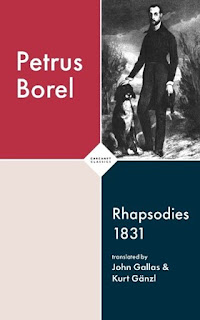
Petrus Borel, "Rhapsodies, 1831," trans. John Gallas and Kurt Gänzl


About Petrus Borel, Rhapsodies 1831, trans. John Gallas and 
Kurt Gänzl  

‘Borel was the sun,’ said Théophile Gautier, ’who could resist him?’ Indeed, who? A lycanthrope, necrophile, absurd revolutionary, Paris dandy with a scented beard, flamboyant sufferer: a man with no grave and no memorial.

His once celebrated red mouth opened briefly ‘like an exotic flower’ to complain of injustice and bourgeois vulgarity; of his frustration in love and reputation; of poverty and blighted fate. Then he withered in the minor officialdom of Algeria, where he died because he would not wear a hat, leaving a haunted house and a doubtful name. ‘And now,’ says his eccentric biographer Dame Enid Starkie, ‘he is quite forgotten.’

Rhapsodies includes all the poems Borel wrote when he was twenty and twenty-one. At the time he sported a red waistcoat, wide-brimmed hat with ribbons, black cloak thrown over his shoulders, and was followed about by admirers. The poems, he said, are ‘the slag from my crucible’: ‘the poetry that boils in my heart has slung its dross.’ It is a fabulous, fiery, black-clouded dross: captains and cutlasses, castles, maidens, daggers, danger; calls to arms, imagined loves, plaints and howls of injustice. ‘Never did a publication create a greater scandal,’ Borel said, ‘because it was a book written heart and soul, with no thought of anything else, and stuffed with gall and suffering’. It was not reviewed. Now it is back.


Borel, Rhapsodies: Why & How, by John Gallas

My first book of translations for Carcanet, The Song Atlas, featured one poem from each country of the world, according to the (then – and since updated) Official United Nations List. Six years of finding poems, discovering and persuading first-draft translators, and then, myself, re-poeming the results, persuaded me that translating was both deeply enjoyable and deeply worthwhile. 

How else would English-reading folks ever get their glorious glimpses of Mango (Guyana), ‘2 Termite Skyscrapers’ (CAR), or the poetry of Ojars Vacietis (Latvia) or Gonzalez Prada (Peru)?

The method for The Song Atlas is the one I have always used: a native-speaker translates the poem, once found and usually chosen by them, into a word-by-word, line-by-line English version, which I then ‘re-poem,’ using any notes provided hinting at, or describing, tone, rhyme, gravity (or not), metre, and anything else they think relevant. As a language-free New Zealander, with only a sprinkling of Anglo-Saxon and Old Icelandic, and an almost complete lack of other-language-learning aptitude, my reliance on others is happily total.     

It’s said that the poems of The Song Atlas and 52 Euros often ‘sound like me.’ Any poet/translator, working at a poem with their full bag of skills and commitments, must, I think, perforce produce something like and of their own kind. I have no theories about the translation of poetry: only that it is a good thing when well done. For a poet (of 10 Carcanet books and 15 others elsewhere of my own poetry) translating is a fascination: freed from providing the ‘original’ emotions, thoughts, feelings, ideas and some elements of personal style, the performance becomes an exercise in a kind of different sameness, a meticulous making of something ‘other’ that requires all the efforts, skills and sympathies usually put to work for one’s ‘self.’   

Kurt Gänzl, my brother, was the French-native-speaker for the Song Atlas translation of Belgium’s entry - ‘Spade,’ by Emile Verhaeren (1855-1916) - as well as for several other French-language poems in the book. We particularly loved the Verhaeren poem, and when it came to putting together 52 Euros (also Carcanet: a translation of 52 European poets, being an A-Z of male and female writers, each represented by a selection of their poems), we collaborated on 10 of his poems for ‘V is for Verhaeren.’ 

Kurt is a prompt and meticulous worker, and a clear-headed indicator of the ‘kind’ of poem he is translating, which information and ideas are much appreciated at this end (he in NZ, me in Leicestershire). Being brothers, we understand what we are each getting at, and often At Speed. 

So on we went, translating a selection of Florian’s Tales, carefully rhymed and metred, as well as poems by Genet (published in The Long Poem magazine), Baudelaire (‘Cat,’ Guardian Poem of the Week), Paul Eluard, Marie de France, Irène Hamoir, Hugo von Hofmannsthal, Jules Laforgue, Maeterlinck, de Nerval, Suzanne Renaud, Renée Vivien, Marguerite Yourcenar (all in 52 Euros) and then …

... up popped Petrus Borel. 

Well, we were looking for a new challenge, at first simply for enjoyment’s, and perhaps a small contribution to a magazine’s sake. Borel seemed unknown, and apparently untranslated into English, and the text of Rhapsodies was available online. So we began with ‘Prologue,’ ‘Benoni’ and ‘The Olden Captain’ and, pleased with the results, agreed we would try a few more. 

At this point I found Enid Starkie’s biography of Borel. I bought it, and read it with some trepidation, hoping not to find some description of his style hopelessly at odds with what we had produced. Not only did this not happen, but it became clear that Petrus Borel’s life was patchily known, and thus Enid Starkie’s book was padded out with contemporary matters in nearly every second chapter. Why did it matter? It is somehow more satisfying to a translator to at least in some degree ‘discover,’ and be first with their subject and their matter. So we continued with a certain excitement, Enid Starkie’s apparent judgement being (a) that Borel was worth a book, being her biography, and (b) that he was a major-minor, or minor-major poet. Perfect. Such poets and their poems often make for translating at its best.  

Here, Carcanet, Michael Schmidt, and PN Review gave us a happy kick. Editor Michael Schmidt liked the poems thus far, and urged us on. We were, quite suddenly, looking at the whole book. Kurt was doubtful: there was a ‘bit of a play’ in there, and a long Preface, and some strange, whirling poems that seemed on the lunatic side. But we gamely decided we would do the job entire. 

Slowly but surely – over two years – Petrus Borel and his Rhapsodies took shape in all their mad, posturing, sensational, gut-wrenching, self-advertising, cod-revolutionary, egotistical brilliance. Even the ‘bit of a play,’ a well-rhymed Gothicky melodrama, and the Preface, a splendid rant of self-importance and undoubted commitment, were hugely rewarding. As Kurt fell more and more out of love with M. Borel himself, and his strutting self-pity, I found his confused and frustrated emotions, ‘safe’ revolutionisms, sensational plots, super-added populism+egoism, and radical carelessness mixed with desperate concern to sell, make money, and be liked, more sympathetic. At the same time, of course, Kurt became more and more admiring of Borel’s style, method, originality and ‘swing,’ which I could do nothing else with but try my very best to reproduce with Kurt’s guidance.  

In the end, Preface and Play, the long and the short, we did the whole book. Here it is, in all its wild whirl, as a Carcanet Classic, with the (we think) wonderfully apposite tag-line – ‘It’s back.’ It is that kind of volume. 

You can see more about the book on the publisher's website here. Below, you can read a sample poem from it. 


From Rhapsodies, 1831

For Jules Vabre, architect

To my dear friend, Jules Vabre:
excellent marrow!
with your little spyglass
on the Fat-Well-Off and their big-bald chins –
you and I must be Martians
on this pale and ordered Earth!
Ah, we must be emmets,
doing what we will, here,
in this pithless Paris,
hither and thither like haywisps on water,
like tonic eddies
through a fly-blown swamp.
Ramblers sans rooves, pewless and
popped from our containers
to live! live slaphappily
like sparrers dancing
on chimneytops!
Wildcats waiting in the wings,
the goggling crowd,
and then, up-curtains please! 
we cross
the light-lit stage of Life. 

Friday, 30 December 2016

Review by Ariane Dean of "Trysting" by Emmanuelle Pagano


When looking back on any relationship, whether it be with a partner or a much-loved friend, there are small moments that may seem insignificant, or may seem hugely important, but that nevertheless stay with us long after that person has left our lives. Emmanuelle Pagano’s book, Trysting, is a love song to the small moments, whether they are good or bad. Not so much a collection of short stories, but gathered snippets from people’s lives, written first in French and entitled Nouons-nous, it has since been translated into English by Jennifer Higgins and Sophie Lewis. The book is published in English by And Other Stories, and in the original French by P.O.L.


Every passage is short, the longest being around a page and half, the shortest just one line. This approach gives one the feeling of dipping into someone’s memories, exploring their past, and examining the responses that they may not have given at the time. Each piece is beautifully crafted, and even the bad times are recounted in a steady, calm manner, providing reflection and peace to experiences of great emotion.  The little tales are deeply nostalgic, a glimpse inside the mind of a stranger.

What I adored about this book was that nearly all the passages were non-gender specific. The stories are told in first person, and while they reference pronouns for their partner, the speaker tells little about themselves, enabling the reader to easily input their own personality and experiences into the story. Sometimes it feels like a friend confessing something they had long kept bottled up, other times it is something you yourself had half forgotten. Each passage works in a new object, place, or time, and finds new meaning in simplicity.

Although the stories are unrelated, there is a strong sense of them being tied together, with an underlying theme of the strengths and weaknesses of human nature. The people in these stories seem very real – they are dealing with ordinary worries and loves. However, Pagano’s beautiful writing and the incredible translation makes them seem vastly more important. There are lines that stayed with me for a long time after I had finished reading, and sections that I read aloud to my partner that conveyed ideas far better than I ever could.

My final thoughts on Trysting are that it was unexpectedly comforting. I had expected after the first few stories to find them sad, a little heart-breaking. Dipping in and out and reading a few little stories every now and then, I discovered that the book makes one feel much less lonely in traversing the difficult points in human relationships. Emmanuelle Pagano’s calm, measured approach to the uneasy things that could be made dramatic far simpler, and I closed the book feeling surprisingly much better than when I went in.


About the reviewer
Ariane Dean is a third year student at the University of Leicester, studying English. She has written theatre and comedy reviews for Buxton Fringe Festival over the last three years, and is working on editing past NaNoWriMo attempts to try and make them readable.