Friday, 6 May 2022

Ian Pople, "Spillway: New and Selected Poems"


Ian Pople, photograph by Mark Epstein


Ian Pople was born in Ipswich and educated at the British Council, Athens, and the universities of Aston, Manchester and Nottingham. He has taught English in secondary and higher education in UK, Sudan, Greece and Saudi Arabia. He taught at the University of Manchester for over twenty years. 


About Spillway: New and Selected Poems, by Ian Pople

Ian Pople is a man of the world. He has travelled and taught in the UK, Greece, Sudan and Saudi Arabia. His poems explore England, the larger world, and how changing perspectives readjust the sense of England and home. They deal with borders, crossings, closing boundaries. They are about transitions in space and time, the ways life and relationships change and adapt to illness, love, estrangement and loss.

The traveller changes identities as he moves, responding to different surroundings, and the early poems collected here provide a varied retrospect, moving through Africa, Europe and Asia – so that we read the more recent work from a different perspective. The travel poems explore the range of reactions, appropriations and misappropriations as physical and psychological boundaries are crossed. More recent writing responds to music and the visual arts, using assemblages or bricolage to convey the painfully familiar experience of displacement, dislocation. There are poems that answer back to figures from jazz history, Roland Kirk, Dupree Bolton and Pat Metheny among them. It is wonderful to encounter such an accomplished and varied a body of work which shares with us its vivid spaces and tones. Pople, one of the most lucid critics of modern and contemporary—especially American—poetry, is an original artist in his own right.

You can read more about Spillway on the publisher's website here. Below, you can read a sample poem from the collection. 


From Spillway: New and Selected Poems, by Ian Pople

The Aerodrome

This is rain in the Home Counties.
It falls on station platforms, on bicycle

helmets, on magpies that strut
on the grass, among the crows that spool

from the tops of trees, and winter
wheat as it appears in the field,

the field corner with its weed and rubbish.
It is raining from the corner all the way

to the horizon, to where the ‘no’
is divided from the ‘yes’; and beyond

to that transfiguration, and to you,
old aerodrome among fields, runways

among grass, broken frames, Nissen huts
that rust among the silver birches.

Thursday, 5 May 2022

Amanda Jennings, "The Haven"


Amanda Jennings is the author of six psychological dramas and short stories, published both in the UK and abroad. Her debut, Sworn Secret, topped the Italian bestseller list, and was a UK kindle Top 5 bestseller, while In Her Wake was a W. H. Smith Fresh Talent pick. The Judas Scar, her second book, was optioned and is due to be rereleased later this year with HarperCollins. Her books are set in Cornwall, where her family originates and where her heart lies. The Haven came out in March this year in hardback, ebook and audio, with the paperback due out next spring. The Financial Times called it 'hypnotic,' while Lisa Jewell said it has 'spine-tingling ending that will take your breath away.' Amanda and her husband have three daughters and live in Oxfordshire with a menagerie of animals. Her website is here.


About The Haven, by Amanda Jennings

Winterfall Farm, spectacular and remote, stands over Bodmin Moor. Wanting an escape from the constraints of conventional life, Kit and Tara move to the isolated smallholding with their daughter, Skye, and a group of friends. Living off-grid and working the land, they soon begin to enjoy the fruits of their labour amid the breathtaking beauty and freedom of the moor.

At first this new way of life seems too good to be true, but when their charismatic leader, Jeremy, returns from a mysterious trip to the city with Dani, a young runaway, fractures begin to appear. As winter approaches, and with it cold weather and dark nights, Jeremy's behaviour becomes increasingly erratic. Rules are imposed, the outside world is shunned, and when he brings a second girl back to the farm, tensions quickly reach breaking point with devastating consequences ... 


From The Haven

They lie together, limbs entwined, her body warm against his, his arms looped around her, their breathing synchronised. Somewhere outside an owl hoots. The dog responds with a half-hearted bark then the house stills. The silence is so loud it rings in his ears. He didn’t realise how much he’d missed this stillness until now. When he was a child he’d often creep out of the house at night. He’d lie in the rowing boat moored on the lake or hide in the soft grass in the fields, and stare up at the stars, a billion balls of fire a billion miles away, and imagine he lived on one. This place, this farm, is one of those stars. A new world. Somewhere they can be free. Somewhere he can build a home for his family.


Tuesday, 3 May 2022

Sarah James, "Blood Sugar, Sex, Magic"


Sarah James is a prize-winning poet, fiction writer, journalist and photographer, also published as Sarah Leavesley. Her poetry has featured in the Guardian, Financial Times and Poems of the Decade 2011-2020: An Anthology of the Forward Books of Poetry 2011-2020, as well as in a café mural, on the BBC, on buses and in the Blackpool Illuminations. She is the author of eight poetry titles, an Arts Council England-funded multimedia hypertext poetry narrative > Room, two novellas and a touring poetry-play. Winner of the Hippocrates Prize for Poetry and Medicine 2020, the manuscript for Sarah’s latest collection Blood Sugar, Sex, Magic (Verve Poetry Press 2022) won the CP Aware Award Prize for Poetry 2021. In her spare time, Sarah is a keen walker, cyclist and swimmer, especially enjoying nature outdoors. Meanwhile, her spare room is home to V. Press, publishing award-winning poetry and flash fiction. Her website is here.


About Blood Sugar, Sex, Magic

Blood Sugar, Sex, Magic is award-winning poet Sarah James’s exploration of forty years living with type one diabetes, a life-threatening autoimmune condition that is now treatable, but remains incurable. The collection tracks her personal journey from diagnosis, age six, to adulthood, including the high and the low points, as well as the further long-term health risks lurking in the background. These are poems of pain, but also of love and beauty, taking in motherhood, family, nature, aging and establishing self-identity in a constantly updating world. The route to some kind of acceptance and belonging may be troubled by ‘trying to escape’ but it also ‘holds / more light than your eye / will ever know.’ The manuscript for Blood Sugar, Sex, Magic won the CP Aware Award Prize for Poetry 2021 and the collection is available from Verve Poetry Press here.


From Blood Sugar, Sex, Magic, by Sarah James

Thick-skinned, Thin-fleshed

on diabetes type 1

In the old young days: piss
          on diastix, and a glass syringe
twice the length of my palm.

On the children’s ward, I practised
          on thick oranges. Pushing a needle
through the fruit’s peel was so

unlike the ice-cold sting
          of pressing it through my own
thin-fleshed skin, the weight

of glass in my hand, pushing
          the plunger home. This sterilised
in my mum’s special saucepan,

while I played houses, and childhood.
          Later, lighter plastic for injections,
then a cannula and pump.

Blood tests now, for precision.
          Fingertips pricked to a scarred
numbness. For thirty-five years,

the red of life with a glint of steel.
          Each needle’s point etches
my mind; my body’s rubbed hard

by time. I carry the condition’s
          sharp sweetness in my blood;
its other daily stabs as invisible

as genetics. My fingers are a scabby
          black braille of blood-test marks,
and the smell of man-made insulin.

This wet dependence is survival.


Promise

He starts with a well-placed breath,
hint of a tingle blown gently
across the nape of my neck.

And again. I am a mouth-organ
with many quivering reeds;
silent vibrations amplify inside.

One by one, he un-hooks each bone
of my spine, lower, lower,
and still no lip-touch, no kisses, not

a single brush of finger on skin,
but oh, the soft rush of air,
the slow – fast, fast – slow press

of his presence. I breathe
seduction in.


Along the Edge

Living beside the canal towpath, every day brings doorstep birdsong, frogs and the water’s glisten, pulling me closer.

Moorhens snip the surface; a swan ruffles up a lace dress with her feather-stitched wake towards her reed-moored nest. Shimmering light hides the fast paddling beneath, the deeper flit of fish, and other sunken secrets – rusted metal re-sculpted by weed.

This evening, the hedgerow is a chorus of bird chatter and May blossom. Snazzy bulrushes and tall grasses sway to the late hours’ slow jazz.

As I watch from the footbridge, the sun’s touch warms my skin: a thin layer of amber silks across everything still within the day’s reach.

Here, I’ve no need for frog-princes – the canal carries my love without spilling.

Before night seals over, time skips a single heartbeat. It’s just long enough for me to lift my arms like wings, and dream the ease of quiet flight: rising as high as a whooper swan, looping and curving with the water, but always returning to this, my reed-moored home.

                                                                                     sleep is a ripple
                                                                                     of unseen breaths; a lone owl
                                                                                     hoots through the darkness

Saturday, 30 April 2022

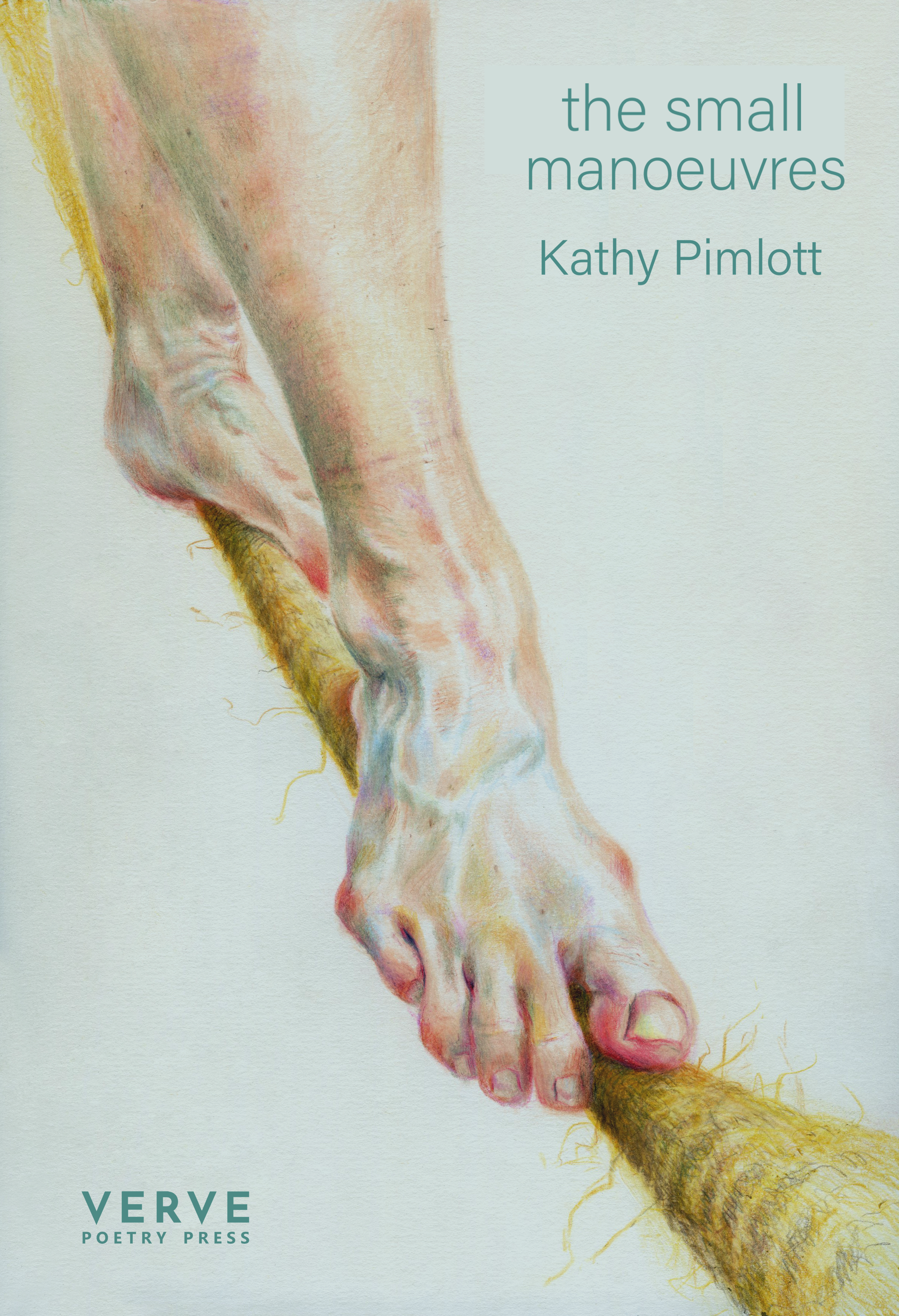
Kathy Pimlott, "the small manoeuvres"


Kathy Pimlott was born and raised in Nottingham but has spent the last 45+ years living and working in Covent Garden, specifically Seven Dials, home of the broadsheet and the ballad. Her debut full collection, the small manoeuvres, was published by Verve Poetry Press in April 2022. She has two pamphlets with The Emma Press, Elastic Glue (2019) and Goose Fair Night (2016), and her poems are published widely in magazines and anthologies. Her poem ‘Closeups in Lockdown’ was one of just 20 chosen for inclusion in the Poetry Archive’s Now! Wordview 2020 Collection. Kathy has been a social worker and community activist, worked on a political and financial risk journal, in arts television and artist development. She currently earns her living as the administrator of a community-led charitable trust.


About the small manoeuvres 

In this, her first full collection, Pimlott slips her arm through ours and draws us in with her deceptively easy and intimate address, separating out the threads that make us – history, class, education, family, work, friendships – to examine 'the small manoeuvres that trundle us over the drop and on.' She weaves back and forwards through a lifetime with a mordant humour laced with tenderness. Fine-tuned to the oddness and beauty of the ordinary, she celebrates them with a relish for the deliciousness of language. There are mice, possible lions, natty Soho dogs, poison, georgette and a mermaid, apples, temples and gentrification, sticky carpets, vegan Bratwurst and aqueducts – something for everyone in this unsettling dance through time, characters and place.   


From the small manoeuvres, by Kathy Pimlott

Return to the Terminus

Too often now I sway into the night,  
that cosy winter dark between tea and
the turning out of pubs and cinemas, 
a late traveller fogging a rattling bus. 
See me on the upper deck with the dogs 
and other coughers, taken up with smoking 
in that sophisticated way, dragon-nostrils. 

I shouldn’t keep going back, am already yellow 
beyond scrubbing. These comfortable excursions
just won’t do while all the while life howls 
for attention. Last year a clever man I knew 
a bit courted a death he didn’t believe in. 
Visiting, face it, out of a desire to be blessed,
by happenstance I was invited into the scan,

into the intimacy of his scarred insides, 
to witness a death sentence, 90% sure, but, ah, 
that golden 10. First question: can I still 
have a drink? He died, swollen, in a hard clutch. 
And now this other man, mine, heads that way too. 
But anyhow, look, here comes the whipsmart clippie 
machine grazing her hip, its crank and buttons 

primed for pernickety fares. Only she commands
the bell: one for stop, two sharp dings for go. 
If I don’t tell you, how will you ever know about 
that bronco ride of side benches, the fear of slipping 
right off the bus as the driver speeds, skips stops, reckless 
on corners, to the end of his shift? It’s late, so join me, 
grip the pole, lean out into those bright, melancholy lights.


The Grand Union Canal Adventure

We three old girls, fractured 
by the usual losses, aren’t mended 
Japanese-style with precious seams 
that make each fissure sing,
but rivetted: serviceable, not art.

To prove our mettle, we choose 
to chug along the old Grand Union,
moor by fields of roosting geese 
to sway in darkness on the water’s 
shallow, dreamless shift.
 
Forty feet above the Ouse, I’m left.
The others go below to show me 
I can, despite my doubts, skipper us
along the strait way of the aqueduct, 
not falter, step back into empty air 

down into the river’s wilder waters. 
On a narrow boat there’s no choice
but to make the small manoeuvres 
that trundle us over the drop and on, 
now and again to know the satisfaction 

of a perfect approach to a bend. 
Shins bruised, knuckles scraped raw, 
we tie up, step ashore to climb the hill
up to the Peace Pagoda, so golden, 
so unlikely, outside Milton Keynes.

Wednesday, 27 April 2022

Sophie Haydock, "The Flames"


Sophie Haydock is an award-winning author living in east London. Her debut novel, The Flames, is about the four muses who posed for the artist Egon Schiele in Vienna more than 100 years ago. She is the winner of the Impress Prize for New Writers. 

Sophie trained as a journalist at City University, London, and has worked at the Sunday Times Magazine, Tatler and BBC Three, as well as freelancing for publications including the Financial Times, Guardian Weekend, Arts Council, Royal Academy and Sotheby’s.

She has interviewed leading authors, including Hilary Mantel, Maggie O’Farrell, Bernardine Evaristo, Sally Rooney and Amy Tan. Passionate about short stories, Sophie also works as a digital editor for the Sunday Times Short Story Award and is associate director of the Word Factory. She judges writing competitions and hosts her own short story club.

Her Instagram account @egonschieleswomen – dedicated to the women who posed for Egon Schiele – has a community of over 115,000 followers. For more, visit her website here


About The Flames, by Sophie Haydock

Vienna at the dawn of the 20th century. An opulent, extravagant city teeming with art, music and radical ideas. A place where the social elite attend glamorous balls in the city’s palaces whilst young intellectuals decry the empire across the tables of crowded cafes. It is a city where anything seems possible – if you are a man. 

Edith and Adele are sisters, the daughters of a wealthy bourgeois industrialist. They are expected to follow the rules, to marry well, and produce children. Gertrude is in thrall to her flamboyant older brother. Marked by a traumatic childhood, she envies the freedom he so readily commands. Vally was born into poverty but is making her way in the world as a model for the eminent artist Gustav Klimt. 

None of these women is quite what they seem. Fierce, passionate and determined, they want to defy convention and forge their own path. But their lives are set on a collision course when they become entangled with the controversial young artist Egon Schiele whose work – and private life – are sending shockwaves through Vienna’s elite. All it will take is a single act of betrayal to change everything for them all. Because just as a flame has the power to mesmerize, it can also destroy everything in its path …


From The Flames

Then Edith experiences the tipping point – a moment of balance before the descent – the sensation manifesting itself first in her belly. She puts her hand to her stomach, desperate, scared that somehow the baby is in danger, that it is all her fault. Why is she being so reckless? 

She remembers, then, that she has been pushed to the edge by the people she loves most.

It takes less than half an hour for the wheel to complete its circuit. In that time, she has thought of death and love, of blood and betrayal, and where her loyalties lie.

Who can we trust in this world? Edith still hasn’t a clue.

She begins walking again. Where else can she go? She feels as if she were a homeless rambler, one of these unfortunate types who have frittered everything away and must wander the streets, with no chance of redemption or return. She is sure she’s mistaken for such a figure too, grubby as she has become, shivering and shaking. She warms her belly, thinking only of the baby, of its emerging limbs and eyes closed against the darkness inside her.

Edith approaches the market. Stalls are closing up for the evening, men and boys packing away the produce, piling up crates. She runs her hands over wrinkled fruit and meagre vegetables, the prices sky-high.

‘One for a pretty girl, down on her luck,’ a man says, putting his hand beneath his stall and pulling out an orange. He holds it out and she is transfixed. Edith sits down. He produces a knife to peel it. She’s so empty, and the juice is so sweet. It’s rare.

As she is leaving, she touches a stack of tall, brittle firewood, the only type that can be sourced during this sad war, and imagines the flames that will consume it, given time. They promise so much: life-giving warmth, and destruction. A line that is so terribly fine.

Monday, 25 April 2022

Robert Graham, "The Former Boy Wonder"


Robert Graham is the author of the novel Holy Joe; the short story collections The Only Living Boy and When You Were a Mod, I Was A Rocker; and the novella A Man Walks Into A Kitchen. His play about fans of The Smiths, If You Have Five Seconds To Spare, was staged by Contact Theatre, Manchester. He is co-author, with Keith Baty, of Elvis – The Novel, a spoof biography; and, with Julie Armstrong, Heather Leach, Helen Newall et al, of The Road To Somewhere: A Creative Writing CompanionEverything You Always Wanted to Know About Creative Writing, and How To Write A Short Story (And Think About It). He grew up in Northern Ireland and for most of his adult life has lived in Manchester. He teaches Creative Writing at Liverpool John Moores University. For more information please see his website here and follow Robert on Instagram @robert55graham. 

Below, you can read more about his new novel, The Former Boy Wonder, published in 2022 by Valley Press. 


About The Former Boy Wonder, by Robert Graham

My novel offers an insight into the way a man’s mind and heart works – not always with great wisdom. Mid-life crisis men who, failing on many levels, seek comfort in chasing after the ghost of their first love cause a lot of pain to the women who live with them. These men are also ridiculous. Because many have experienced it, this theme may appeal to women readers. It may also appeal to men who are having a similar mid-life crisis. 

Peter, the protagonist, is a romantic who is also needy and a bit of an idiot. The novel leans towards the side of the women in it, but at the same time, Peter is funny and has a fair degree of charm. So many readers won’t like his behaviour, but they may end up on his side – even though they will know he is heading towards a self-inflicted disaster. 

Peter’s attitudes and behaviour are not uncommon in mid-life men. Research shows that men often romanticise their first loves in a way that women don’t. To that degree, he may resonate with both female and male readers. Some will have experienced what happens when the dying of the light causes them to make foolish decisions while others may relate to frustrations and temptations my protagonist experiences in the course of the novel.


From The Former Boy Wonder

I was a romantic boy, looking for some whispered mystery, hungering for wonder. In my teens, I had a flickering dream about the fabulous girl who would someday appear. I would see her and recognise her, and life would finally begin. For years before this dream, though, I believed I lived under an evil spell. I had been the little prince, the apple of my father’s eye, and then he left. The little prince had lost his kingdom; he had been a happy little boy before it all went wrong. By the time I went to college, my circumstances had primed me to be rescued, reborn once I met this fabulous girl. She would appear before me, I would be hit by a bolt of lightning, fall for her in a heartbeat. That was the dream.

Manchester was bigger and more exciting than Belfast, any day. I arrived at the Poly and entered a new universe. In Manchester, nobody blew up bus stations and people didn’t shoot each other. Over here, it was safe to go out and have fun. British bands, the ones I listened to and read about pretty much never came to Belfast. The only gig in town was Rory Gallagher, who played the Ulster Hall at least once a year and swept audiences away, but that wasn’t much compensation for living in a musical ghost town. Yes, British bands who would risk their necks to come over were as rare as a solar eclipse, but every UK tour came to Manchester. Not many years before, I could have caught Bowie’s Ziggy Stardust tour at the Hard Rock in Stretford, and a few years before that somebody shouted ‘Judas!’ at Dylan in the Free Trade Hall. This was the place where the magic names in the NME walked off the page and into a venue that was only a bus ride away.

Friday, 8 April 2022

Rebecca Burns, "Kezia & Rosie"


Rebecca Burns is an award-winning writer of short stories. Her story collections – Catching the Barramundi (2012) and The Settling Earth (2014) – were both longlisted for the Edge Hill Short Story Award. She was nominated for a Pushcart Prize in 2011 and 2020, winner of the Fowey Festival of Words and Music Short Story Competition in 2013 (and runner-up in 2014), winner of the Black Pear Press Short Story Competition in 2014 and, in 2016, was listed for competitions including the Evesham Festival of Words and Music, the Chipping Norton Festival, the Sunderland Short Story Award, and the Green Lady Press Short Story Award. She has also been profiled as part of the University of Leicester’s “Grassroutes Project,” a project that showcases transcultural writers in the county.

Her debut novel, The Bishop’s Girl, was published by Odyssey Books in September 2016, followed by: a third short story collection, Artefacts and Other Stories, in 2017; a sequel novel to The Settling Earth, called Beyond the Bay, was published in 2018. Her first novella, Quilaq, was published by Next Chapter in 2020. Kezia and Rosie is her seventh book.

Her website is here, and you can follow her on Twitter at @Bekki66 and on Facebook at Rebecca Burns.


About Kezia & Rosie

When sisters Kezia and Rosie arrive at their grandparents' house in the summer of 1986 they aren’t sure when they’ll see their Mum and Dad again. 

While her younger sister Rosie is content playing on the allotment gate and having picnics in the garden, Kezia begins to realise that things aren’t quite what they seem. While embraced in Granddad and Grandma’s loving care, it's not long before seven-year old Kezia begins to notice strange looks between them, hushed whispers, and secret phone calls. She realises she must step into the frightening adult world if she is to make sense of her parents' troubled marriage.   

Written in beautifully delicate prose, Rebecca Burns' collection of linked short stories explores how a child learns to navigate new familial territory, the heartache of uncertainty, and a growing understanding of what, exactly, real love means.


From Kezia & Rosie, by Rebecca Burns

This is the best part of a weekend breakfast. When they first came to stay, the sight of creamy fat streaked with brown in the dripping pot made Kezia feel sick. It looked like earwax. Rosie point-blank refused to touch it. But even Grandma eats it on toast, so Kezia tried it. She found she liked the coffee-coloured blobs most of all, for they tasted of meat. Grandad puts a plate of toast in front of her and she takes the earthenware pot and smears dripping on top. He watches and nods. 

‘Good lass. That’ll put hairs on your chest.’ 

Another of his sayings, she’s heard it before. She’s supposed to say in return – ‘but I’m a girl’ – and, because it’s her birthday and she doesn’t feel sad, Kezia does. Then a thought occurs and the words are out before she can stop them.

‘Did my mum like beef dripping when she was little?’ 

Grandad pauses over the frying pan. A frown on his face, which he tries to hide. The toast is a brick in Kezia’s mouth. The feeling of heaviness which has clung to her for days, except for this most precious of mornings, slams back into her. 

‘Not really,’ Grandad says eventually. ‘Your Uncle Andy did.’ 

‘What about mushrooms?’ Kezia can’t believe she’s asking more. But, as it’s her birthday, she wonders if Grandad will open up and tell her something about her mother. It’s bright and early and sun streams through the kitchen window, turning the bottle of washing-up liquid into a collection of emeralds, and the clock ticks round like a steady companion. Kezia can see lint and dust in the air; it seems as if the house has momentarily slipped free of its mooring on Vernon Street, free of its place in the row of pre-war semi-detached houses with identical front lawns and paths and on the 318 bus route into town. At this very moment while Rosie and Grandma sleep upstairs, 3 Vernon Street is a floating space where anything might happen or be said. 

Grandad sighs and turns off the gas under the frying pan. He sits down opposite Kezia. He places a thick hand against the silver teapot and pours himself a fresh mug. 

‘This has been an upside down few weeks for you girls, hasn’t it?’ he says. ‘I don’t think you’re really interested in whether your mum liked dripping or mushrooms.’