Showing posts with label HarperCollins. Show all posts

Wednesday, 13 August 2025

Jo Bell, "Boater: A Life on England's Waterways"


Jo Bell, photo by Lee Allen


Jo Bell is an award-winning poet, writer, and archaeologist whose collections include Kith and Navigation. She was the UK's inaugural Canal Laureate and is a former director of National Poetry Day. Originally from Sheffield and raised on the edges of the Derbyshire Peak District, she has spent the past twenty years living a life afloat on the waterways of England. She can usually be found on a mooring somewhere in Cheshire. Boater is her first memoir.


About Boater, by Jo Bell
After decades of calm aboard England’s historic canals, a turbulent relationship finds Jo Bell embark on a year-long odyssey navigating the country’s canals. Exploring the past and present, Boater is both her story and the story of the living waterways – told with wit, wisdom, and deep insight into a culture found on the other side of the map.

In this beautifully crafted memoir, Jo uses her experience as an archaeologist to guide readers through this floating world. Along the way, there is heartbreak, disaster, a particularly grisly episode involving a Canada goose, biscuits, and an array of unforgettable and curious
characters.

She also highlights the importance of key historical figures who shaped the system we know today – James Brindley, Thomas Telford, L. T. C. Rolt – whose groundbreaking work revolutionised and revitalised transportation in England.

You can read more about Boater on the publisher's website here. Below, you can read an excerpt from the memoir. 


From Boater
This is an adventure story. The adventure is a small one, and the country in which it happens is not on the usual map, because the place where I live is not on your map. It sits inside a parallel geography, on a map-within-a-map of England and Wales. It requires you to look differently at the land you live in. Its history, too, is a history-within-a-history; a rival to the chronicles of great men whose monuments are columns, and whose homes were themselves monuments. This watery nation is an idiosyncratic country, which inspires a love of place without nationalism.

Its people include ordinary workers, clowns, freaks, and charlatans. All share a sense of self, time, and purpose, which makes their world different to the one that lies ten feet away, beyond the water’s edge. I have not crossed the Atlantic in a dinghy with nothing but a jar of peanut butter and a waterproof hat. I have not scaled Everest, or rescued a friend from a crevasse by cutting off my own leg. But then, adventure is not a question of scale. What I have done is travel the waterways of England (and sometimes Wales) for twenty years, meeting with extraordinary people in an extraordinary environment. I have learned a lot about human nature, including my own; about rope, and Brasso, and bravery; and above all, about the necessity for a constant supply of biscuits.


Thursday, 5 May 2022

Amanda Jennings, "The Haven"


Amanda Jennings is the author of six psychological dramas and short stories, published both in the UK and abroad. Her debut, Sworn Secret, topped the Italian bestseller list, and was a UK kindle Top 5 bestseller, while In Her Wake was a W. H. Smith Fresh Talent pick. The Judas Scar, her second book, was optioned and is due to be rereleased later this year with HarperCollins. Her books are set in Cornwall, where her family originates and where her heart lies. The Haven came out in March this year in hardback, ebook and audio, with the paperback due out next spring. The Financial Times called it 'hypnotic,' while Lisa Jewell said it has 'spine-tingling ending that will take your breath away.' Amanda and her husband have three daughters and live in Oxfordshire with a menagerie of animals. Her website is here.


About The Haven, by Amanda Jennings

Winterfall Farm, spectacular and remote, stands over Bodmin Moor. Wanting an escape from the constraints of conventional life, Kit and Tara move to the isolated smallholding with their daughter, Skye, and a group of friends. Living off-grid and working the land, they soon begin to enjoy the fruits of their labour amid the breathtaking beauty and freedom of the moor.

At first this new way of life seems too good to be true, but when their charismatic leader, Jeremy, returns from a mysterious trip to the city with Dani, a young runaway, fractures begin to appear. As winter approaches, and with it cold weather and dark nights, Jeremy's behaviour becomes increasingly erratic. Rules are imposed, the outside world is shunned, and when he brings a second girl back to the farm, tensions quickly reach breaking point with devastating consequences ... 


From The Haven

They lie together, limbs entwined, her body warm against his, his arms looped around her, their breathing synchronised. Somewhere outside an owl hoots. The dog responds with a half-hearted bark then the house stills. The silence is so loud it rings in his ears. He didn’t realise how much he’d missed this stillness until now. When he was a child he’d often creep out of the house at night. He’d lie in the rowing boat moored on the lake or hide in the soft grass in the fields, and stare up at the stars, a billion balls of fire a billion miles away, and imagine he lived on one. This place, this farm, is one of those stars. A new world. Somewhere they can be free. Somewhere he can build a home for his family.


Monday, 14 March 2022

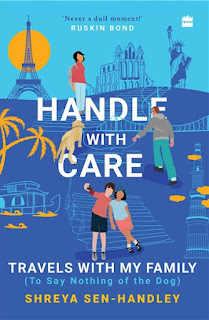
Shreya Sen-Handley, "Handle with Care: Travels with My Family (To Say Nothing of the Dog)"


A CNBC and MTV journalist and producer, and East India head for Australasian Channel [V], Shreya Sen-Handley has authored three books for HarperCollins: the award-winning Memoirs of My Body (2017), short story collection Strange (2019), and travelogue Handle with Care (2022). 

A Welsh National Opera librettist, the first South Asian woman to write international opera, she has written for their film series Creating Change (2020), and operas Migrations (a 200-performer production touring Britain in 2022) and Blaze of Glory (2023). Her play Quiet premiered in London with award-winning Tara Theatre (2021). 

A columnist for National Geographic, CNN, The Guardian, and more, she also writes a syndicated newspaper column for India. Her essays can be found in anthologies, including the University of East Anglia’s Writing Places (2019) and Hodder Education’s British secondary school English textbook, Detectives (2020). 

Her short stories and poetry have been published, broadcast, and shortlisted for prizes in Britain, India and Australia. In 2020, her poetry spearheaded a British national campaign against hate crimes.

She teaches creative writing at British and Indian institutions, including Cambridge and Nottingham Universities, illustrates for Hachette, HarperCollins, Welsh National Opera, Nottingham UNESCO City of Literature, and Nottingham City Council, translates literature for National Literacy Trust, and commentates on BBC Radio.


About Handle with Care: Travels with My Family (To Say Nothing of the Dog)

Shreya Sen-Handley’s Handle with Care is a blithe and zippy travelogue that chronicles her adventures around the globe. In tow, most of the time, is the ‘quirky clan’ comprising her British husband, their two children, and their dog.

Here are tales of the world beyond south Kolkata and Sherwood Forest – places they call home. From much-loved Indian locales like Rajasthan and Kerala to bustling international capitals like New York and Paris, from English idylls like Dorset and Haworth to the sleepy pleasures of Corfu – the journeys are described in vivid detail, seasoned with humour, and sprinkled with wise trip-tips. No matter how gruelling the trek, you weather the storms well, and while you’re about it, have tons of fun, food and epiphanies. Mishaps or not, one learns, there is always magic to find.

These are delightful stories that’ll take you places without having to move an inch!

Here is author, naturalist and TV presenter Lee Durrell’s description of the book: “I feel a deep personal connection to this book. Gerald [Durrell] always told me that one of the reasons for his family’s move to Corfu was that his mother, Louisa, missed India terribly. She had been born, married and brought up children there, relocating to England only because of the sudden death of her husband. In the grey, damp and cold, she pined for the vibrant sights, sounds, scents and tastes of India, for the company of a warm and generous people, and the vivacity and colour her life had once had. Corfu, so like India in these many ways, rekindled her love of living. In this book we’re immersed in India, Corfu and all other points of the compass, the author skillfully guiding our way and revealing the treasures that each and every place surely has. But above all, this is a book about love – romantic, parental, familial and whatever the word is for the family dog. About love of place, history, literature, poetry and art, all around the world. It celebrates adventure and fun.”


From Handle with Care, by Shreya Sen-Handley

From the chapter ‘Corfu: Garden of the Gods’

Exploring the villages and beaches, we stopped to refuel at the open-air tavernas that dotted every jetty, roadside, and spit of white sand. As delicious as the food was, with an abundance of aubergine, lamb, and feta cheese, the joy of taverna-hopping was as much about the varying views it offered each time. The finest were, of course, on the beach, looking out at the cobalt blue Mediterranean Sea, but the roadside ones were perfect for watching people, who were as colourful and chaotic. We enjoyed sniffing out markets just as much, some big and bustling, others secretively tucked away, and a few twinkling around harbours like seashells lost in the sand. From these we bought baskets of fresh, flavoursome food, and the occasional trinket. We swam in the sparkling sea too, but it was a cooler summer than usual, and more joy was to be had in walking along its pristine shore. These delights were entwined with our search for the Durrells’ old villas – the strawberry pink, the daffodil yellow, and the snow white, preserved in my memory from childhood.

We decided to give many of the better-known and disputed sites a wide berth for the hidden gems, even if their links with that famous family were just as weak. This took us to many quiet lanes, overgrown copses, and deserted watering holes no one had set foot in in years. Some we set out to find and never did, some we discovered to be disappointing, so devoid were they of mystery and romance, and others we stumbled upon by chance. Many we drove up to, especially if they were on elevated ground, smelling of evergreens and dusk, so late in the day did we arrive after hours on the hunt. To get to a few though, we had to abandon the car and walk down dense tracks, following glimmers of sunlight, and our instinct for the hidden and the glorious. In an abandoned orchard we followed a pearly glow to find a diminutive but dazzling edifice that was well worth the nettle stings, but not likely to be the Durrells’ snow-white villa for how few of their extensive menagerie of guests and pets it could have held. Down a path of long grasses heading out to sea, we discovered a vibrant yellow establishment, like a sunflower in a field. But we both agreed after a cursory search that it lacked the required je ne sais quoi to be their daffodil-yellow villa.

It was on our way back from this find that we decided to stop for a picnic in a sun-dappled olive grove we’d spied earlier. After a satisfying meal of fresh bread, olives, and feta-stuffed tomatoes, we decided to explore. It was then that we discovered the house concealed in the cypress trees. A house we weren’t expecting because it wasn’t on our map. In a patch of land humming with life but deserted by humans, stood a faded ruby villa, large enough for a boisterous family and its many wards, but not so large that it couldn’t lose itself with time and the onrush of vegetation. We circled it, standing on its vine-entwined porch, looking in through its weathered windows, but as desolate as it clearly was, it felt oddly lived-in too.

We sat on the porch, breathing in the tranquillity of the moment and the reticent beauty of our setting. When my husband put his arm around me, I lay my head on his shoulder, and a few kisses were exchanged. When he leaned in for the fifth (or thereabouts, I don’t often count when kissing), we heard a noise in the house. It could have been a chair pulled back for a better look at what was outside. Or a harumph – the clearing of a human throat – to indicate the undetected presence of an onlooker. We jumped, casting around to ascertain who or what it could’ve been. ‘Can you hear a goat?’ my new husband hazarded, proving himself not very well acquainted with goats. I, on the other hand, had grown up in a part of Kolkata overrun with goats, and knew a cloven hooved critter when I heard one. ‘Human, I think,’ I whispered to him, as we made for our car. We had largesse in the back, in the form of mouth-watering food with which we did not intend to part. Nor did we want to be arrested for trespassing, or for our spate of kisses. Scrambling into the car, we were sure it felt more crowded than when we drove in, yet thought nothing further of it.

Suddenly our own villa was quiet no longer. We heard the tread of unfamiliar footsteps in the empty kitchen. The splash of water when no one was in the pool. Whispers in the garden that weren’t leaves in the breeze. And on one occasion, another of those harumphs we’d heard at the apparently abandoned villa.


Monday, 21 September 2020

Shreya Sen-Handley, "Strange"


Former television journalist and producer for CNBC and MTV, and East India head for Australasian Channel [V], Shreya Sen-Handley is the author of two books with HarperCollins, the recently published short story collection Strange, and the award-winning Memoirs of My Body, published in 2017. A librettist for the Welsh National Opera, the first South Asian woman to have written an international opera according to the international press, their multicultural opera Migrations will go on tour in the UK in 2021. Shreya is also a columnist for the international media, writing for the National Geographic, CNN, The Hindu, Times of India, The Guardian, and more, a creative writing teacher for British universities and other institutions, and an illustrator for Hachette, HarperCollins, Welsh National Opera, Arts Council England, and Nottingham UNESCO City of Literature. Her short stories have been published, broadcast, and shortlisted for prizes in Britain, India and Australia. This year she wrote her first ever poems, which went on to be published and broadcast in Britain and India, as well as spearheading a British national campaign against hate crimes. She is currently working on a new Welsh National Opera production Creating Change in which she combines poetry and illustration, and writing her third book for HarperCollins, the travelogue The Accidental Tourist, alongside her monthly column for top Asian newspapers The Asian Age and Deccan Chronicle.


About Strange

The thirteen twisted tales of the unexpected in Shreya Sen-Handley’s Strange are about everyday people whose lives take unforeseen turns. They find themselves suddenly and inexorably drawn into encounters and situations that weren’t part of their plan, but which result in the shocking revelation of buried parts of their psyches, haunting both them and their readers for a long time after their stories have come to an end. Author Prajwal Parajuly calls the book ‘a superb collection of profoundly unsettling and unusual stories,' whilst Ruskin Bond writes, ‘The author is adept at evoking an atmosphere of fear in apparently mundane situations. After reading some of these dark tales I found myself looking under my bed.’ 

For all its links to India, it has as many to the British Midlands, and the wonders and vicissitudes of life therein. Amongst the stories its people and places have inspired in this collection are ‘Room for Two,’ in which a Nottingham mother and daughter go on holiday to come to terms with difficult truths about themselves, and ‘Full Circle,’ in which the Bengalis of Leicester embrace enchantment in different ways. You can read an extract from the latter story below. You can also read a review of Strange on Everybody's Reviewing here


From ‘Full Circle’ in Strange, By Shreya Sen-Handley

The usually gloomy Bosworth Drive community hall had been transformed by a dozen large chandeliers, loud music, and even louder voices hailing each other in hearty Bengali, into a mela. Except that it wasn’t so much a mela as a pujo. A pujo, mind you, not a puja, Yana reminded herself in that exact finger-waggling manner Putul ‘Aunty’ had, and hid a little smile. A puja is worship of the gods, Biplob Uncle had explained in his pantomime villain way (twirling his moustache and booming at her jocularly), but a pujo is living it up like the gods. 

Pujo, anywhere in the world, means getting up at the crack of dawn to slokas sung in a gravelly, just-outta-bed voice. For Yana, it meant gathering at the festive hub of the community hall bright and early for the most enormous breakfast anyone had ever seen. Luchi, aloor dum, even prawn kochuri if the aunty in charge of the kitchen had woken happy. And the most mouth-watering range of soft, squidgy, syrupy sweetmeats ever served outside Bengal. That was just the start. For the rest of the day, the hall would fill with music and games and as much chatter as could be squeezed in, making up for months of maintaining a stiff, very British upper lip (which even the British no longer bothered with; not since Diana’s death, Biplob said). Lunch would see a mind-boggling array of delicacies, from paturi—spicy fish baked in banana leaf—to patishapta – sweet coconut and cream filled pancakes. And all this was just a prelude to the evening’s revelry! 

‘First you eat, and then you eat again, then you gossip, and (sometimes without being asked) sing until your jaw clacks loosely, and your belly grows so large from all the food, it obstructs your vision and makes you believe your singing is going down well,’ Biplob’s brother, Subir, said with that same twinkle in his eye. Clean-shaven as he was, there was no opportunity to twirl a moustache. ‘Then you repeat it all, till you’re round enough to roll home at the end, promising yourself to never do it again, and yet you do!’

The Bengalis of Leicester were her mother’s folk …