Showing posts with label Oral History. Show all posts

Wednesday, 5 March 2025

"Writing the Coal Face: Oral History and Creative Writing: A Methodology in Practice"

By Kathy Hoyle


On March 1st, 2025, I was invited to chair a discussion at Sunderland Museum with Dr Louise Powell about her work with oral histories and poetry. Louise had used recordings of local people from now-decimated mining communities to create an exhibition of poetry alongside stunning tintype images by local photographer Andy Martin.

When Louise first told me about the project I was instantly intrigued since my own PhD thesis focuses on authentic North-East dialect and narrative voice in working-class fiction. I also use oral history recordings as a springboard for my creative work, so I was keen to see a similar methodology in practice. Moreover, I’m the daughter of a miner. My dad worked in Horden pit, and I was born and raised just down the road from Sunderland, in Hartlepool, so, if ever there was a project that appealed to me both professionally and personally, this was it!

After visiting the exhibition with my Dad, it was clear that ‘Coal Face’ carried a deep reverence for the local mining communities and was a wonderful way of preserving Northeast heritage and history.  By marrying images with poetry and using excerpts of the recordings as voiceovers to accompany both, Powell and Martin had created an exhibition that brought respect and understanding of Northeast heritage to a much wider audience – particularly those who might otherwise have had little understanding of the bravery, camaraderie and resilience of mining communities.

During our discussion, Powell explained that she worked closely with recordings for many months, searching through over 80,000 words of transcript to find emerging themes, phonetic patterns and dialect terms that could be used to create her poetry. In structuring the pieces, she cleverly used different poetic forms to mirror physical and emotional moments in the miners' lives, the constraints of the haiku representing the compact, claustrophobic space within the mine, sonnets reflecting the contradicting emotional lives of the workers, and prose poetry that emulated speech patterns and regional dialect, all perfectly woven through the exhibition alongside the powerful images created by Andy Martin. 

Powell went on to discuss the importance of using dialect in her work. By using dialect, she explained, she was not only preserving heritage and memory but also preserving language. She wanted to stay as true as possible to the recordings and added that to whitewash the local dialect would have made no sense to her at all - how can you authentically represent a regional community without using the language within it?  

She went on to describe her joy at using dialect within her work, the rich beauty of the language and the emotional resonance she felt with the mining community in doing so. 

Several members of the audience were nodding enthusiastically throughout the discussion and one gentleman went on to tell us a wonderfully light-hearted story about how he had worked in a mine in Yorkshire and caused much confusion with his colloquial language. 

It was clear the exhibition was of real importance to the local community, and it has been incredibly well-received. You could see grown men visibly moved while they were walking around the exhibition space. 

My own father’s response was quite visceral, and I was surprised at how emotional he became – holding his hands up to compare his arthritic fingers to the photographs of other miners' hands, his memory sparked by the poetry and recordings and afterward he was quite still for a moment. Then he simply said, ‘I can’t really tell you if these are good memories or bad, but either way, it’s wonderful!’

It seems that Louise Powell and Andy Martin have created something deeply meaningful for both the local community and beyond. It was a real pleasure to be involved and wonderful to see oral history being used so effectively as a spark for creative practice.  

Coal Face exhibition is open until March 15th at Sunderland Museum and Winter Gardens- you can find more information here.

Accompanying podcasts by Dr Louise Powell can be found here.

You can read an interview with Dr Louise Powell on Everybody's Reviewing here.


About the author
Kathy Hoyle’s work is published in literary magazines such as The Forge, Lunate, Emerge literary journal, New Flash Fiction Review, South Florida Poetry Journal and Fictive Dream. She has won a variety of competitions including The Bath Flash Fiction Award, The Hammond House Origins Competition and The Retreat West Flash Fiction Competition. She was recently longlisted for The Wigleaf Top 50 and her work has been nominated for Best Small Fictions, Best Microfictions and The Pushcart Prize. She is currently a PhD Creative Writing student at the University of Leicester. 

Saturday, 11 December 2021

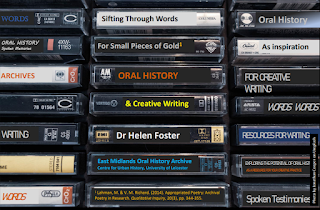
"Let Them Speak! Oral History Archives as an Inspiration for Creative Writing"

By Helen Foster


Oral history is the practice of recording and preserving the memories of people through interviews. These voices can be those often under-represented in other forms of recorded history, including working class people, women, disabled people, black and minority ethnic groups and the LGBTQ community.

Many creative practitioners work with oral history, particularly dramatists and poets. Some go out and record their own interviews and use these in writing and performance. But the potential of material already held in oral history archives is often overlooked. There are thousands of recordings stored at repositories up and down the country. Many are free to access online offering a ready-made resource to inspire the creative writer. 

An oral history interview captures the authenticity that lies in the lived personal experiences of the interviewee. It emphasises the fact that we all experience history differently. Listen in and you can stumble across wonderful subjective moments – anecdotes and jokes – that are open to creative reinterpretation.

You may find some oral histories resonate with your own personal histories; listening to a recording about a place you knew as a child may trigger your own memories of that place, which in turn may seep into your writing. 

It’s not just the anecdotes and stories captured in the archives that can spark creativity. There is the language itself: the words that interviewees use and the ways in which they use them. The seams of vernacular that can run through interviews in the form of accent and dialect words can open up ideas around creative dialogue. The imagery and sensory descriptions that interviewees conjure up can be used as writing prompts.

Writers have a responsibility to work ethically with oral history. Don’t pick chunks of testimony out of an interview and embed it in your creative work. Cherry-pick words, phrases and ideas and use these as starting points for your own responses. Avoid lifting the interviewee out of the recording and turning them into a character in your writing: allow their personality to influence your ideas, by all means, but take a composite approach to character development. Just remember to tread carefully and be respectful of the memories which have been so generously shared for the archive.

You can find oral histories online. Try British Library Sounds for starters. This has recordings from across the UK and further afield. Their Unlocking Our Sound Heritage project has been digitising analogue recordings from across the UK. For more local content, the University of Leicester’s Special Collections Online holds a range of material from the region, including a range of material for the East Midlands Oral History Archive

Contact local archives and libraries to see if they hold any collections. This material is likely to have been collected locally, so consider widening your search if you are interested in material from other parts of the country. 

The majority of oral history remains in analogue format so you may have to find appropriate equipment in order to listen to recordings on cassette tape for example. You may be given transcripts of interviews. These are useful navigational tools, but are not substitutes for the original audio recording. Whenever you can, listen to oral history recordings rather than relying on transcripts. You may decide to create your own oral histories as part of your writing project. The Oral History Society offers advice and training on all aspects of oral history and is your first port of call for up-to-date information on making sure that your work is legal and ethical.


About the author


Dr Helen Foster is a writer and researcher at the University of Leicester, currently working on the Wellcome Trust ISSF project, Sharing Stories: Developing a Wellbeing Approach to Gathering Midlife Narratives. She is also being funded by an ESRC grant to write Menopaurus: Words that Women Use to Talk about Menopause. Helen holds a PhD in Creative Writing and her fiction has been published in Mslexia and performed at the Edinburgh International Book Festival.

Sunday, 14 October 2018

Typewritten Tales: Call for Volunteers

By Divya Ghelani 


Become an oral historian and learn the hidden story of Leicester's historic Typewriter Strike!

Typewritten Tales is an Arts Council supported Oral History Project about the 1974 Typewriter Strike at Imperial Co. on East Park Road. Participants will learn to conduct interviews with former factory workers. These oral histories will form the inspiration for a dynamic series of local flash fiction events called Typewritten Tales and will culminate in a chapbook publication in partnership with the Centre for New Writing at the University of Leicester. 


The project kicks off with an Oral History Collection training session led by the University of Leicester’s Oral Historian Colin Hyde. Colin runs the East Midlands Oral Histories Archive and will be training brand new oral historians on October 17th, 1-4pm in The Seminar Room, 3-5 Salisbury Road. You’ll learn about life on the factory floor, race relations in 1970s Leicester, and how the strike affected workers from the city’s settled working-class community and newly-arrived immigrant workers. We welcome a diverse pool of applicants!

PRE-BOOK this FREE Oral History training with Colin Hyde by emailing typewrittentalesproject (at) gmail (dot) com.