Showing posts with label Canada. Show all posts

Monday, 9 March 2026

Hilda Hoy (金邦琳), "Mother Tongue"


Hilda Hoy (金邦琳) is a Taiwanese Canadian writer, editor, and translator based in Berlin. In addition to working as a reporter for the Toronto Star and the Prague Post, she has published narrative non-fiction in Roads & Kingdoms, Slate, BBC Travel, and Narratively, as well as a travel guidebook titled The HUNT: Berlin. 

She is currently working on an essay collection exploring the entanglement of identity and language in individuals with backgrounds of migration or displacement. In December 2024, this project saw Hilda serve as writer in residence at the Taiwan Literature Base in Taipei. The diaspora experience and examinations of identity are central themes in her writing.


About Mother Tongue, by Hilda Hoy
In Mother Tongue, Hilda Hoy explores the manifold capacities of language: to shape one’s sense of self, to bring together, to hold apart.

Raised in Taiwan by her Taiwanese mother and Canadian father, bilingual from the beginning, Hoy explores her experience of growing up with otherness, and traces how English became her dominant tongue. After many years living in Canada and Europe, her Chinese-speaking self packed into a box and sealed shut, the repercussions of her loss of Mandarin are thrown into sharp focus when her mother is diagnosed with dementia, and begins losing the ability to speak.

A tender exploration of grief and reconnection, of belonging and self, Mother Tongue is the story of a journey to locate one’s voice between hybrid places.

You can read more about Mother Tongue on the publisher's website here. Below, you can read a short excerpt from the book. 


From Mother Tongue
When my father was at work and my mother had errands to run, we sometimes went into the city by taxi. These journeys followed a pattern. Crooning ballads on the radio, the smell of cigarette smoke and perm solution. The crinkle-haired driver examining us in the rearview mirror, brow scrunched in puzzlement. Zhèxiē háizǐ shì shuí de? Whose children are these?

Wǒ de, my mother would reply. They’re mine.

Crooning ballad on the radio. Cigarette smoke. Exclamations of disbelief. How could a woman like her have such white children? They’re mine, my mother would repeat, her jaw tensing ever so slightly. Or: You’re right, I found them on the street. The driver would laugh, but she did not. I understood every word but said nothing, watching the world go by through glass. It seemed pointless to speak when my face spoke for me, telling the only home I’d ever known that I did not belong.


Thursday, 22 August 2024

rob mclennan, "On Beauty: stories"


Born in Ottawa (Canada’s glorious capital city) and raised on a farm near Maxville, Ontario, rob mclennan lives in Ottawa, where he is home full-time with the two wee girls he shares with Christine McNair. The author of more than thirty trade books of poetry, fiction and non-fiction, he won the John Newlove Poetry Award in 2010, the Council for the Arts in Ottawa Mid-Career Award in 2014, and was longlisted for the CBC Poetry Prize in 2012 and 2017. With recent titles including World’s End (ARP Books, 2023), essays in the face of uncertainties (Mansfield Press, 2022) and the anthology groundworks: the best of the third decade of above/ground press 2013-2023 (Invisible Publishing, 2023), On Beauty: stories (University of Alberta Press, 2024) is his fourth work of fiction, after the novels white (The Mercury Press, 2007) and Missing Persons (The Mercury Press, 2009), and The Uncertainty Principle: stories (Chaudiere Books, 2014). An editor and publisher, he runs above/ground press periodicities: a journal of poetry and poetics and Touch the Donkey [a small poetry journal], and co-founded the ottawa small press book fair in fall 1994, which he’s run twice a year on his own since. He is the Artistic Director of VERSeFest: Ottawa’s International Poetry Festival, he spent the 2007-8 academic year in Edmonton as writer-in-residence at the University of Alberta, and he regularly posts reviews, essays, interviews and other notices on his blog here


About On Beauty: stories, by rob mclennan
The thirty-two stories in On Beauty exist as lyrically dense bursts of short prose that move across wide swaths of narrative in compact spaces, offering explorations of characters working through small or large moments. The stories include parenting, pregnancy, the death of a parent, complications between friends, spouses, etcetera. These stories, in their own ways, explore moments as potential sequence, and how each of those moments might impact each other. To ask where, when, how or who: the “why” is the story; all else are facts.

You can read an excerpt from On Beauty below. You can read more about the book on the publisher's website here


On beauty
Upon the death of her widower father, there came the matter of dismantling his possessions. Emptying and cleaning the house for resale. It wasn’t as though either of the children were planning on returning to the homestead, both some twenty years removed, but it fell to them to pick apart the entirety of their parents’ lives from out of this multi-level wooden frame, a structure originally erected by their grandfather and great-grandfather immediately following the Great War. Theirs was the first house in the area, constructed on seventy-five acres of farmland, long since disappeared to development. Across the street, a smaller house of similar design and build, where the hired man and his family had lived. Where, originally, their widowed great-grandmother spent her final days, sixteen long years past the death of her husband.

The house was a local oddity, an obvious construction decades before the brown brick and stone-grey on either side, and contemporary infills. Where the neighbouring bungalow was once their back garden; another, where livestock spent fallow days. Where most likely a barn stood, then a shed, which now hold driveway and garage. Foundation maintenance that routinely uncovers the roots of an orchard. The difficulty of inground pools, and the puncture of linings.

Their father’s house: now that he was dead, it was though it had died as well. They had no choice but to bury it. Not a word. Silence. My wife and her sister, dismantling what would never exist again, and by dismantling, removing it from all but their memory. This, too, will fade.


Friday, 5 January 2024

Angel Dionne, "Sardines"


Angel T. Dionne is an Associate Professor of English literature at the University of Moncton Edmundston campus. She holds a PhD in Creative Writing from the University of Pretoria, and she is the founder/head editor of Vroom Lit Magazine. Her writing has been featured in several journals and anthologies. She is the author of a full-length collection of short fiction, Sardines (ClarionLit, 2023) and two chapbooks, Inanimate Objects (Bottlecap Press, 2022) and Mormyridae (LJMcD Communications, forthcoming). She also served as co-editor for Rape Culture 101: Programming Change (Demeter Press, 2020). She currently lives in Canada with her wife and cats. 


About Sardines
It is a universal enough truth that human beings are social by nature. There is space within us which normally fills up with relationships and rich experiences. When we are rendered solitary by circumstance or temperament, however, that space fills instead with the symptoms of loneliness. Angel Dionne’s dry, observant short stories pull back the lid of that claustrophobic way of life, giving us a vantage on the minor existential pains of people talking most often to themselves.

In this, the author’s first collection, readers will find twelve tinned tales of a world both familiar and disquietingly austere. For all of her economy of expression, Dionne’s investigations into the scenes - hair salon, butcher’s, library, zoo, café - and occurrences - a read-through of the paper, a conversation at the cash-out, an inquiry into the open job - of everyday life are meticulously observed.

Dionne’s story-telling is a kind of narrative atomic theory, in the same philosophical school as the writing of Nancy Huston, Édouard Louis, Valeria Luiselli, Thomas Bernhard, I. L. Peretz. Life, Dionne shows, is not so abstract or so complex that it cannot be made sense of. With sympathy, wit, and a relentless eye for detail, she demonstrates how to discern the commonplace minutiae of human existence, and how to see the ways they interact and compound until the mundane begins to resonate with human meaning.

You can read more about Sardines on the publisher's website here. Below, you can read an excerpt from one of the stories in the collection. 


From Sardines, by Angel Dionne

Sardines (excerpt)

Antoine had always marveled at the way the concrete walls and darkened windows of city buildings were transformed at night. By day, they stood benign, but at night they rose and became towering giants looming high over narrow streets. The tenement buildings and brick storefronts, in crowded desperation, attempted to blot out the moon, and the city sank into a tepid darkness from which Antoine wasn’t certain it would ever rise.

Antoine had been born in this city, had grown up in this city, had toiled and agonized and would, as far as he was concerned, die in this city. At sixty-two years of age, he awaited death like one awaits a long-departed lover. He occupied a little ground-floor apartment in a tenement building, facing neither the sunlight by day or the damp luminescence of moonlight by evening — the perfect place for a forgotten pensioner burdened with arthritis and a stubborn cough.

Although thin-walled, the apartment was good enough to suit him. It wasn’t quite home. In fact, the city never really had been despite the fact that he’d never left it. The oppressive air and colourless pavement made up the sum total of his life. Sometimes, he wished things had been different for him ... 

Tuesday, 28 November 2023

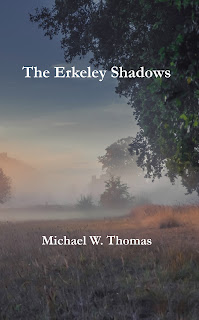
Michael W. Thomas, "The Erkeley Shadows"


Michael W. Thomas has published nine collections of poetry, three novels and two collections of short fiction. His latest poetry collections are Under Smoky Light (Offa’s Press) and A Time for Such a Word (Black Pear Press); his latest fiction titles are Sing Ho! Stout Cortez: Novellas and Stories (Black Pear Press) and The Erkeley Shadows, a novel (Swan Village Reporter).  With Simon Fletcher, he edited The Poetry of Worcestershire (Offa’s Press).  His work has appeared in The Antigonish Review (Canada), The Antioch Review (US), Critical Survey, Crossroads (Poland), Dream Catcher, Etchings (Australia), Irish Studies Review, Irish University Review, Magazine Six (US), Pennine Platform, Poetry Salzburg Review, The Times Literary Supplement and Under the Radar, among others. He has reviewed for The International Journal of Welsh Writing in English, The London Magazine, Other Poetry and The Times Literary Supplement, and is on the editorial board of Crossroads: A Journal of English Studies (University of Bialystok, Poland). He was long-listed for the National Poetry Competition, 2020 and 2022, and long-listed and short-listed for the Indigo Dreams Spring Poetry Prize, 2023. His website is here


About The Erkeley Shadows, by Michael W. Thomas

1967. The Summer of Love. Not for Jonathan Parry, perhaps, but certainly a time of big change. Soon his family will emigrate to Canada. But he, at least, won’t be leaving the old country wholly behind. In his heart he carries a dreadful secret, and its consequences track him like an implacable assassin from teenage to manhood, from the Canadian Prairies to the Maritime Provinces and back. What he endures could fill a book – and does. His life-story finds its way into the hands of Will Apland, an officer with the Saskatoon police force. Initially, Will treats it as a diversion, something to while away a Hallowe’en weekend alone. But, almost imperceptibly, Jonathan’s tale begins to infect his thoughts – one man’s history rubs up against another’s. So it is that, by the time he reaches the final page, Will is a man transformed. For him, this strange tale has become a call to arms, an exhortation to seek vengeance – or worse.

You can read more about The Erkeley Shadows here. Below, you can read an excerpt from the novel. 


From The Erkeley Shadows

(This extract, from chapter 2 of the novel, is the opening of Jonathan Parry’s self-penned life story: the very first thing that Police Officer Will Apland reads once he’s settled down with Jonathan’s ‘bulky folder’).

I thought I'd go batty (the guy began) if Mum said it once more: 'Just think, Jonathan—cross-country ski-ing and that kind of lacrosse they do and all sorts.' I couldn't care less about sports at the school I was leaving; a new country wouldn't make any difference. She didn't say much else to me that summer and nor did Dad. Evenings found them surrounded by all that paperwork, except when we did the rounds of goodbyes—Macclesfield, Kettering, Builth. Aunts and uncles full of awe and nostalgia and speculation, saying the same things over and over till I'd have given anything to grow skis and vanish: 'All that space, Jonathan, all those mountains—bigger than Snowdon, some of them, easy.' 'You could say goodbye to someone on the prairies and still see them walking off an hour later. You try it, lad.' 'I was in Winnipeg just after the war. Should have stayed. I was that restless.' Uncle Sid, the Kettering Sid, not the Builth one, ruffled my hair: 'Well, young 'un, give my love to Rose Marie and the Mounties. They always get their man.' That's true. They will again, this man, though not quite how Uncle meant it. 

I tell a lie about Dad. He did say something to me that summer: 'Turn off that blasted Good Night, Midge. I can't think straight.' He never explained Good Night, Midge, though he sang it. He was always singing, stuff from the war, ditties about pumping ship and The Rodney Renown. So I assumed that Midge was more drollery of the ocean wave. He sang it to the start of Three Blind Mice—or to put it another way, the way he so much objected to, the start of 'All You Need is Love,' which pretty well melted on my turntable. Not their best single but, for me, their most magical, probably because of how they recorded it, at the end of 'Our World,' the first global TV hook-up, which went out one Sunday night and wound up at Abbey Road. John, Paul and George were perched on bar-stools with those mikes like Skyrocket lollies. John chewed gum as he sang.

I had to placate Dad. He controlled the electricity, which he wasn't above cutting off to dramatize a point. Most of the time, though, he was hunched over forms or the telephone, or arguing with Mum about how to word some reply to the Consulate. Always 'The Consulate,' never the Canadian Consulate or the High Commission of Canada. Both of them handled the word as though it were 'Eden' or 'Xanadu.' And it was, to them, especially whenever Mr Walden, Dad's prospective boss at Manitoba Power, entered the picture. Communications from him were beyond sacred. He'd interviewed Dad—both of them, in fact—in London, an experience which, going by Mum's star-struck account, made an audience with the Queen seem like a quick nod in our local pub. 


Monday, 16 August 2021

Lorette C. Luzajic, "Winter in June"


Lorette C. Luzajic writes from Toronto, Canada. Her flash fiction and prose poetry have been widely published, including in Cleaver, The Citron Review, JMWW, The Miramichi Reader, Unbroken, Ghost Parachute, Cabinet of Heed, and numerous anthologies. She won first place in a flash contest at MacQueen’s Quinterly and was longlisted at Furious Fiction Australia. She has been nominated three times each for Best of the Net and the Pushcart Prize. Lorette is the creator and editor of The Ekphrastic Review, a journal devoted entirely to literature inspired by visual art. She is also an internationally collected collage and mixed media artist. Her website is here


About Winter in June, by Lorette C. Luzajic

Winter in June is a collection of flash fiction and prose poetry, small stories haunted by art history and memories real and imagined. Each piece is inspired by an artist or a work of visual art, but stands alone. You will meet a monk, a stripper, a man obsessed by taxidermy, and take a ride on a train with a man who isn’t there. You will smoke salvia divinorum, the most psychotropic plant known to humankind. You will sample salami in Italy, and join a pilgrimage to the shrine of Saint Death in Mexico City. You will see the phantom of Flatwoods for yourself, reluctantly attend a bullfight, fall in love with a convict, search for Andy Warhol’s grave, and ask a machine to grant your deepest longings. You will swim with a barracuda and watch a man eat his own grandmother. You will also visit a safe space, an art gallery where there is nothing to see but clean white walls. Even with all this terror and enchantment, it is really just a scrapbook of snapshots of everyday moments and ordinary magic.  

Winter in June is available here. You can see more details here. Below, you can read a sample piece from the collection. 


From Winter in June

Night Flight

Imagine, we were half bird. Our flight is fleeting, yes, but still we sometimes slipped into the sky. You are new to this world and don’t know the half of it. Even so, you show us the way. How to slay the dragons, how to turn the page. We gnaw on plastic poultry legs and rubbery bananas and you fake punch a random price into a toy cash register, hold your grubby paw out for my pocketful of coins. I wouldn’t have wished the world on you, but here you are. You have arrived, starry eyed and surprised. You have a blue-green bike and a matching bow in your hair. You love cucumbers and mangos and the frilliest pajamas. Every word is a victory and you’re starting to string them together. We were dancing in our sock feet in your toy room, stripes and polka dots a blur in your swirl. If only we had more ice cream, you say when I pull out the goodnight story. You stall for time before lights out and I guess it’s the same for all of us. Lord, just one more year, just one more day, just one more hour. But soon you are drifting through the clouds and I watch sleep soften your small face. The moon is your witness, I think, kissing you where she does on your dimple. I cover you in a thin sheet, watch your shifting shoulders, small wings dark as earth.  


“Night Flight” first appeared in Gyroscope Review.


Monday, 23 April 2018

Two Poems from "The Book of Smaller," by rob mclennan


Photo by Matthew Holmes

Born in Ottawa, Canada’s glorious capital city, rob mclennan currently lives in Ottawa, where he is home full-time with the two wee girls he shares with Christine McNair. The author of more than thirty trade books of poetry, fiction and non-fiction, he won the John Newlove Poetry Award in 2010, the Council for the Arts in Ottawa Mid-Career Award in 2014, and was longlisted for the CBC Poetry Prize in 2012 and 2017. In March, 2016, he was inducted into the VERSe Ottawa Hall of Honour. His most recent titles include the poetry collection A perimeter (New Star Books, 2016), and the forthcoming How the alphabet was made (Spuyten Duyvil, 2018) and Household items (Salmon Poetry, 2018). An editor and publisher, he runs above/ground press, Chaudiere Books (with Christine McNair), The Garneau Review (ottawater.com/garneaureview), seventeen seconds: a journal of poetry and poetics (ottawater.com/seventeenseconds), Touch the Donkey (touchthedonkey.blogspot.com) and the Ottawa poetry pdf annual ottawater (ottawater.com). He is “Interviews Editor” at Queen Mob’s Teahouse, a former contributor to the Ploughshares blog, editor of my (small press) writing day, and an editor/managing editor of many gendered mothers. He spent the 2007-8 academic year in Edmonton as writer-in-residence at the University of Alberta, and regularly posts reviews, essays, interviews and other notices at robmclennan.blogspot.com. Here are two poems by him:


from The Book of Smaller


The book of smaller

Everything had to be broken. First, snow-people duel with hair dryers. East through the mouth. I am windowless. Echo. Repeat. The children, asleep. I’ve stew in the slow cooker. Focus now on what crumbles. Aleppo. You are history. It is painful to be so dismissed. A conversation on beauty. The fresh breath of airports, unsealed. The connection one has with the body. Look east, and kneel. The girls are still missing. What doesn’t, instead. I hate this. Boil down into nothing. Mother-of-pearl. The smallest space I can fathom.


Forty-seventh birthday

Along the horizon, a hole opens. How does the line move? The sentence? A jet-liner, manifest. To fence in a heartbeat. To barricade. What does lava protect? What is hidden. A history of volcanos on Mars. They accumulate. Swim so far upstream. Galloping. I would stroll home in the pitch. A hummingbird touches her hair. I would stumble. They banter, they bicker, they argue. Such dark is impossible. I want to surpass myself: sleep.