Showing posts with label Michael W. Thomas. Show all posts

Tuesday, 11 March 2025

Tina Cole & Michael W. Thomas, "Nothing Louche or Bohemian"


Tina Cole was born in the Black Country and now lives in rural Herefordshire near Ludlow. She has three published pamphlets, I Almost Knew You (2018), Forged (Yaffle Press, 2021) and What it Was (Mark Time Books, 2023). As a poet and reviewer, she has led workshops with both adults and children and judged a number of U.K. and international competitions. Her published poems have appeared in many U.K. magazines and collections, including in The Guardian newspaper. She is a past winner of a number of national poetry competitions, 2010-2023, and completed an M.A. in Creative Writing / Poetry at Manchester Metropolitan University in 2023.


Michael W. Thomas has published ten collections of poetry, three novels and two collections of short fiction. His most recent poetry collection, prior to this, is A Time for Such a Word (Black Pear Press); his most recent short fiction collection is Sing Ho! Stout Cortez: Novellas and Stories (Black Pear Press); his most recent novel is The Erkeley Shadows (KDP / Swan Village Reporter). With Simon Fletcher, he edited The Poetry of Worcestershire (Offa's Press). His work has appeared in Acumen, The Antigonish Review (Canada), The Antioch Review (US), The Cannon's Mouth, Critical Survey, Crossroads (Poland), Dream Catcher, Etchings (Australia), Irish Studies Review, Irish University Review, Magazine Six (US), Pennine Platform, Poetry Salzburg Review, The Times Literary Supplement and Under the Radar, among others. He has reviewed for The London Magazine, Other Poetry and The Times Literary Supplement, and is on the editorial board of Crossroads: A Journal of English Studies (University of Bialystok, Poland). He was long-listed for the National Poetry Competition, 2020 and 2022, and long-listed and short-listed for the Indigo Dreams Spring Poetry Prize, 2023. Michael's website is here. He blogs here@thomasmichaelw


About Nothing Louche or Bohemian, by Tina Cole and Michael W. Thomas
A miscellany box of memories, intense and disconcerting; a gently encouraging piano teacher; teddy bears that knew better days; tinkling bottle-tags; classroom faces happy, wistful, preoccupied; a district nurse’s long-ago phone call; an assignation beneath a canal bridge; a father’s jokes worn down to the metal. These and so many other scenes find their places in the landscape of Nothing Louche or Bohemian. As the collection unfolds, threads are caught, drawn out, found to be markers on the map of what once was—and what, in these pages, lives again … enthralling, troubling, never less than vivid. Tina and Michael have known each other for several years but discovered that they’d grown up in the same area of the Black Country – and gone to the same secondary school. Those coincidences prompted Tina to suggest that they collaborate on a project. This is it.  


From Nothing Louche or Bohemian

Intoxication

It's all in the way you look at things 
or so they say. I remember them being purchased 
in a junk shop just behind The Miners Arms.
My hand went out instinctively to three silver
bottle tags, fingers tracing the engraving, whisky
gin, vermouth, how they glinted in the forty-watt 
light amongst tarnished soup tureens and discarded 
cutlery, but oh, that word    vermouth! 

                          It was evenings in cerise silk pyjamas, 
something louche, bohemian, a life away from corseted 
cares. Listening to Rachmaninov, nights at the Royal Opera 
not the sixpenny stalls at the Sedgley Clifton. No, the life 
I deserved sitting in a green Lloyd-loom chair, wafting 
about a Hampstead flat thin and mysterious, smoking
something sweetly scented. I would have written 
a clutch of acclaimed collections, beautiful poetry
not the usual tat that is continually rejected. 

                          It's all in the way you look at things, 
in the way one's hand reaches out for beauty,
a rose, a baby's hand, a moment of success, 
and that word vermouth    is still    intoxicating. 

- Tina Cole

Jacqueline Burnett

           Holy Trinity Roman Catholic School, Oxford Street, Bilston, 1958-1965

We were in the same class
at primary school. Shared 
the same birthday. One year
were told to stand up
so the room could sing
and toast the nothing we'd done.

Slight, she was, freckled:
tawny keeps coming to mind.
Already bringing on a bit of a stoop
to oblige the future.

You'd glimpse her 
slipping out to play,
edging the shadows
of the manager's son
and the town-clerk's daughter.

She answered each question perfectly
then retrieved her stillness,
putting the world away from her
till called upon again.

She rarely smiled,
perhaps never,
certainly not the day she and I
held an end apiece of coincidence,
like a pageant-flag
golden from a brush of sun
fluttered in a pocket of wind.

- Michael W. Thomas

Wednesday, 24 April 2024

Michael W. Thomas, "A Time for Such a Word"


Michael W. Thomas’s latest poetry collection is A Time for Such a Word (Black Pear Press). His latest novel is The Erkeley Shadows (KDP / Swan Village Reporter). He has published nine poetry collections, two collections of short fiction and three novels. His work has appeared in, among others, The  Antigonish Review (Canada), The Antioch Review (US), Critical Survey, The London Magazine, Pennine Platform, the TLS and Under the Radar. He is on the editorial board of Crossroads: A Journal of English Studies (University of Bialystok, Poland). From 2004 to 2009, he was poet-in-residence at the Robert Frost Festival, Key West, Florida. He contains no (well, few) additives. His website is here. His blog is The Swan Village Reporter.


About A Time for Such a Word
"A time for such a word" is taken from Macbeth, which might suggest an attempt to doom this collection from the start. True, there are dark corners here and there, but they exist for good reasons and are most carefully explored. And there is also much light and hopefulness. Visiting different points of time and space—now a desert island at dusk, now a log-store with an out-of-season moth, now Grenada, now a suburban house as it unbuilds itself—Thomas’s speakers reflect, speculate, even reanimate what seems valueless, a lost cause, a scene of no account.  The collection’s final line is "You’re alright, you, you’re alright." Now quietly, now emphatically, A Time for Such a Word insists that the world might just be so. 

You can read more about A Time for Such a Word on the publisher's website here. Below, you can read two poems from the collection. 


From A Time for Such a Word, by Michael W. Thomas

The Orphans of Midsomer
          
          (Midsomer Murders, ITV, 1997 onwards) 

And every so often
a young person stares unseeing
over and around the last five minutes.
The Inspector pats their shoulder,
the DS gives a smile his heart
can’t really afford, because already the next case
is among the foliage, the credits are antsy
at the foot of the screen.  Doors must slam.  
The unmarked car must drive 
into this time next week.

So the young person
without so much as a neighbourly hug
is left to stand outside what they’re stuck with:
a cottage in which the odours have to stoop,
a mansion where the chill huddles into itself
at corniced junctions – 
Death’s pay in kind, there being no other family,
not truly, mum or dad having hooked it
before the episode began,
the other one having been fed to the plot,
even unmasked as the murderer
brewing more grudges than all the hot dinners
touted in the breaks.

A proper wrong ‘un
will always fight the glove
that seeks to pilot their head
through the squad-car’s rear door.
So it is now, before the orphan’s unmendable heart.

The DS and Inspector
will make off through ending’s dusk,
fade in step with their tail-plate.
The supporting cast will tumble
into the run-off down the sides of the script.
Only the orphan remains and is real,
standing before a house whose secrets
will never now stop yakking.
Maybe they’ll pray for their own tomorrow
(though veiled as yet by that fight of names,
key grip, location bod, gaffer…) – 
even tell themselves they can almost see it,
like a hometown glimpsed as a train slows,
half-melted in an indifference of rain.
 

Yes

A blackbird stands on a branch
above where philadelphus
makes the path feel less alone.

It’s the moment when day
starts threading down hand over hand,
stuck about with the odd small glory.

The bird sings the whole mad run of the world
to the second it opened its beak.
War and pleasure bubble in its notes.

Late rain clicks at the greenhouse
as though an irradiated man hides there
and the elements baulk at his wormy blood.

And now a plastic bag
cartwheels past the gate to the lane.  
The blackbird sees off its tale of the hour just gone

and flies.  Imagine them rising together
wet with the first tears of night,
making for what doesn’t know it will be dawn.

Imagine the bird dropping notes into the bag
like unstrung pearls with no floor for their skitter.
Imagine the bag as a singing moon…

…till they swerve apart,
the bird to rise on,
the bag to cascade the knockings of a song

that someone might assemble as they wear against the dark
and try through once or twice…and find
a yes, small and improbable, itching at their heart.

Tuesday, 28 November 2023

Michael W. Thomas, "The Erkeley Shadows"


Michael W. Thomas has published nine collections of poetry, three novels and two collections of short fiction. His latest poetry collections are Under Smoky Light (Offa’s Press) and A Time for Such a Word (Black Pear Press); his latest fiction titles are Sing Ho! Stout Cortez: Novellas and Stories (Black Pear Press) and The Erkeley Shadows, a novel (Swan Village Reporter).  With Simon Fletcher, he edited The Poetry of Worcestershire (Offa’s Press).  His work has appeared in The Antigonish Review (Canada), The Antioch Review (US), Critical Survey, Crossroads (Poland), Dream Catcher, Etchings (Australia), Irish Studies Review, Irish University Review, Magazine Six (US), Pennine Platform, Poetry Salzburg Review, The Times Literary Supplement and Under the Radar, among others. He has reviewed for The International Journal of Welsh Writing in English, The London Magazine, Other Poetry and The Times Literary Supplement, and is on the editorial board of Crossroads: A Journal of English Studies (University of Bialystok, Poland). He was long-listed for the National Poetry Competition, 2020 and 2022, and long-listed and short-listed for the Indigo Dreams Spring Poetry Prize, 2023. His website is here


About The Erkeley Shadows, by Michael W. Thomas

1967. The Summer of Love. Not for Jonathan Parry, perhaps, but certainly a time of big change. Soon his family will emigrate to Canada. But he, at least, won’t be leaving the old country wholly behind. In his heart he carries a dreadful secret, and its consequences track him like an implacable assassin from teenage to manhood, from the Canadian Prairies to the Maritime Provinces and back. What he endures could fill a book – and does. His life-story finds its way into the hands of Will Apland, an officer with the Saskatoon police force. Initially, Will treats it as a diversion, something to while away a Hallowe’en weekend alone. But, almost imperceptibly, Jonathan’s tale begins to infect his thoughts – one man’s history rubs up against another’s. So it is that, by the time he reaches the final page, Will is a man transformed. For him, this strange tale has become a call to arms, an exhortation to seek vengeance – or worse.

You can read more about The Erkeley Shadows here. Below, you can read an excerpt from the novel. 


From The Erkeley Shadows

(This extract, from chapter 2 of the novel, is the opening of Jonathan Parry’s self-penned life story: the very first thing that Police Officer Will Apland reads once he’s settled down with Jonathan’s ‘bulky folder’).

I thought I'd go batty (the guy began) if Mum said it once more: 'Just think, Jonathan—cross-country ski-ing and that kind of lacrosse they do and all sorts.' I couldn't care less about sports at the school I was leaving; a new country wouldn't make any difference. She didn't say much else to me that summer and nor did Dad. Evenings found them surrounded by all that paperwork, except when we did the rounds of goodbyes—Macclesfield, Kettering, Builth. Aunts and uncles full of awe and nostalgia and speculation, saying the same things over and over till I'd have given anything to grow skis and vanish: 'All that space, Jonathan, all those mountains—bigger than Snowdon, some of them, easy.' 'You could say goodbye to someone on the prairies and still see them walking off an hour later. You try it, lad.' 'I was in Winnipeg just after the war. Should have stayed. I was that restless.' Uncle Sid, the Kettering Sid, not the Builth one, ruffled my hair: 'Well, young 'un, give my love to Rose Marie and the Mounties. They always get their man.' That's true. They will again, this man, though not quite how Uncle meant it. 

I tell a lie about Dad. He did say something to me that summer: 'Turn off that blasted Good Night, Midge. I can't think straight.' He never explained Good Night, Midge, though he sang it. He was always singing, stuff from the war, ditties about pumping ship and The Rodney Renown. So I assumed that Midge was more drollery of the ocean wave. He sang it to the start of Three Blind Mice—or to put it another way, the way he so much objected to, the start of 'All You Need is Love,' which pretty well melted on my turntable. Not their best single but, for me, their most magical, probably because of how they recorded it, at the end of 'Our World,' the first global TV hook-up, which went out one Sunday night and wound up at Abbey Road. John, Paul and George were perched on bar-stools with those mikes like Skyrocket lollies. John chewed gum as he sang.

I had to placate Dad. He controlled the electricity, which he wasn't above cutting off to dramatize a point. Most of the time, though, he was hunched over forms or the telephone, or arguing with Mum about how to word some reply to the Consulate. Always 'The Consulate,' never the Canadian Consulate or the High Commission of Canada. Both of them handled the word as though it were 'Eden' or 'Xanadu.' And it was, to them, especially whenever Mr Walden, Dad's prospective boss at Manitoba Power, entered the picture. Communications from him were beyond sacred. He'd interviewed Dad—both of them, in fact—in London, an experience which, going by Mum's star-struck account, made an audience with the Queen seem like a quick nod in our local pub. 


Sunday, 6 February 2022

Michael W. Thomas, "Sing Ho! Stout Cortez: Novellas and Stories"


Michael W. Thomas is the author of eight poetry collections, two short fiction collections and two novels. His latest poetry collection is Under Smoky Light (Offa's Press, 2020); his latest fiction collection is Sing Ho! Stout Cortez: Novellas and Stories (Black Pear Press, 2021). His work has appeared in The Antigonish Review (Canada), The Antioch Review (US), Critical Survey, Crossroads (Poland), Etchings (Australia), Irish Studies Review, Irish University Review, Magazine Six (US), the TLS and Under the Radar, among others. For many years he was poet-in-residence at the Robert Frost Festival, Key West, Florida. He has just completed a new novel, Nowherian, the memoir of a Grenadian exile's time in England.


About Sing Ho! Stout Cortez: Novellas and Stories 

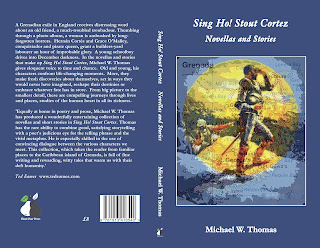
A Grenadian exile in England receives distressing word about an old friend, a much-troubled troubadour. Thumbing through a photo album, a woman is ambushed by long-forgotten horrors. Hernán Cortés and Grace O’Malley, conquistador and pirate queen, grant a builders-yard labourer an hour of improbable glory. A young schoolboy, victim of incipient abuse, steals the family car and drives into December darkness. In the novellas and stories that make up Sing Ho! Stout Cortez, Michael W. Thomas gives eloquent voice to time and chance. Old and young, his characters confront life-changing moments. More, they make fresh discoveries about themselves, act in ways they would never have imagined, reshape their destinies or embrace whatever fate has in store. From big picture to the smallest detail, these are compelling journeys through lives and places, studies of the human heart in all its richness.

Speaking of the collection, Michael says: "All of these pieces were written within the last four years, aside from Esp, which was shortlisted for the UK Novella Award, 2015, and which enlarges on the experiences of Henderson Bray, first encountered in 'Misshapes from Cadbury’s' in my story collection, The Portswick Imp. An early working title for the present collection was Timely Voices. What seemed to unite the pieces here was the sense that, in each, the narrator or main character works towards (or stumbles upon) a crucial time in their life: a time to discover, confront, act or somehow honour a long-standing rendezvous with something—a feeling, a nugget of knowledge—whose importance can no longer be dodged.  I think that such a theme still holds good. Reading through the pieces again, however, I’m also struck by another one: escape from current circumstance. In some pieces, characters literally do just that (all hail to the car and the open road). Of course, once a story ends, it’s lights out and curtain. But it’s been observed that every exit becomes an entrance elsewhere. So I can only hope that, however these characters act, whatever prompts their changes or departures, they will find what they’re looking for (or something as near as makes, in the end, no difference)."   

You can see more details about Sing Ho! Stout Cortez on the publisher's website here. Below, you can read a sample from the book. 


From Sing Ho! Stout Cortez, by Michael W. Thomas

Extract from Esp: The Voice of Grenada: A Novella

Henderson Bray, a Grenadian working for a year at a care centre in the English Midlands, receives a letter about an old school-friend, Esp, a wayward troubadour and troubled soul.  The letter transports Henderson back to his early years: particularly, to Esp’s rise as self-styled Voice of Grenada ...

When he wasn’t enraging Restless Headey, our unspeakable English teacher, Esp was into the guitar. He got pretty good, too. His favourite players came from all over. But there was no face among them from any Caribbean island, no Dwight Pinkney, no Fitzroy Coleman or Flores Chaviano. His heroes came from lands where, we thought, folk had permanent colds or got moved on by the cops for looking like that instead of this; then, too, they were coeval with our older brothers, our youngest dads, which made them even mistier.  Eric Clapton and Jimi Hendrix tussled for Esp’s golden crown, though they got shunted off at times in favour of, say, Pete Townshend’s windmill arm or the precise snap of Mark Knopfler. And he went yet further, in time and oddity. My Uncle Padmore, a limited but flamboyant picker himself, got wind of Esp’s doings and dug out a cassette of Les Paul and Mary Ford whose quality spoke of a mike prodded against a mono-speaker:

‘Pass him this.  “How High The Moon,”  boy. One listen and he’ll be flying there.’

He was right.  Their take on the song enraptured Esp—the whole swamp-toned album did.  He saw a giddying challenge in Les Paul’s multi-track wizardry.  Clapton and the rest were great, no doubt of it, but they played one guitar. There were times when they defied it, outraged it, melted it, but it was still just a single thing in their hands. This Les Paul, said Esp ... and his wonderment would stream out in a long whistle. He became the pioneer’s gospeller. 

The business of reproducing what Les Paul had wrought with miles of tape—who knows, even cried over, while Mary supplied beer and handkerchiefs—didn’t faze Esp in the least. At an audition for a school show, he constructed a singular hommage to ‘How High The Moon,’ playing a tape he’d recorded of the chord progression and then—with art and elegance, the rest of us thought—playing the same progression live but with a sweetly-timed delay to catch something of the original’s fat echoes. Now and then he threw in mouth-guitar, a line of juvva-da-juv juvs which jostled sparkily with the live chords ...


Friday, 21 September 2018

Two Poems by Michael W. Thomas


Michael W. Thomas’s most recent novel is Pilgrims at the White Horizon.  His poetry collections include Batman’s Hill, South Staffs (Flipped Eye, 2013) and Come to Pass (Oversteps, 2015).  His work has appeared in The Antioch Review, Critical Survey and the TLS.  In 2015, his novella, ‘Esp,’ was shortlisted for the UK Novella Award.  His latest titles are Early and Late: Poems and Images (with Ted Eames, Cairn Time Press), and The Portswick Imp: Collected Stories, 2001-2016 (Black Pear).  He is currently working on Nowherian, the memoir of a Grenadian traveller.  www.michaelwthomas.co.uk 


Someone’s 

And there were times
when he was someone’s someone.
The air then was clean upon the days,
showed faithfully the smoke of whispers.

The pavements were as wide
as a hope on waking,
each evening struck the sun to its reddest
as chimney and tree grew against it.
Later, the moon would raise a brow
as if in surprise at its ancient blessing.

He was someone’s someone,
excess to name and date of birth,
never going lost in the Sunday lands – 
at least for some improvised while.

Over is longer to say than happen.
Each time it came for him
he was back as in a rental
a moment before the expiry of terms,
nothing only a phone on a shelf
by a book of codes for strangers.

Now he is no-one’s,
lives within his own breath
and makes discoveries for one.
No matter.  He has known otherwise,
could still call up a daystar or two
for chase-and-tag behind his gaze.

Instead he looks upon a Monday world
with a middling cast of sky,
sees all the unshaped forms that hurry there – 
shrugs, makes a silence of himself, 
steps in.  


Housemaid on Fire

‘Thank God, he’s still breathing.  Get water!’
The girl works her lips,
repoints her urgency: ‘Now, idiot!’
Her words set the housemaid on fire,
hurl her from the room. In the kitchen
Cook’s jug leaps in a slop at her frontage.

A bad go.  But in time, as always, 
the demons loose the baronet
so, in the far forest of his mind,
he can stumble-slither back through no man’s land,
flop into the trench and live again.

‘I’ve no doubt, my lady,’ says the doctor,
just arrived, ‘that you handled all with eclat.’
She gives him a proper dimple
as he dips about his gladstone bag,
notices the soaked and trembling maid:
‘More water here, girlie – at the double!’ 

Soon the baronet will be right as rain,
will again venture a hand below stairs,
know the worth of a chortle, a horse, 
a discreet consultation in Jermyn Street.

And the housemaid, still damp,
will sit in The Feathers, watch the clock-hands
as they work into the evening nick by nick,

will hope that Gerry won’t be late,
though she knows it depends 
which broken bits of him have charge 
of the light in his eyes,

will write steerage in the table slops
and dream of the day she sees
another fire-maker, sightless and tall                        
on Bedloe’s Island, torch high
over a snake of faces tired to the death,

will pray she won’t herself 
look poor and huddled when they dock, 
having already selected that best blue
of Auntie Vi’s, and Mum’s locket also,

will pray too that Gerry hasn’t told a soul,
as she has not, and is right about the milk train
stopping at the halt tomorrow dawn.


Note: By Act of US Congress, Bedloe’s Island was renamed Liberty Island in 1956.